

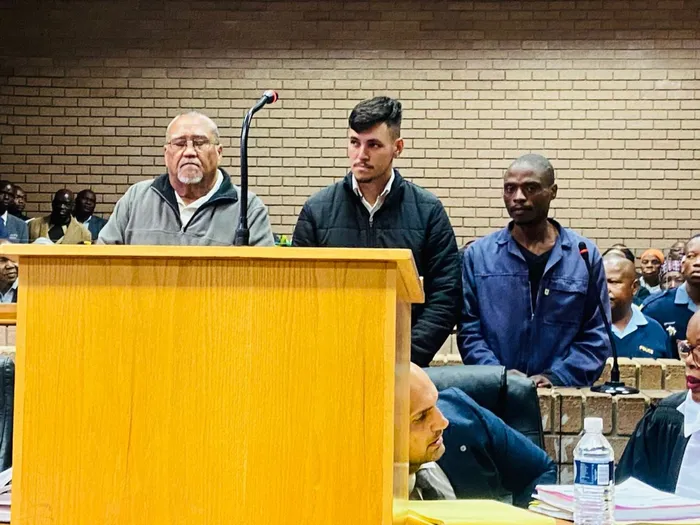
Rudolph De Wet, (pictured in the middle) now a state witness, was previously accused alongside Zachariah Olivier and William Musora in the murder of two women whose bodies were allegedly fed to pigs on a Sebayeng farm near Polokwane.
Image: NPA
The State has officially withdrawn charges against farm supervisor Rudolph De Wet, accused number two in the murder case involving the deaths of two women whose bodies were allegedly fed to pigs on a farm near Polokwane last year.
Zachariah Olivier, 62, a farmer, and his employees, Rodulph De Wet, 20, and William Musora, 48, allegedly shot and killed Maria Makgato and Kudzai Ndlovu in Sebayeng, outside Polokwane, in August 2024.
The victims were reportedly searching for food on the farm when they were attacked.
The State alleges that after the women were murdered and their bodies were fed to pigs in an attempt to destroy evidence.
The decomposed remains were discovered in a pig enclosure later that month.
The three men appeared at the Polokwane High Court on Thursday.
Olivier is accused number one, De Wet number two, and Musora number three.
According to Limpopo National Prosecuting Authority (NPA) spokesperson Mashudu Malabi-Dzhangi, the charges against De Wet have been provisionally withdrawn after he turned state witness under Section 204 of the Criminal Procedure Act.
“Accused number two (De Wet) has turned to be a state witness under Section 204, which means that his charges have been withdrawn for now and he’s going to testify,” Malabi-Dzhangi said.
She explained that De Wet’s charges would be permanently dropped only if the court finds that he testifies "frankly and honestly."
The defence for accused number one, Olivier, has requested a postponement to conduct its investigation following De Wet’s decision to testify against his co-accused.
The trial, which began on Monday, has been postponed and is scheduled to resume from October 6 to 17, 2025.
The accused are facing charges of murder, attempted murder, for allegedly shooting at Ndlovu’s husband during the incident - possession of an unlicensed firearm, and obstructing justice.
Musora, a Zimbabwean national, faces an additional charge under the Immigration Act for allegedly being in the country illegally.
De Wet, who was working as a supervisor on Olivier’s farm at the time of the murders, testified this week that Olivier was the one who shot and killed the two women.
IOL News previously reported that Mametlwe Sebei, president of the General Industries Workers Union of South Africa (Giwusa), said the union welcomes the start of the trial, despite the unjustifiable delays that have deepened the pain for the victims’ families and farmworkers across the country.
He further stated that the horrific crime, killing impoverished Black individuals scavenging for food and leaving their bodies for pigs to consume like refuse, exemplifies the ongoing dehumanisation faced by farmworkers.
Sebei said the reflects a persistent system of white terror and severe exploitation still prevalent on farms.
He emphasised that they are calling for the trial, along with a harsh sentence, to send a clear message that such brutality will not be tolerated in a democratic South Africa.
Sebei warned that the case reveals ongoing failures to protect and support farmworkers in rural areas, who remain isolated and vulnerable due to weak government oversight, poor access to unions, and a legacy of exploitation.
He stressed the need to address these issues to prevent future abuses.
“Many farmers operate as feudal lords, believing oversight won’t reach them. There is a need to send a message and create conditions where this cannot be.
“The case also epitomises how racialised, exploitative labour practices persist 30 years into democracy. Although in this case the victims might not have been workers, the reign of terror they have fallen victim to directly points to the door of this parasitic system of primitive slavery,” he said.
simon.majadibodu@iol.co.za
IOL News