

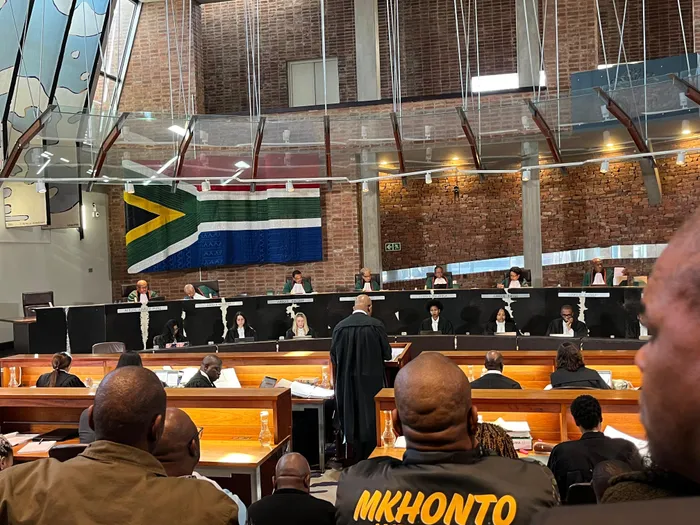
The Constitutional Court in Johannesburg heard legal arguments relating to whether the Justice Minister or the National Prosecuting Authority is the body to execute extraditions.
Image: Kamogelo Moichela/IOL
South Africa’s extradition laws came under the spotlight on Tuesday before the Constitutional Court, with the question of whether the minister of justice or the National Prosecuting Authority holds the authority to request extradition from foreign states.
The matter could impact the ability of the NPA to extradite fugitives, as a recent Supreme Court of Appeal ruling found that the Minister of Justice, not the NPA, must initiate extradition requests.
In 2024, the SCA heard a matter involving Johnathan Schultz (who was due to be extradited from the United States) in which he argued the NPA does not have the authority to request an extradition.
The SCA ruled in his favour and ordered that only the Minister of Justice had the power to request extraditions under the Extradition Act. It also ruled that its ruling would apply with full retrospective effect.
Using the Schultz judgment, the Free State High Court overturned the extradition of Moroadi Cholota, Ace Magashule’s assistant. This meant that she no longer had to face the music in the R255 million Free State asbestos case. The court found her extradition from the United States was unlawful as the NPA and not the minister applied for her extradition.
The NPA is now appealing the SCA judgment in the Schultz case as well as the Cholota matter in so far as its retrospective effect is not limited. The consequence of this is that all of South Africa’s previous and pending extradition requests are now susceptible to legal challenge - with vast and deleterious ramifications for the criminal justice system, Advocate Kevin Hopkins SC, for the NPA in the Schultz matter, argued.
He commented that many others seek to take advantage of the so-called Cholota strategy (relying on the SCA’s Schultz judgment).
“The finding of the SCA in Schultz on the merits may be correct, but the retrospective application of the SCA’s order should have been tempered to avoid undue hardship and disruption to the criminal justice system,” Hopkins argued.
He explained that the NPA has for decades been initiating (at a domestic level) South Africa’s outgoing extradition requests. The NPA’s power to do so has never been questioned, and it exercised these powers in good faith.
As a result of Schultz, every single one of these requests is now susceptible to being reviewed and set aside. This will have devastating consequences for the NPA, the criminal justice system, and South Africa as a whole, he argued.
Hopkins added that while the Extradition Act regulates in some detail how incoming requests (requests made to South Africa by foreign States) are to be conducted, it is silent on the conduct of outgoing requests.
Given this legislative vacuum, all persons assumed that the power to initiate outgoing requests lay with the NPA (or its predecessors in function). This is because extradition requests are an important tool in bringing suspected criminals before South African courts to face prosecution, Hopkins said.
Advocate Wim Trengove SC, acting for the prosecution in the Cholota matter, meanwhile argued that the court erred in finding it lacked jurisdiction to try her. Trengove said it is in the interests of justice to grant the State leave to appeal that judgment as the matter is of public importance with profound effects on future extradition cases.
Trengove further argued that the SCA in Schultz wrongly declared that only the minister has the authority to request extradition as the NPA has, in terms of the law, the powers to request extradition. He argued that outgoing requests are prosecutorial and incoming requests are diplomatic. Trengove said Cholota was extradited under a valid US court order, making her extradition lawful.
zelda.venter@inl.co.za