

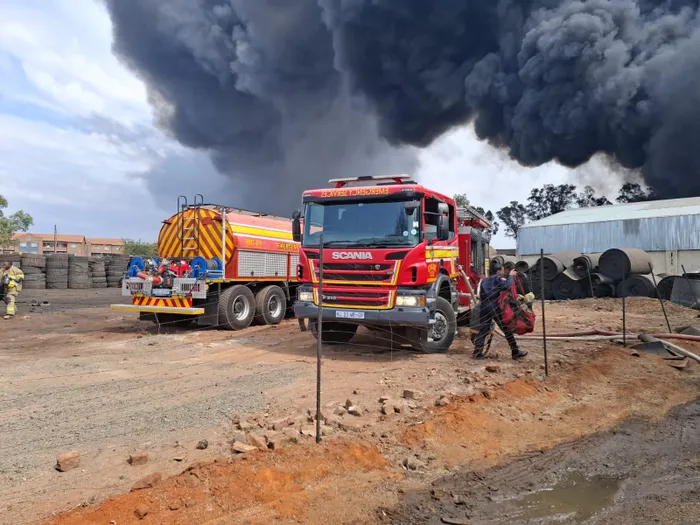
The Tshwane metro's legal bid to ban private firefighters' associations unless they have registered to render such services, were turned down by the Pretoria High Court.
Image: File
The Tshwane Metropolitan Municipality’s legal action to have private firefighting services operating in the metro declared illegal has failed, after the Gauteng High Court, Pretoria, found that the rendering of firefighting services by businesses to their clients and by volunteers affiliated with associations is not prohibited by legislation.
Judge Norman Davis, however, stressed that private firefighting services may not interfere with the fire brigade’s powers granted by the Fire Services Act.
The judgment delivered on Wednesday followed an application by the Tshwane metro to have private firefighting services operating in the metro declared illegal.
Its legal team maintained that private firefighting services are illegal, as it is against the Act, but AfriForum argued that no law prohibits the existence or operation of private firefighting services.
The application was aimed at the Sinoville Firefighting Association (SFA) and Fidelity Securefire Ltd. The SFA mainly assists with dousing fires in the areas north of the city, while Fidelity has contracts with mainly businesses to assist in the case of a fire.
While the metro initially wanted these organisations forthright banned from rendering any firefighting services in its jurisdiction, it shortly before the hearing tempered down its demands. It called for an amended order that the respondents apply to the minister to register as firefighting services within a designated area within the metro’s area of jurisdiction.
It, however, still called for an interdict stopping the respondents from operating as fire brigades pending the finalisation of the legislative processes regulating private fire brigade services.
Fidelity’s position, as argued in court, is that it does not provide private firefighting services to the public with whom it holds contracts. Thus, it said, it does not want to apply to become a “designated service” or to become a firefighter.
Fidelity said it never interferes with the services of Tshwane’s firefighting unit, and when at a scene of a fire, it works together with the metro’s firefighters. Fidelity expressed a wish to enter into an agreement with the metro to enhance cooperation with the city’s fire brigade to establish standard operating procedures.
The SFA, meanwhile, argued that it does not have clients, but it renders voluntary firefighting services in Sinoville. It similarly expressed hope to work together with the city’s fire brigade.
Judge Davis pointed out that there is no legislation specifically regulating private fire brigade services. He also noted that the city said it allows private firefighters in its jurisdiction, as long as they limit themselves to their own premises. The private firefighting services at BMW’s premises in Roslyn and the Wonderboom Airport were cited as examples.
Judge Davis also noted that there is no express prohibition against the rendering of private firefighting in the Act. He pointed out that fighting a fire under emerging conditions or preventing veldfires from spreading is not an offence.
There can also be no doubt that in cases of emergency and where the city’s fire brigade has not yet arrived on the scene, private people can use fire hydrants to douse a fire. However, he added, once on the scene, the city’s official firefighters must be allowed to take over.
He said the purpose of the Act is clearly to allow the local authorities to provide firefighting services within their jurisdiction. However, in cases of emergency, nothing is preventing private citizens and organisations from jumping in to help, as long as they don't interfere with the work of the local authorities, tasked with doing this job.
zelda.venter@inl.co.za