

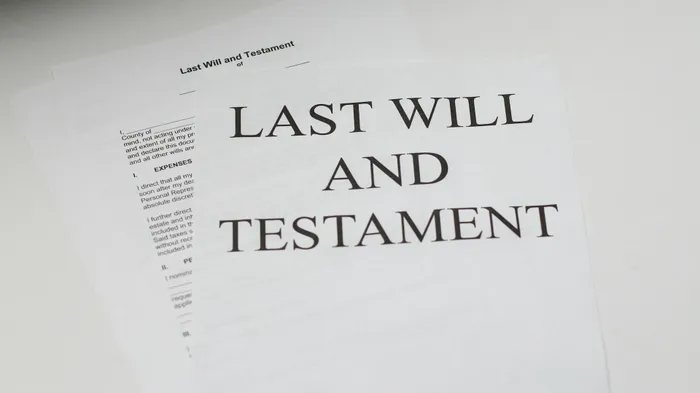
A bitter legal feud is raging between two siblings regarding their mother's last will after the sister, who was left out as a beneficiary, claimed her brother either forged the mother's signature on the document or the mother was not mentally capable of executing the will.
Image: Unsplash
A bitter legal feud has erupted between two siblings over the inheritance of their late mother, who had bequeathed her estate only to her son, with the daughter now claiming her mother did not have the mental capability to draw up a new will disinheriting her.
The son (the respondent), however, told the North West High Court, sitting in Mafikeng, that their mother (the deceased) had obtained a protection order against her daughter two years before her death. This prompted their mother to disinherit her daughter.
The daughter (the applicant), identified only as M, on the other hand, claimed that her brother, identified only as V, forged his mother’s signature on the document.
She successfully applied for the matter to be ventilated in court via oral evidence, so that her brother’s claims that the will was legally executed could be tested in court - a move which the brother had opposed.
But the court found that all facts were in dispute and that oral evidence was the appropriate method for establishing the true facts.
In the main proceedings, the daughter is asking the court to set aside her mother’s will to disinherit her. This is on grounds that include forgery by her brother, lack of testamentary capacity on the part of the deceased, and undue influence exerted by her brother.
At the time of her death, the deceased was the owner of several immovable properties situated in Mogale City and Moruleng in North West, as well as various motor vehicles.
The daughter argued that the deceased suffered from serious chronic illnesses during the three years preceding her death, including hypertension, diabetes, and renal failure.
According to her, these conditions caused an altered mental state, rendering the deceased unable to appreciate the nature and consequences of executing a will a few months before her death.
According to her, her brother, who resided with the deceased, was abusive, a substance abuser, and exerted undue influence over the deceased.
The daughter stated that the deceased typically nominated both her children equally across all her policies and would not have disinherited the applicant had she been of sound mind.
She claimed that the document was not prepared pursuant to the deceased’s own instructions, but rather at the behest of her brother, and that the mother did not grasp the consequences of the will.
A further pall of suspicion is cast by the daughter’s suggestion that the signature on the document may be forged, irregular, or otherwise not indicative of a conscious and capable act of the testatrix.
According to the son, his mother possessed full testamentary capacity when she made the will. In support of this position, he presented a detailed chronology of her dealings with her financial advisor.
He said she drove herself from Rustenburg to Pretoria to consult on the preparation of her will, completed the wills application form, and authorised its submission to Standard Bank.
He denied the allegation of undue influence and pointed to a protection order the deceased obtained against her daughter, which he said proves that they were not close.
The son further argued that his sister has furnished no expert medical evidence, no handwriting analysis, and no substantiation capable of sustaining the allegations of forgery or incapacity.
The court remarked that in cases concerning the validity of a will, the central enquiry remains the testator’s mental capacity at the precise moment of execution.
The papers reveal indisputable areas of factual contention. Central among these are the deceased’s mental capacity at the time the will was executed, the presence or absence of undue influence, and whether the will reflects the deceased’s true intentions.
These issues, the court said, can only be ventilated via oral evidence.
zelda.venter@inl.co.za