

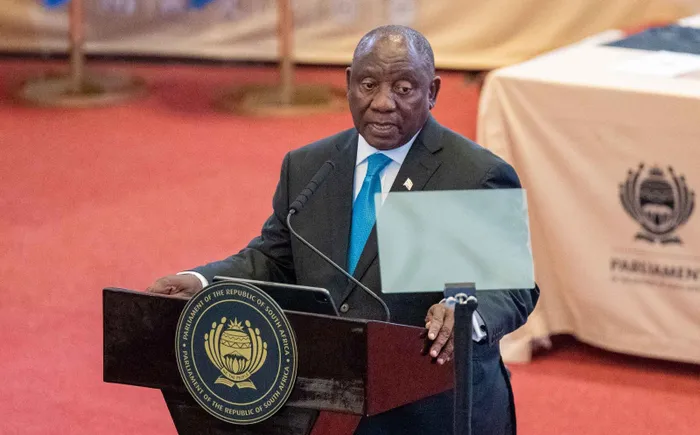
President Cyril Ramaphosa delivered the State of the Nation Address, where he warned against barring foreign nationals from public facilities while outlining tougher immigration enforcement measures.
Image: Henk Kruger / Independent Newspapers
President Cyril Ramaphosa used his State of the Nation Address (SONA) to deliver a dual message on immigration: a hardline crackdown on illegal immigration — and a firm warning that foreign nationals must not be unlawfully denied access to schools, clinics and other public facilities.
“Illegal immigration poses a risk to our security, stability and economic progress,” Ramaphosa said, outlining additional steps to secure South Africa’s borders.
But he was equally emphatic that immigration enforcement must not descend into vigilantism.
“No foreign national should be unlawfully barred from accessing public facilities, including schools and health facilities,” he said.
The president announced that funding would be prioritised to strengthen border security, covering infrastructure, technology and personnel. Key border posts will be redeveloped through public-private partnerships, and the Electronic Travel Authorisation system will be extended to all international airports and the busiest land ports of entry.
Drones and surveillance technology are already being deployed more extensively along the country’s border line, he said.
Inside the country, police, Home Affairs officials and labour inspectors will work together to crack down on violations of immigration, labour and other laws. Employers who hire foreign nationals without valid visas “will face the full might of the law,” Ramaphosa warned.
To tighten enforcement, government plans to hire an additional 10,000 labour inspectors this year.
“We insist that the laws of our country must be observed by everyone,” he said.
Yet he also drew a firm constitutional boundary.
“We will not tolerate violence and other acts of lawlessness directed at foreign nationals,” Ramaphosa said.
His remarks come amid growing tensions in parts of the country, where foreign nationals have reportedly been turned away from clinics and schools by community groups claiming public services are overwhelmed.
South Africa’s public health system has long struggled with resource constraints, staff shortages, infrastructure backlogs and rising patient numbers.
Provincial health departments frequently report overcrowded clinics, medicine shortages and long waiting times. Rural and township facilities in particular face heavy patient loads, often serving both South African citizens and foreign nationals.
The strain has intensified in recent years due to funding pressures, the emigration of healthcare professionals, and the lingering impact of the Covid-19 pandemic.
In this environment, foreign nationals have increasingly become targets of frustration, with some activist groups arguing that undocumented migrants are placing additional pressure on already overstretched facilities.
However, government has repeatedly stated that no individual may be denied emergency medical care, and that access to basic healthcare services cannot be determined by nationality alone.
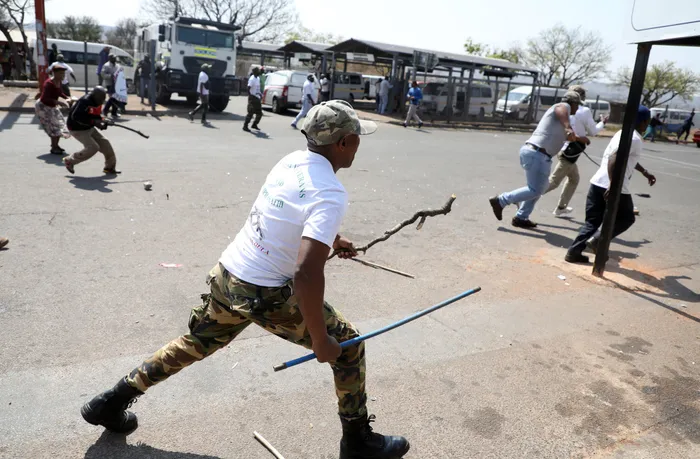
Clashes were previously seen at Kalafong Provincial Tertiary Hospital in Tshwane when police used stun grenades to disperse members of Operation Dudula who were vetting people entering the hospital.
Image: Oupa Mokoena/ Independent Media
Health experts warn that blocking access to clinics not only violates constitutional protections but also creates public health risks by driving vulnerable patients away from formal healthcare systems.
The education system faces similar pressures.
Each year, provinces grapple with classroom shortages, infrastructure constraints and teacher shortfalls. Overcrowded classrooms — sometimes exceeding 40 or 50 learners — remain a reality in many public schools.
At the start of academic terms, protests over learner placement are common in parts of Gauteng, KwaZulu-Natal and the Western Cape, where parents demand space for their children.
Government figures have previously indicated that hundreds of thousands of learners in the system do not have South African ID numbers — a statistic that does not automatically mean they are undocumented, but which has fuelled political and community debate.
Education experts stress that Section 29 of the Constitution guarantees every child the right to basic education, regardless of nationality or documentation status.
School governing bodies do not have the authority to exclude children on the basis of citizenship alone.
Ramaphosa’s SONA message reflects a delicate political balance.
On one hand, government is responding to mounting public anger over unemployment, porous borders and illegal immigration.
On the other, it is attempting to prevent anti-immigrant activism from turning into violence or unlawful exclusion.
The President’s speech signalled that immigration enforcement will be intensified — through stronger border management, technology, labour inspections and action against non-compliant employers — but that enforcement remains the responsibility of the state.
Communities, he made clear, cannot take the law into their own hands.
As South Africa continues to wrestle with unemployment, service delivery backlogs and economic stagnation, the tension between resource scarcity and constitutional protections is likely to remain a flashpoint.
Ramaphosa’s warning suggests government is seeking to draw a firm line: illegal immigration will be tackled decisively — but constitutional rights will not be sacrificed in the process.
jonisayi.maromo@iol.co.za
IOL News