

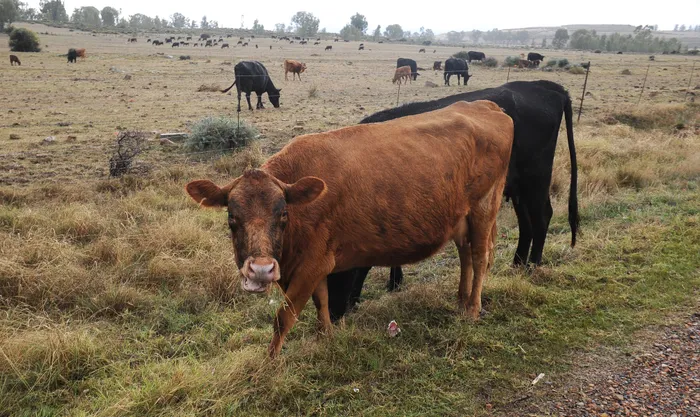
Amidst a severe outbreak of foot-and-mouth disease in the country, farmers will turn to court in a bid to vaccinate their animals themselves.
Image: File
Livestock farmers will later this month turn to court in a desperate plea for the private sector to produce foot-and-mouth disease (FMD) vaccine and for the go-ahead to those who can privately administer it, to do so.
There should be no State interference regarding the private sector and farmers distributing and administering the vaccine. It is unconstitutional and unconscionable to cling to State control under the circumstances, the applicants said in papers filed with the Gauteng High Court, Pretoria this week.
Sakeliga, the Suider-Afrika Agri Inisiatief (Saai) and Free State Agriculture stated that the livestock farmers merely want to protect their property from the disease that threatens their livestock and operations. They say as things stand, they are prohibited from doing so while it should be a relatively simple task that they can easily achieve on their own without State interference.
Their application comes in the wake of the FMD crisis which is crippling farmers. They claim that the state has failed to contain the spread, and that they should be given the freedom to take matters into their own hands.
Francois Rossouw, chief executive officer of Saai, said in an affidavit filed at court that many farms will face bankruptcy, and more are bound to follow. “Livestock farming is not viable unless the vaccine is rolled out at a rapid pace. The entire industry is facing financial ruin,” he said.
Rossouw added that the applicants, their supporters and members and the agricultural sector in general are “pleading” with this court to come to their urgent assistance and salvation.
Parliament this week welcomed the arrival of 1.5 million doses of FMD vaccine from the Türkiye-based manufacturer Dollvet, which arrived on Sunday. But Rossouw said the recent press release from Agricultural Minister John Steenhuisen highlights that the plan is still only to vaccinate cattle.
Steenhuisen recently warned that the litigation could derail the national FMD vaccination rollout and divert critical veterinary and financial resources away from outbreak control. He said in a statement that FMD is a state-controlled disease governed by the Animal Diseases Act and that a strictly centralised vaccination programme is required to regain South Africa’s “FMD-free status with vaccination” from the World Organisation for Animal Health.
He also cautioned against what he described as reckless calls for unrestricted access to vaccines. But the applicants say he failed to substantiate his prohibitions on private sector vaccine procurement and administration, and his department’s interference obstructed and delayed private sector vaccine imports.
“The Minister’s and his colleagues’ insistence on state control of all aspects of FMD vaccination, in contrast to the common practice of private procurement and administration of livestock vaccination for other diseases, has caused widespread distress and production losses,” Sakeliga said.
Their legal strategy involves two phases. The first is to ask for an interdict restraining the state from blocking private individuals from administering registered or authorised FMD vaccines on livestock. It also seeks an interdict prohibiting the state from interfering in the relationships between those who legally import the vaccine into the country and their suppliers.
The second stage will be a review application in which they will ask declaratory relief confirming that there exists no impediment to owners or managers of livestock administering the vaccine.
Rossouw, meanwhile, said the effect of the disease and its rapid spreading touches on the extreme urgency of the matter. According to him, the matter is so urgent that a state of disaster was declared on February 13. Despite this, the disease has spread like wildfire “because of the absence of adequate state measures".
He questioned why the State “clings to control" over the disease and does not want farmers to save their own livestock from this disease.
The Minister and other respondents, meanwhile, have until March 10 to file their opposing papers.
zelda.venter@inl.co.za