

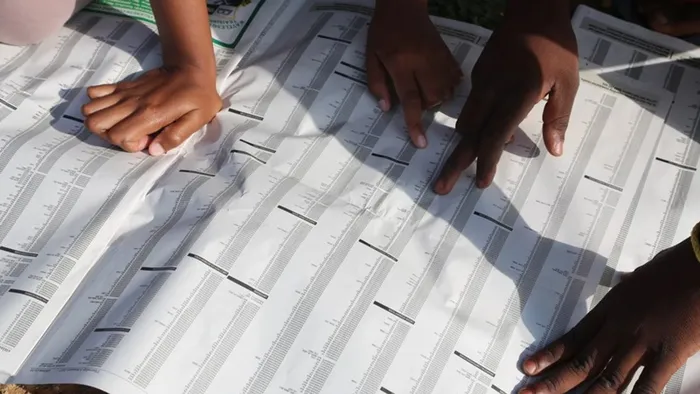
The longstanding legal battle over the publication of matric results in newspapers is back in court, this time to decide whether the Information Regulator should be granted leave to appeal a judgment allowing for the publication.
Image: File
The Gauteng High Court, Pretoria, is expected to only give judgment next week on whether the issue surrounding the publication of the matric results in newspapers and online should move to the Supreme Court of Appeal (SCA).
The court on Thursday reserved its judgment in the application by the Information Regulator (IR) for leave to appeal to the SCA against an order issued in December, in which three judges gave the go-ahead for the publication of the results.
It was made clear in that order, as well as three previous orders, that the results may only be published using the learners’ exam numbers.
The IR, however, maintains that this is still in contravention of the Protection of Personal Information Act (POPIA).
It argued that the High Court erred in its interpretation of the Act, and said that another higher court should take a look at the issue so that there can be clarity as to whether it is legally sound to publish the results.
Judge Letty Molopa-Sethosa, Omphemetse Mooki, and Acting Judge Mark Morgan on Thursday listened to the arguments of the IR and the opposing arguments of the Department of Basic Education (DBE) and of AfriForum, who are also a party to the proceedings.
According to Alana Bailey, AfriForum’s Head of Cultural Affairs, the civil rights organisation hopes that the case can now finally be concluded.
Legal action regarding the publication of matric results has been ongoing for more than four years. In 2022, the court ruled in favour of AfriForum and others involved for the first time that the release of the results is in the public interest and may, therefore, continue.
At the end of 2024, the IR tried to prevent the DBE from publishing the 2024 matric results. However, the IR’s application to obtain an interdict against it failed, leading to the subsequent case on the merits. In December 2025, the full bench of judges confirmed in their judgment that matric results may indeed be published on public platforms.
It was further found that the use of examination numbers as the only means of identification offers sufficient protection for the privacy of matriculants, and that the DBE acted lawfully in not complying with the IR’s order to withhold the results.
In the application for leave to appeal, the IR questioned, among other things, the court’s jurisdiction to condone the disregard of statutory instructions such as those of the regulator to the DBE.
In contrast, the legal teams of AfriForum and the DBE emphasised the court’s jurisdiction and reaffirmed the protection that examination numbers offer learners’ right to privacy.
According to Bailey, the outcome of the case will influence more issues than just the publication of matric results.
“Several research fields use the information of individuals who can only be identified by means of numbers or codes. These markers are specifically used to protect their right to privacy and anonymity. The judges’ decision will, therefore, also determine the future use of data and the continuation of vital research,” she said.
She added that the outcome of these proceedings will contribute to defining the balance between protecting the right to privacy and promoting public interest more clearly.
zelda.venter@inl.co.za