

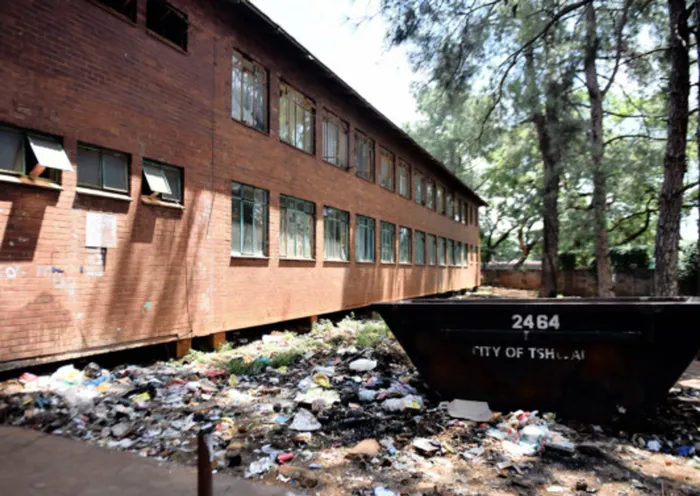
The future of residents of the dilapidated Melgisedek Buildings in Riviera is unsure. While the City of Tshwane plan to relocate them this week, the eviction sparked renewed court action.
Image: Oupa Mokoena/Independent Newspapers
While the City of Tshwane is planning on relocating the about 450 occupiers of the notorious Melgisedek building in Pretoria on Wednesday to a site 2.4km away, residents and business owners of the Moot will turn to court for an urgent application halting this move.
The Gauteng High Court, Pretoria last week issued an urgent eviction order and ruled that due to the building being dilapidated and dangerous, the city could move the people to a tented camp. The site, belonging to the city, is located on the eastern corner of Steve Biko and Nico Smit Street. The city intends to erect 45 tents on the site, which were earlier used during the Covid-19 pandemic.
The Democratic Alliance meanwhile also launched its own urgent court proceedings in a bid to stop this move. Lawyers for Human Rights, who are representing the occupiers, lost their bid on Friday for leave to appeal against the eviction order. They are now considering petitioning the Supreme Court of Appeal directly in an attempt to appeal the order.
The city last week told Judge John Holland-Muter that apart from the unsafe structure, the Melgisedek building, which consists of various blocks, is surrounded by a foul odour, mosquitoes, rodents and flies. A nauseating mixture of water and human waste flows through the area.
The city made it clear that the building is dangerous and said in light of the recent building collapse in Johannesburg, in which several people had died, they cannot allow these residents to stay there any longer.
Judge Holland-Muter noted that the building has no electricity or running water and it is close to the Steve Biko Hospital and schools. “We are sitting here with a health time bomb,” he said in granting the eviction.
Llewelynn Hemmens of AfriForum, who is also a resident of the Moot, pointed out in the latest application to be heard this week that the building has been problematic since about 2006 when the occupiers moved in.
He said in court papers that the community of Gezina in the Moot, which is directly affected by the move as the people are being relocated to their doorstep, were not told about the order nor were they consulted on the planned move.
They only became aware when they saw the city digging trenches there to lay water pipes. He pointed out that the tents earmarked to house the people can only accommodate six people each, thus the 45 tents can only house about 270 people.
Based on the past behaviour of the occupiers, the Moot residents said they also fear “their future behaviour”. The biggest complaint is the lack of services at the site. Hemmens said it appears that water will be supplied on a rudimentary basis and no provision is made for sewerage or electricity. Only 10 chemical toilets will be supplied. It is also not sure if it will be 450 people being moved or more will move in.
It is naive to expect that a measly fence will contain further influx, he said. With the winter around the corner and the occupants expected to make fires, the synthetic tents also pose a fire danger, he said.
The DA meanwhile said it will also launch proceedings to stop the relocation to Gezina, as this proposed site will not meet the needs of the people, nor the residents of the Moot. According to the DA, city-owned community centres exist to which the city can move the people. The city, however, earlier told the court there are no other alternative housing available.
zelda.venter@inl.co.za