

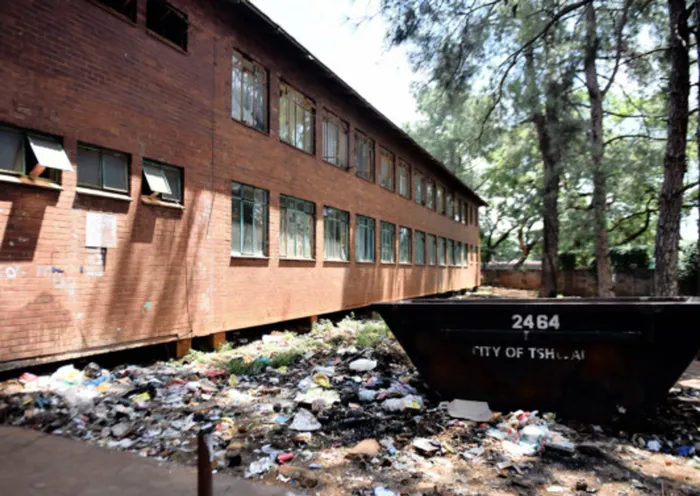
The future of residents of the dilapidated Melgisedek Buildings in Riviera is uncertain. While the City of Tshwane plan to relocate them, the eviction sparked renewed court action.
Image: Oupa Mokoena/Independent Newspapers
The eviction of about 450 people from the notorious Melgisedek building in Pretoria seems far from being resolved, with the residents now approaching the Supreme Court of Appeal for its help in the controversial move.
The City of Tshwane, which obtained the eviction order earlier this month in the Gauteng High Court, Pretoria, meanwhile will return to court this week to ensure the eviction, despite the appeal to the SCA.
While the City of Tshwane planned on relocating the occupiers this past weekend to a site 2.4km away, this did not happen. Residents and business owners of the Moot also lost their high court bid last week to halt this move.
AfriForum, which launched the application on their behalf, meanwhile said it continues its fight against the relocation to the site in Gezina. This comes after the court dismissed its application for an urgent interdict to stop the relocation. AfriForum said it is now also considering the possibility of appealing the refusal of the interdict.
It launched an urgent application after it emerged that the Metro intended to relocate more than 450 people to an open plot of land on the corner of Nico Smith Street and Johan Heyns Drive. Some of the organisation’s main objections are that there is no proper infrastructure on the open land and that there was no consultation with the community prior to obtaining the eviction and relocation order.
AfriForum argued that the tented site was not suitable for a large-scale temporary settlement, that the zoning did not permit it, and that the planned development posed serious risks to safety, health, and public order.
AfriForum said although the court did not grant the requested urgent interdict, the core issues raised by the organisation remain unaddressed. "The reality remains that the Metro is imposing an ill-considered and harmful decision on an established community. The decision will have far-reaching consequences for the residents of the Moot,” Llewellynn Hemmens, AfriForum’s District Coordinator for Pretoria said.
According to him, this case is not just about the Pretoria Moot but about the broader principle of accountable government: “The Metro cannot continue to address crises by simply moving them from one area to another. This is neither sustainable nor fair to the Moot community or Melgisedek residents".
The Melgisedek residents, represented by Lawyers for Human Rights, on Friday filed a petition with the SCA to try to prevent the relocation, and AfriForum said it will consider joining as a party to this case.
Following the dismissal of AfriForum’s urgent application, the City of Tshwane said it has prepared thoroughly for the relocation, adding that all identified occupants will now be relocated without delay to temporary, serviced accommodation on City-owned land in Gezina. It said this judgment sends a clear message that efforts to delay or derail essential progress through prolonged legal challenges and technical objections will not halt its commitment to ending urban decay across Tshwane.
However, the move by LHR to turn to the SCA automatically suspends the eviction order, but the city will this week ask the court to rule that it remains in force. Judge John Holland Mutter, in granting the eviction order, commented that “we are sitting here with a health time bomb,” after listening to evidence from the city about the dilapidated state of the buildings.
Meanwhile the illegal occupants of Melgisedek maintain that this has been their home for many years. They are opposed to being relocated to a tented camp which they say is simply not suitable.
zelda.venter@inl.co.za