

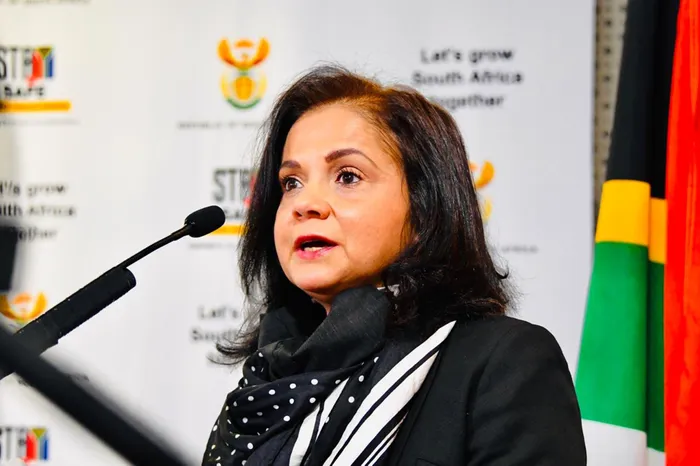
The MK Party turned to court for an urgent order to prevent former NDPP Advocate Shamila Batohi from receiving her pension and post-term benefits.
Image: File
The uMkhonto weSizwe Party (MKP) on Wednesday asked the Gauteng High Court, Pretoria to block former National Director of Public Prosecutions (NDPP) Advocate Shamila Batohi’s pension payout while serious claims of possible misconduct against her have yet to be addressed.
Advocate Kameel Premhid, on behalf of the MKP, argued that the respondents, which included President Cyril Ramaphosa and the Department of Justice cannot now simply close their eyes to possible misconduct on the part of Batohi, because she has retired.
“It cannot be that now her term of office has come to an end, her accountability has come to an end,” Premhid said.
In part A of its application, the MKP asked for an interim order that at least the portion of Batohi’s pension benefit contributed by her employer - the State - be held back pending the conclusion of an inquiry into whether she is guilty of misconduct.
Should the respondents decide to proceed with Batohi’s pension payout, the MKP requested that a sufficient amount be withheld as security until its application had been finalised and no adverse findings were made against her.
Part B of the application related to the MKP’s right to file a review application should the state decide to effect payment to Batohi irregularly or unlawfully, and to challenge the state’s funding of her legal fees in respect of the Nkabinde Inquiry, which was still in progress.
The inquiry was a judicial investigation established by Ramaphosa to determine the fitness of Advocate Andrew Chauke to hold office as Director of Public Prosecutions (DPP) for South Gauteng.
Part C concerns the MKP’s right to issue summons to determine the amount Batohi would be required to repay should the ruling in Part B be decided in favour of the party.
Premhid told Judge Nicolene Janse van Nieuwenhuizen that the applicant was concerned about the State’s contribution towards her pension, as there was a need to protect the fiscus. In this regard he referred to Batohi’s conduct during the Nkabinde Inquiry and the fact that she received State funding for her legal costs.
In arguing that the matter was urgent, Premhid referred to the fact that Batohi had a 60-day window period to activate her pension fund claim from the Government Employees Pension Fund which was due to lapse at the end of this month.
He told the court that the applicant was not saying that she was not entitled to any of her pension ever, only the portion which may later become relevant if misconduct was proved against her.
Premhid said the funds ought to be preserved at this stage pending the unresolved misconduct allegations and added that the state cannot close its eyes now and say it will act later.
“The intention is to test the misconduct allegations before her pension is paid out,” he told the court.
In pointing to the urgency of the matter, he said that once the money was paid out to Batohi, it will be very difficult to recover it again.
Advocate Nyoko Muvangua, acting for the President, said there were no facts stated by the applicant as to why Batohi would squander the money if it was paid to her. She said there were in any event, means to later recover any funds if necessary.
There were also other remedies the applicants can utilise in finding redress, such as to approach the Legal Practice Council which was the governing body over her being an advocate.
Muvangua further argued that the president had nothing to do with Batohi’s pension payout. “My client does not pay pensions,” she told the court. She added that Batohi has done her tenure as NDPP and she should be able to receive her pension. “There is no basis in law that gives the President power to withhold funds benefit payouts,” Muvangua said.
Advocate Geoff Budlender for Batohi argued that there was no legal basis for the application and that pension benefits were governed by statute and were rule-based. The law provided that when a member has a right to retire on pension, that person has a right to their pension benefits.
Budlender also pointed out that at this point, no judgment has been obtained against her, and no quantifiable monetary loss was identified. Thus, no debt has been established against her.
Judgment was reserved.
zelda.venter@inl.co.za