

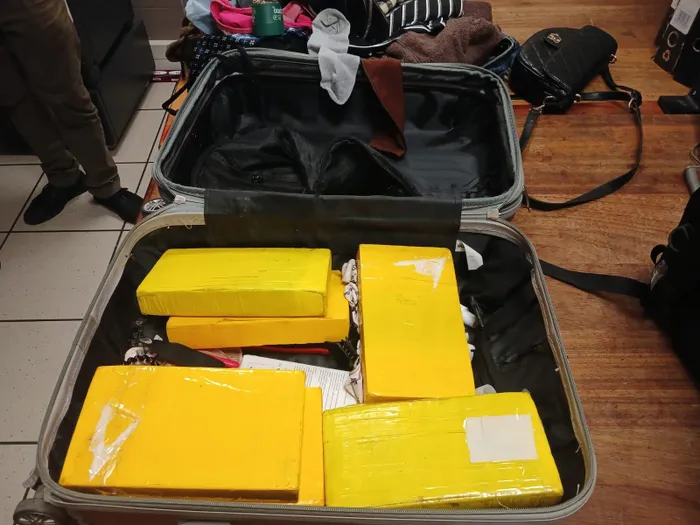
South Africa serves both as a destination for local drug distribution and a transit hub for international trafficking, this is according to Major General Hendrik Flynn
Image: SAPS
The Madlanga Commission heard on Tuesday that South Africa serves both as a destination for local drug distribution and a transit hub for international trafficking.
Hendrik Flynn, a major general and component head for serious organised crime at the Directorate for Priority Crime Investigation, was testifying on allegations of criminality and corruption linked to drug busts.
Flynn said illicit drugs include substances that were either inherently illegal or lawfully possessed under specific conditions but used or distributed unlawfully.
His testimony focused on the former category, which he divided into naturally derived and synthetic drugs.
Naturally derived drugs include cocaine and heroin, he said, adding that methamphetamine originating from Afghanistan could also be considered in this context.
Cocaine is derived from coca plant leaves cultivated mainly in South American countries such as Colombia.
According to him, the leaves are processed into coca paste and then refined chemically into cocaine hydrochloride, the form commonly trafficked and sold.
Heroin is produced from the opium poppy, primarily cultivated in Afghanistan. The opium is processed into morphine and then further refined into heroines.
Flynn said cocaine and heroin typically enter South Africa through established transnational maritime routes involving multiple regions.
He said Cocaine is often transported from South America via West Africa before reaching Southern Africa, while heroin is commonly moved from Afghanistan through East Africa, including Mozambique, into South Africa.
“These substances are moved using a variety of methods, including air couriers, commercial maritime routes and overland transport,” Flynn said.
He added that organised criminal networks operating across borders conduct these activities, using South Africa both as a destination and a transit point.
Flynn described a common smuggling method known as “rip-on/rip-off”, in which drugs are concealed inside legitimate cargo without the knowledge of the consignor or consignee.
“The illicit drugs are placed into a legitimately packed shipping container and later removed at the port or transit point,” he said.
The method relies on identifying legitimate shipments, often involving employees at the consignor targeted by trafficking syndicates, as well as corrupt officials at both the source and destination ports.
Bulk consignments of contraband are typically hidden in backpacks, baggage or boxes placed near the back of containers.
Flynn said in some cases, duplicate seals were left inside the container to allow it to be reopened and resealed without detection.
“At the destination, corrupt officials break the seal, remove the contraband and replace it with the duplicate seal,” he said.
He said that, in many cases, the shipper, forwarding agent, clearing agent and transporter were unaware of the concealed drugs and rely on shipping documentation indicating legitimate cargo.
Customs officials review the documents and conduct physical inspections on some containers, occasionally detecting narcotics and alerting the Hawks for further investigation.
Flynn pointed to a case on July 30, 2021, when nearly a tonne of cocaine - 999kg - was seized at a freight depot in Durban.
The drugs were hidden at the back of a container carrying truck parts, which originated from the Port of Santos in Brazil.
He said the company linked to the shipment was unaware of the drugs. The cocaine was seized and taken to a local police station.
Before investigators from the Hawks arrived, Border Policing officers had placed a detention order on the container after receiving information about possible narcotics.
Co-commissioner Advocate Sesi Baloyi SC asked Flynn to clarify Border Policing’s role in such operations, including whether their involvement was routine or based on tip-offs.
Flynn said that, in this case, officers had acted on specific information, leading to the detention order.
He added that Border Policing’s primary responsibility is within harbour precincts, though he did not have detailed knowledge of their full operational mandate.
The commission continues.
simon.majadibodu@iol.co.za
IOL News