

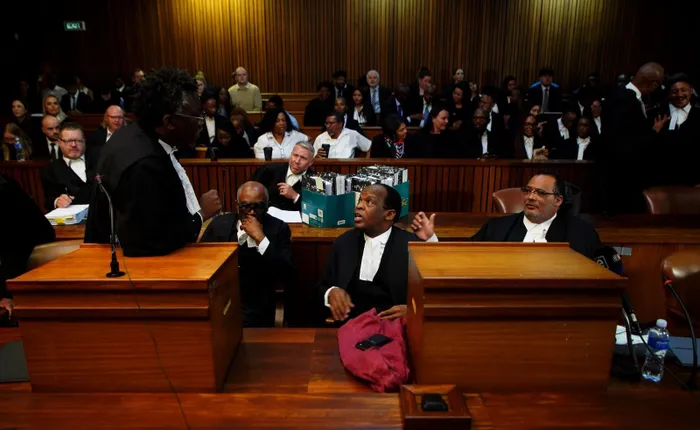
Counsel in the challenge against the Legal Sector Code gearing up for another day of arguments in the Pretoria High Court.
Image: Oupa Mokoena / Independent Newspapers
Trade union Solidarity, which has launched its own application to have the Legal Sector Code (LSC) overturned, argued that the code prioritises race in decision-making over merit and threatens freedom of choice.
The LSC diminishes the goodwill and reputation of legal practitioners by limiting their ability to work and directing that they only be allocated a certain portion of work, Advocate Wilhelm Bekker told the Gauteng High Court, Pretoria, on Wednesday.
Although Solidarity did not join the application brought by Deneys (formerly Norton Rose Fulbright), Bowmans, Webber Wentzel, and Werksmans to review and set aside the LSC, its application is being heard at the same time by a full court (three judges).
It, as well as the four top law firms, are asking the court to review the sector-specific B-BBEE framework for the South African legal profession gazetted by the Minister of Trade, Industry and Competition Parks Tau in September 2024.
Bekker argued that this application concerns the lawfulness of the process and authority by which the LSC was developed and promulgated.
“It is not an attack on transformation, affirmative action, or the constitutional commitment to substantive equality. On the contrary, it is a challenge brought precisely to ensure that transformation measures are implemented within the discipline of the Constitution and the rule of law,” he said.
Bekker explained that Solidarity does not contend that affirmative action, sectoral transformation, or remedial measures, as authorised under the B-BBEE Act, are per se unconstitutional or unlawful.
The application is confined to a far narrower, but constitutionally indispensable, enquiry: whether the LSC was formulated and adopted in accordance with the empowering legislation, mandatory procedures, and constitutional limits that govern the exercise of public power.
Bekker said the respondents' repeated attempts to characterise this application as “anti-transformation”, ideologically driven, or motivated by bad faith are misplaced. The respondents include the ministers of Trade and Industry and Justice.
“This case is, therefore, not about whether transformation in the legal profession is necessary. It is about whether the means chosen to pursue that goal comply with the Constitution, the B-BBEE Act, and the binding framework governing sector codes. The applicant submits that they do not.”
Bekker said the court is not asked to determine the wisdom of the LSC, but its lawfulness. In asserting its legal right to bring this application, Solidarity said some of its members are employed in the legal sector and stand to suffer directly based on the limitations that the LSC imposes on their employment and their career opportunities.
He also argued that people have the right to freely elect a legal representative of their choice - a right which the LSC limits and seeks to regulate. According to Bekker, the LSC also infringes on the right to collective bargaining by imposing specific numeric targets to be achieved by legal firms.
The LSC is a binding regulatory instrument designed to regulate racial and gender representivity through measurable targets, with direct downstream effects in procurement, briefing patterns, enterprise participation, and workplace demographic outcomes. It is, therefore, capable of infringing on constitutional rights for both those included in, and those excluded from, its benefits, Bekker said.
Key features of the LSC include that it sets 50% black ownership targets and 60 to 80% procurement spend on black-owned firms and advocates within five years. It exempts more than 95% of legal practices in South Africa because they fall below the turnover threshold for compliance.
The court is, meanwhile, on Wednesday hearing legal arguments on behalf of Minister Tau, which is expected to be followed by arguments on behalf of the Justice Minister. Both are opposing the application.
zelda.venter@inl.co.za