

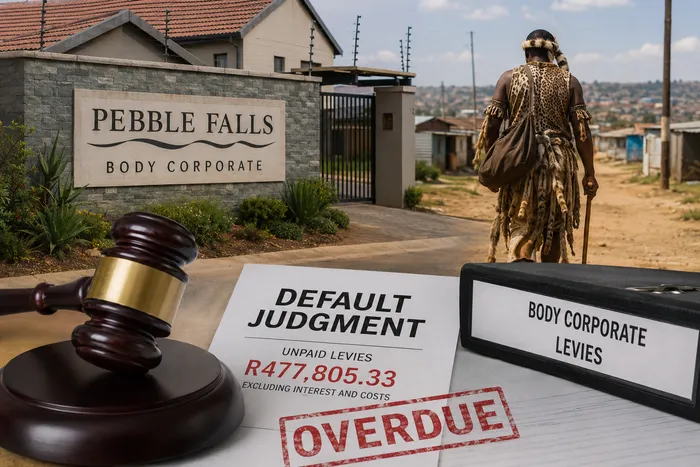
Gauteng man faces R470,000 levy bill after three-year absence for traditional healer initiation.
Image: AI-Generated
A Gauteng man who left his Boksburg home locked and unattended for almost three years while undergoing traditional healer initiation after responding to what he described as an ancestral calling has failed in his bid to overturn a default judgment for unpaid body corporate levies.
The South Gauteng High Court in Johannesburg dismissed an application by L to rescind a default judgment obtained by the Pebble Falls Body Corporate, as well as his application for condonation for filing the matter out of time.
L told the court that his troubles began in 2016 when he experienced illness and misfortune. According to his court papers, a traditional healer informed him in December 2019 that his condition was linked to a calling from his ancestors. Believing that failure to answer the calling could result in serious illness or death, he began training to become a traditional healer in May 2022.
During that period, L moved to his tutor’s home in Soweto and travelled extensively as part of his initiation. He remained under his tutor’s supervision until February 2025. His residence at Pebble Falls in Boksburg remained locked throughout his absence.
The court heard that while L was away, the Pebble Falls Body Corporate obtained a default judgment against him on 29 January 2024 for unpaid levies amounting to R477,805.33, excluding interest and costs.
L argued that he only became aware of the legal proceedings after the sheriff served documents relating to an application to execute against his property. He maintained that his prolonged absence explained why he had not received the summons and that he had not deliberately avoided service.
Judge Rean Strydom accepted that L had not wilfully evaded service of the court papers. The judge found that L had exercised his right to leave his residence and pursue his traditional initiation and that there was no evidence that he had consciously ignored the court process.
However, the court found that once L became aware of the litigation and the default judgment in early 2025, he failed to act within the time limits prescribed by the court rules. Instead of immediately launching a rescission application, he first focused on opposing an application to declare his property specially executable.
The judge ruled that L had not provided a satisfactory explanation for the lengthy delay before eventually filing the rescission application in July 2025.
The court also found that L had failed to establish a bona fide defence to the body corporate’s claim. Although he challenged the legality of the trustees who approved the levies and alleged irregularities in the management of the body corporate, the judge described those allegations as largely unsubstantiated and unsupported by evidence.
L argued that the trustees had not been lawfully appointed and that the levies had therefore been raised unlawfully. The court rejected those claims, finding that they were based largely on speculation and unsupported assertions.
Judge Strydom noted that L acknowledged that he was liable for levies in principle but disputed whether they had been lawfully imposed. The court found that he had failed to provide sufficient factual material to demonstrate that the trustees or managing agents had acted unlawfully.
The judgment further noted that L had accumulated substantial arrears. By September 2025, the outstanding amount reflected on the levy statement had grown to more than R801,000.
In dismissing the application, the court concluded that L had not shown a defence with reasonable prospects of success and had failed to justify his late filing.
The court ordered that both the condonation application and the rescission application be dismissed, with costs awarded against L.
The ruling leaves the default judgment in favour of the Pebble Falls Body Corporate intact and clears the way for the body corporate to continue enforcing the debt.
sinenhlanhla.masilela@iol.co.za
IOL News