

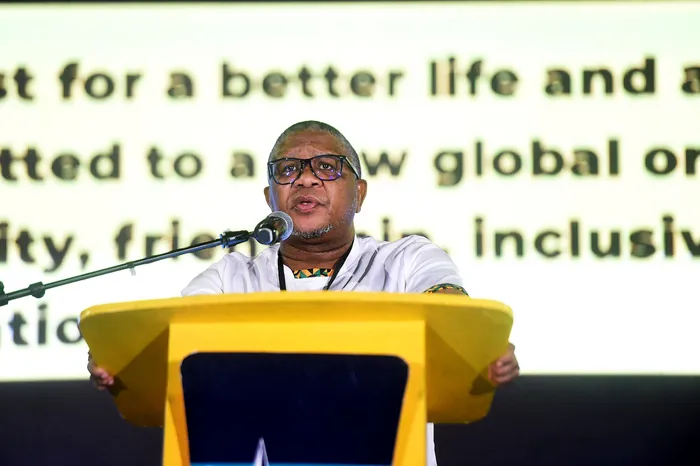
ANC Secretary-General Fikile Mbalula delivers an address at the 5th ANC National General Council in Boksburg.
Image: Itumeleng English / Independent Newspapers
The Secretary-General’s organisational report to the 5th NGC is serious, detailed and honest. It lists declining membership, weak branches, factionalism, broken deployment practices, electoral setbacks and the erosion of public confidence.
It cites the 55th National Conference resolutions on organisational renewal and repeats the commitment to make the ANC once again a “movement for transformation and a strategic centre of power.” But there is a hard truth we must face in Boksburg: We do not suffer from a shortage of resolutions. We suffer from a shortage of power that is organised around a clear purpose.
For fifteen years we have passed organisational renewal resolutions faster than we have renewed the organisation. Meanwhile, the people’s patience shrinks, the vote declines, and parallel power structures mafias, cartels and tender syndicates occupy the space where the movement should be. If this NGC is to be a real line in the sand, we must shift from paper renewal to power renewal.
The SG’s report starts, again, with structures: NEC, PECs, RECs, branches, leagues, sub-committees. It is faithful to the constitution, but it is strategically upside-down.In any liberation movement there is a simple sequence:
We keep trying to fix culture by tinkering with structure, while leaving strategy vague. The result is what Lenin warned against: “revolutionary bookkeeping” perfect minutes, zero impact. At this conjuncture the organising idea is not mysterious.
Our central task is National Development: transforming the productive structure of the economy, rebuilding the state, and defeating criminal sovereignty so that the people can live, work and thrive.
If strategy is sharpened to that point, half of our organisational problems begin to answer themselves.
The ANC Branch Manual reminds us that “the branch, and its members, is the most important part of the ANC … the future strength of the ANC depends on the strength of our branches.” Yet in practice, we still define a “functional branch” by whether it: Holds a BGM, Files reports and submits a list in time. That is how you measure a club, not a movement.
New functional definition for branches:
A functional ANC branch is one that delivers at least one measurable community solution per quarter, aligned to local development needs.
Examples:
If a branch cannot point to a concrete quarterly gain for the community, it is non-functional, no matter how perfect its paperwork.
The SG’s report correctly highlights deployment failures, corruption and uneven governance. But it does not go far enough in naming the core strategic problem:Too much power has been outsourced from the democratic state to:
Organisational renewal is impossible without state capacity renewal.
Commission directives that connect the two:
When branches see the data, and the state has the tools, the movement can once again be a strategic centre of power not a spectator.
The SG’s documents give us long lists of Key Performance Indicators. The 55th Conference resolutions again promised to “rebuild branches as agents of community development” and to “reconnect the ANC with society” through campaigns like Letsema. The problem is not the aspiration. It is overload. Real strategy is brutal about focus.
Propose ONE national organisational KPI:Every branch must initiate, support, or win one visible development or anti-corruption intervention every 90 days.
Measured nationally. Published quarterly. Discussed at NEC, PEC, REC and branch level.
Every Alliance document ANC, SACP, COSATU locates a key crisis in the quality of councillors and public representatives: parasitic networks, predatory elites, “tenderpreneurs in T-shirts”. We cannot talk renewal while:
Commission-ready reform:
This is not “liberalism”. It is returning to our own tradition of people-centred democracy and popular mandates.
The 2012 Organisational Renewal document already warned that cadre development had become “sporadic, rhetorical and not systematically linked to deployment.”
Ten years later, the problem is worse. We send comrades to “schools” and “indabas” and they return unable to:
New approach:
Every cadre development programme must end with a practical assignment in a real ward (voting district):
Only cadres who have successfully completed such tasks should be considered for public office or senior organisational roles.
COSATU, NEHAWU and other unions have long experience with shop-floor feedback: shop steward (voting district)s know when the mood turns before leadership does. The ANC at branch level lacks similar “early-warning systems”.
Practical tools for organisational renewal:
This is what Dullah Omar Region has already begun piloting in its own NGC submissions: using real community grievances as the organising principle of ANC work, not just internal league or slate contests.
To comrades inside the movement:
Renewal begins where people live, not where leaders speak.
If we return from Boksburg with only new phrases and old behaviour, we will confirm what many already think: that we have turned a liberation movement into a talk shop.
To South Africans outside the ANC:
You are right to be angry. You are right to demand better. But know this as well: unless the ANC and its Alliance partners rebuild organisational power in communities and in the state, no party will be able to stabilise municipalities, defeat mafias, or drive a long-term national development project.
That is why this NGC matters beyond party lines.
Final Commission Guideline
When a resolution on “organisational renewal” is placed before you, ask just two questions:
Draw the line in the sand: “This is not what we struggled for branches with slogans but no service; leaders with titles but no delivery.”
Organisational renewal must now mean one thing: Visible, measurable improvement in people’s lives or it is not renewal at all.
* Faiez Jacobs is a former Member of Parliament, founder of The Transcendence Group, Capetonian, Activist, and Servant of the People.
** The views expressed do not necessarily reflect the views of IOL or Independent Media.