

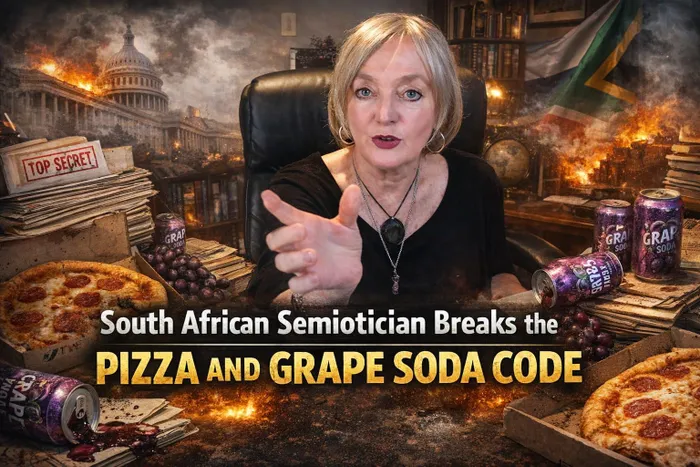
How did the Epstein files reshape our understanding of coded language among elites? Gillian Schutte unpacks the deeper implications of the phrase 'Pizza and Grape Soda'.
Image: Supplied / Gillian Schutte
The release of the Epstein files shifted public understanding in ways that reached far beyond legal questions. They exposed a social world built on wealth, access, and silence. In that world, language often worked as a shield as much as a tool of conversation. Phrases that once sounded childish or trivial began to feel heavier once placed inside this context. “Pizza and Grape Soda” resurfaced in that charged atmosphere, no longer heard only as casual slang, but as part of a culture shaped by discretion and euphemism.
The phrase also intersects with the earlier moment known as PizzaGate. At the time, mainstream media and institutions dismissed PizzaGate as a conspiracy theory and ridiculed those who raised questions about coded language among elites. That dismissal became part of the public memory of the debate. The later release of the Epstein files reproduced similar, though not exact, claims made during that period. What they revealed was a documented network of influence marked by secrecy, privilege, and carefully managed public speech. In hindsight, this created a tension. The files showed a milieu where indirect language and coded familiarity would have fit easily within the habits of powerful circles.
My entry into this inquiry was as a semiotician trained to read symbols, patterns, and layered communication. Alongside my work as a scholar and political writer, I have long practised a range of esoteric and healing arts. Some of this knowledge came through maternal lines of embodied practice and intuitive perception. Other strands were formally studied and certified over many years.
While completing my BA in African Politics and Literature some decades back, I ran a healing practice known for sports massage, shiatsu, kinesiology, reflexology, and deep fascia treatments, all of which I am trained in. I also conducted Jungian tarot readings, using archetypal symbolism to explore unconscious narratives rather than predict events. I later became a Kundalini yoga teacher, working with breath, posture, and meditative discipline as ways of reading subtle energetic patterns. To this day I practise Advaita Vedanta and follow the teachings of Nisargadatta Maharaj, a yogic master who remained outside scandal and material excess. His focus on direct self-inquiry continues to shape both my ethical orientation and my intellectual method.
I also studied and used lexigramming based on the Linda Goodman method. This deepened my work on Akashic records and symbolic life patterns. Goodman’s system is strict and disciplined. One takes a name or phrase and works only with the exact letters present. No additional letters may be added and none may be omitted. Words and sentences must arise faithfully from that closed letter field. The premise is that meaning already resides within the linguistic structure itself. The interpreter’s task is not to impose meaning but to reveal what is already contained there.
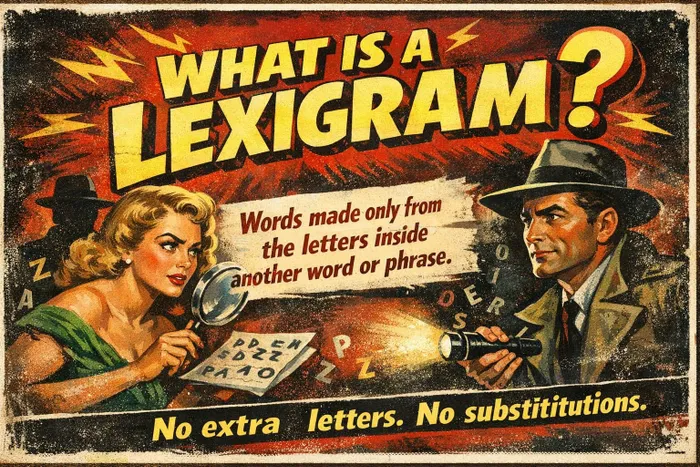
A lexigram is a word made up using only letters inside another word or phrase.
Image: Supplied / Gillian Schutte
In Goodman’s view, lexigrams expose the hidden themes embedded in a person’s name or in a significant phrase. They can reveal tensions, talents, desires, and life lessons that remain active beneath the surface of personality. The method rests on the belief that language is patterned rather than random, and that the internal vocabulary of a name or phrase can act as a symbolic mirror of identity and destiny. Through years of using this method, I experienced it as a way of reading deeper layers of intention and consciousness that shape human experience.
Many mystic traditions hold a related belief. They suggest that before we are born we choose or attract our birth dates and names for their vibrational reflection of our life purpose, our current path, and our level of consciousness. Names, in this view, are not accidental labels but energetic signatures that carry themes we are meant to live through, resolve, or embody. Lexigramming becomes one way of examining that symbolic signature, allowing the hidden language of a name or phrase to speak.
It was this background that I brought to the phrase “Pizza and Grape Soda.” I approached it as a semiotician would approach a name or symbolic text. I listed the exact letters contained in the phrase and worked strictly within that fixed set. The phrase had to reveal its own internal vocabulary without invention or manipulation. The first extraction that emerged was Aesopian, fully contained within the letters of “Pizza and Grape Soda.” This finding is letter-faithful and undisputed. It arises directly from the phrase itself. Aesopian language historically refers to veiled or indirect speech used by elites and closed networks who communicate in ways that appear innocent to outsiders while carrying deeper implications for insiders.
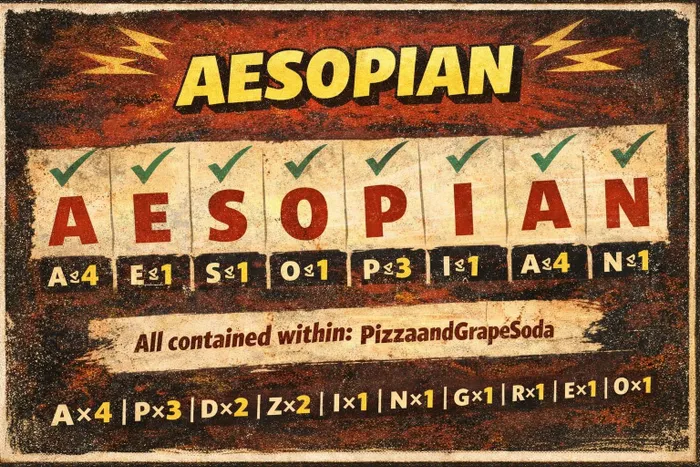
A lexigram found in the phrase 'Pizza and Grape Soda'
Image: Supplied / Gillian Schutte
From there I continued working within the available letter field, constructing phrases only from the letters present in “Pizza and Grape Soda”. The sequence that emerged is presented exactly as derived from that letter structure, followed by its symbolic rendering within the lexigrammatic narrative.
These are some of the messages encoded into the phrase.
Symbolically, this suggests that institutional or moral authorities, either in costume or in their official capacity, tacitly sanction hidden, coded rituals that unfold in enclosed, controlled environments. The imagery frames power as theatrical and ceremonial, carried out behind walls and justified through layered language.
This evokes ruling figures (padrones) presenting themselves in mythological or divine roles, staging a spectacle of self-elevation. The symbolism points to elites adopting archetypal identities that legitimise their authority and dramatise their superiority.
Here the imagery suggests a hierarchy in which powerful actors dressed in pagan or mythological attire oversee and display the powerless, turning domination into ritualised spectacle. It reflects themes of control, exhibition, and the staging of human vulnerability.
Within the symbolic lexigrammatic field, this line reflects the ultimate consequence of unchecked domination: the erasure of dignity and life under totalised power. It represents the extreme endpoint of dehumanisation within closed systems of control.
Symbolically, this line points to generational complicity, where elder authority figures are portrayed as endorsing, permitting, or engaging in abuses within a hierarchy. The imagery suggests continuity of power structures across generations and the normalisation of permissible acts of savage depravity within those systems.
This sequence portrays ruling figures as deriving symbolic and sadistic power from terror and emotional suffering, transforming cruelty into ritualised performance. It reflects an allegory of elites feeding on despair to reinforce their dominance.
Here the symbolism centres on disappearance and disposal, evoking the erasure of victims and the reduction of human beings to expendable matter. The imagery conveys extreme devaluation and the absence of accountability.
This line intensifies the theme of dehumanisation. Symbolically, it suggests that those under total control are treated as waste, stripped of personhood and moral worth by those who dominate them. It also refers to the age-old method of feeding bodies to pigs to cover up crimes.
This final sequence introduces the theme of narrative control. Symbolically, it suggests that media praise and orchestrated publicity cleanse reputations, allowing hidden actions to vanish from public consciousness through managed perception.
Seen together, this lexigrammatic sequence reads as an allegorical narrative of hidden hierarchies, ritualised power, generational complicity, spectacle, disappearance, and media-managed legitimacy. One possible inference is that a phrase like “Pizza and Grape Soda” could have been deliberately engineered by someone skilled in symbolic or coded language, crafting a term that outwardly resembles an innocent menu item while internally containing a vocabulary suggestive of secrecy, hierarchy, and ritualised excess, and a type of menu of events available and intelligible only to those familiar with the code.
The wonder and semantic science of lexigramming lies in this simple, letter-faithful fact. These words, themes, and symbolic motifs, many of which resonate with material that surfaced in the Epstein files, exist within this single term, undisputed, drawn only from its own letters. That in itself raises a profound semiotic question about how language can function simultaneously as disguise and disclosure within circles where meaning is rarely spoken openly yet is always understood.
How did the Epstein files reshape our understanding of coded language among elites? Gillian Schutte unpacks the deeper implications of the phrase 'Pizza and Grape Soda'.
Image: IOL
* Gillian Schutte is a South African writer, filmmaker, poet, and uncompromising social justice activist. Founder of Media for Justice and co-owner of handHeld Films, she is recognised for hard-hitting documentaries and incisive opinion pieces that dismantle whiteness, neoliberal capitalism, and imperial power.
** The views expressed do not necessarily reflect the views of IOL or Independent Media.