

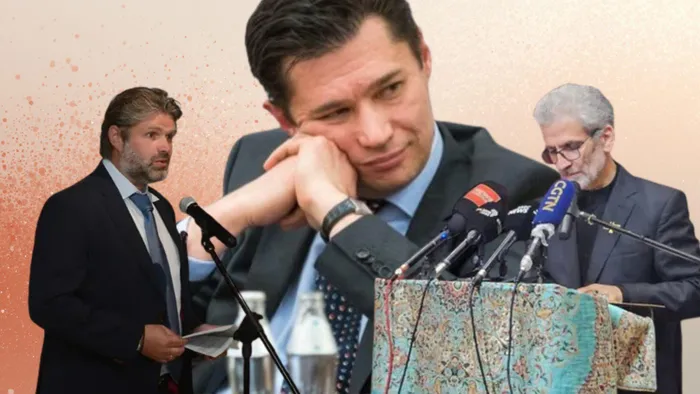
A composite image showing (from left) Russian Ambassador to South Africa Roman Ambarov, Ukrainian Ambassador to South Africa Dr Olexander Scherba, and Iranian Ambassador to South Africa Mansour Shakib Mehr. Gillian Schutte unravels the intricate web of diplomacy as Ukraine's ambassador in South Africa publicly refuses to sign a condolence book for Iran's fallen leaders, igniting a debate on the ethics of diplomatic conduct and the role of media in shaping narratives during conflict.
Image: IOL Graphics
Diplomacy depends on restraint. Rituals exist to preserve a minimum level of civility between states even during periods of conflict. Condolence books belong to that tradition. They acknowledge death and recognise the dignity of a grieving nation. Governments that hold serious disagreements still observe this practice because international relations requires discipline.
The Embassy of the Islamic Republic of Iran in South Africa recently informed foreign missions that a book of condolences had been opened following the killing of Ayatollah Ali Khamenei and senior Iranian officials during the recent United States and Israeli strikes on Iran.
Ukraine’s ambassador to South Africa, Dr Olexander Scherba, responded publicly with a letter refusing to sign the condolence book. He accused Iran’s leadership of responsibility for Ukrainian civilian deaths because Iranian-manufactured Shahed drones have been used by Russia during the war in Ukraine. He concluded that he would not express condolences for someone whose death he does not mourn.
The refusal alone already represents an unusual diplomatic act. The public tone of the letter transformed the episode into something more serious. The ambassador placed the death of a national leader inside a moral indictment directed at another state.
The Iranian Embassy responded publicly on X to clarify the situation. The embassy explained that a note verbale had been sent to the Department of International Relations and Cooperation and copied to the diplomatic corps rather than a personal invitation directed at the Ukrainian mission. It also reminded diplomats that their role is not to incite hostility between peoples.
To explain its broader position on the Russia–Ukraine conflict, the embassy quoted the thirteenth-century Persian poet Sa’di:
Human beings are members of a whole,
In the creation of one essence and soul.
If one member is afflicted with pain,
Other members uneasy will remain.
If you have no sympathy for human pain,
The name of humans you cannot retain.
The verse forms part of Sa’di’s Bani Adam, a work deeply embedded in Persian intellectual tradition. The poem is also inscribed in gold weave on the great Persian carpet displayed at the United Nations headquarters in New York, gifted by Iran to the organisation. The inscription stands as a reminder, within the very architecture of global diplomacy, that humanity shares a single moral condition.
The Russian Embassy in South Africa responded in far sharper language. In a statement posted publicly it wrote:
“We thought we had seen everything from the Ukrainian ambassador, but this goes even further. Mocking the deaths of hundreds of Iranians while claiming to be a person of faith can only come from someone with no conscience and no soul.
Can such people truly care about their own citizens? We doubt it.”
The controversy that followed reveals something larger than a dispute between diplomats.
Iran currently faces sustained military strikes across several cities. Iranian authorities report attacks on residential neighbourhoods, hospitals, schools and emergency facilities. Civilian casualties have been reported across multiple provinces as the conflict expands. Yet the loss of civilian life in Iran receives limited attention in much Western media coverage of the conflict.
Under such circumstances a refusal to acknowledge a condolence gesture directed at a nation experiencing loss raises serious questions about diplomatic conduct.
In earlier periods of diplomatic practice, conduct of this nature could easily have triggered recall or resignation. Ambassadors have historically been required to step down for statements far less provocative than publicly refusing condolences following the death of a head of state. Yet in the present case Dr Olexander Scherba appears able to operate with considerable freedom inside South Africa’s public sphere.
The incident also exposes a deeper problem within South Africa’s media environment.
Dr Scherba has become a regular presence across several South African platforms. Newsroom Afrika frequently hosts him to discuss the Ukraine war. The Mail & Guardian publishes his commentary. These appearances often contain harsh denunciations of Russia and its partners.
Russian and Iranian diplomats, rarely if ever, appear on these platforms.
Public discourse therefore unfolds through a narrow interpretive frame.
South Africa’s official foreign policy moves in another direction. Pretoria has consistently emphasised negotiation and dialogue in global conflicts while maintaining relations with Russia, Iran and China through BRICS and other diplomatic frameworks.
Yet the domestic information environment often mirrors the geopolitical narratives of the Atlantic alliance.
This contradiction creates a serious problem. When a foreign ambassador can repeatedly condemn states that South Africa treats as diplomatic partners while those states receive no opportunity to respond within the same media ecosystem, the public sphere becomes structurally imbalanced.
The episode surrounding the condolence book illustrates the consequences.
One diplomatic mission responded with an appeal to shared humanity through the words of Sa’di. Another mission condemned the mockery of civilian deaths. The Ukrainian ambassador chose to transform a moment of mourning into a geopolitical accusation delivered publicly to a foreign audience.
That decision raises an unavoidable question.
How does a foreign diplomat feel sufficiently empowered to speak with such impunity inside South Africa’s public sphere?
The answer lies partly within the permissive media environment that elevates one narrative while marginalising others. It also reflects a deeper uncertainty about South Africa’s own geopolitical posture under the Government of National Unity.
South Africa once cultivated a reputation as a mediator capable of speaking across geopolitical divides. That credibility depended on intellectual independence and balanced engagement.
War produces grief across borders. Families mourn their dead regardless of political allegiance. Diplomacy exists to ensure that this reality remains visible even during the fiercest conflicts.
When diplomats abandon restraint and convert death into rhetorical ammunition, the damage extends beyond a single letter. It erodes the fragile norms that allow states in conflict to speak to one another at all.
Gillian Schutte unravels the intricate web of diplomacy as Ukraine's ambassador in South Africa publicly refuses to sign a condolence book for Iran's fallen leaders, igniting a debate on the ethics of diplomatic conduct and the role of media in shaping narratives during conflict.
Image: IOL
* Gillian Schutte is a South African writer, filmmaker, poet, and uncompromising social justice activist. Founder of Media for Justice and co-owner of handHeld Films, she is recognised for hard-hitting documentaries and incisive opinion pieces that dismantle whiteness, neoliberal capitalism, and imperial power.
** The views expressed do not necessarily reflect the views of IOL or Independent Media.