

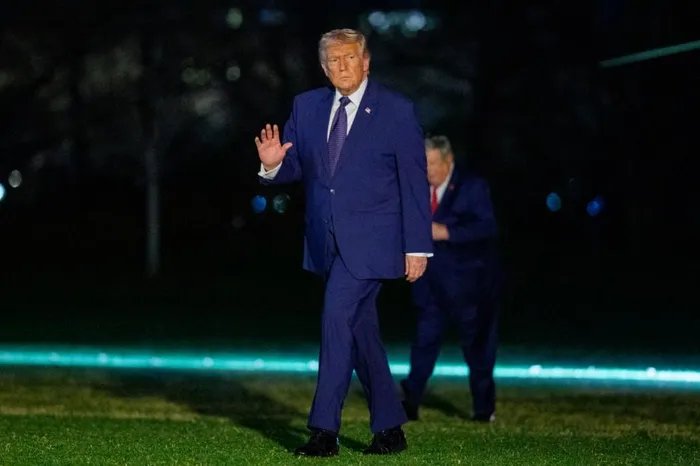
United States President Donald Trump walks across the South Lawn as he arrives at the White House on March 9, 2026 in Washington, DC. In times of war, leaders project confidence, but history shows that the reality often diverges sharply from their predictions, revealing the complexities of modern conflict, writes Armstrong Williams.
Image: Andrew Harnik / Getty Images via AFP
In times of war, leaders often project the outcome they hope to achieve. Confidence can rally a nation, strengthen morale, and signal resolve to adversaries. Yet history reminds us that war rarely unfolds according to the plans or predictions of any single leader. The gap between projected outcomes and the complex, often obscured reality on the ground remains one of the defining features of modern conflict.
Today, that gap is widening under what military strategists have long called the “fog of war”.
Recent statements from President Donald Trump and Defense Secretary Pete Hegseth have projected strong confidence about the direction of the conflict with Iran. The administration has spoken of decisive military advantage, shaping Iran’s future leadership, and restoring stability to a volatile region. At a recent press conference, President Trump suggested the conflict could end soon and even raised the prospect of the United States controlling the Strait of Hormuz one of the most strategically vital waterways in the world.
At the same time, the President has escalated rhetoric closer to home openly raising the idea of asserting control over Cuba or fundamentally reshaping its political future. That suggestion, whether strategic or rhetorical, introduces a new and deeply consequential dimension: the expansion of American confrontation into our own hemisphere.
Such declarations are not unusual. In wartime, leaders must project strength. Public confidence becomes a strategic asset, and clarity of purpose is often presented even when conditions are anything but clear.
But beneath those statements lies a far more complicated and uncertain reality.
The fog of war is not simply about battlefield confusion; it extends to intelligence, decision-making, and public understanding. Information is incomplete. Conditions change by the hour. Allies recalibrate. Adversaries adapt. What is presented publicly as momentum may, in reality, be far more fluid and unresolved.
Even amid intense pressure and confrontation, Iran has demonstrated its own internal agency, reinforcing a fundamental truth: military power can influence outcomes, but it does not easily dictate the political future of another nation. History has repeatedly tested—and often humbled—those who believed otherwise.
Vietnam stands as a cautionary tale. American leaders spoke with confidence about progress and eventual victory, yet the war expanded beyond expectations, reshaping both the region and American society. Iraq followed a similar trajectory. Initial success in removing Saddam Hussein gave way to years of insurgency and instability that few predicted at the outset.
More recently, Afghanistan offered perhaps the clearest lesson. For two decades, progress was reported, confidence was projected, and strategies were adjusted. Yet in a matter of weeks in 2021, those assumptions collapsed, revealing how fragile the underlying reality had become.
These examples do not suggest that leaders act in bad faith. War demands resolve, and hesitation can carry its own risks. But they do underscore a persistent tension: what is said publicly often reflects intention, while what unfolds in reality reflects complexity.
That tension is especially relevant in a confrontation with Iran and even more so when rhetoric extends to Cuba, a nation just 90 miles from our shores. Cuba is not a distant theatre. Any escalation there would not be abstract or contained. It would carry immediate geopolitical, economic, and security consequences for the United States and the broader region.
For Americans observing from afar, the narrative can appear straightforward; defined by progress, setbacks, and turning points. But war rarely offers such clarity. It evolves incrementally, shaped by forces that are often unseen until their consequences are unavoidable.
We must also confront a harder truth: a nation cannot sustainably expand its conflicts abroad while leaving vulnerabilities at home unaddressed. The more fronts we open—whether in the Middle East or in our own hemisphere—the greater the strain on our resources, our focus, and our national cohesion.
This is why humility must accompany strength in foreign policy. Power matters. Leadership matters. But history consistently warns against overestimating the ability of any nation to control the trajectory of another.
The fog of war obscures not only what is happening, but what will happen next.
The lesson is not one of cynicism, but of perspective. Leaders will always project confidence. They must. But the public must also understand that certainty in war is often an illusion.
Projecting the future is easy. Living with its consequences is far harder.
And over time, reality has a way of revealing itself whether we are prepared for it or not.
In times of war, leaders project confidence, but history shows that the reality often diverges sharply from their predictions, revealing the complexities of modern conflict, writes Armstrong Williams.
Image: IOL
* Armstrong Williams is the manager and Sole Owner of Howard Stirk Holdings I & II Broadcast Television Stations and the 2016 Multicultural Media Broadcast Owner of the year.
** The views expressed do not necessarily reflect the views of IOL or Independent Media.