

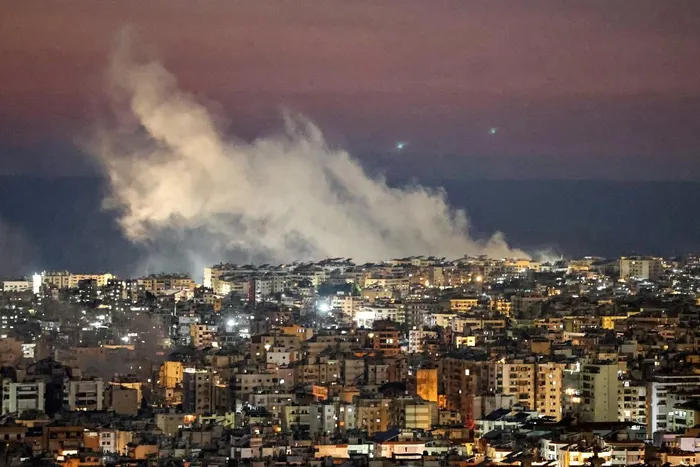
The war launched by the United States and Israel against Iran spread across the Middle East on March 2 with Lebanon's Hezbollah entering the fray and a British air base in Cyprus targeted.
Image: Ibrahim Amro / AFP
Joseph Kent, director of the United States National Counterterrorism Center, resigned this week. “Iran posed no imminent threat to our nation, and it is clear that we started this war due to pressure from Israel and its powerful American lobby,” he stated in his letter of resignation.
That’s a major drop-the-mic moment.
It lays bare — and confirms — that the war against Iran was a miscalculated move.
Trump was played by Israel and fell right into that trap.
Days before the attack on February 28, Israeli Prime Minister Benjamin Netanyahu called Trump, warning him that Israel was about to attack Iran and that, in doing so, Iran would retaliate and target US interests. “So best to join us and let’s attack together” was the alleged message.
Trump, in true impulsive fashion, abandoned negotiations with Iran and joined in the surprise attack. Consider the timing: Iran was at the negotiating table with the US, on the brink of a deal on nuclear arms. Why would anyone attack a country while negotiating a peace deal with it?
It's also now emerged that Israel tried to use the same tactics with former American presidents Joe Biden and Barack Obama — also claiming American interests would be targeted. They refused to be drawn in, and Israel backed off from its plans to attack Iran. This time, it worked on Trump, much to Israel’s satisfaction.
In response, Iran — a sovereign country — did what any nation would do under attack: it defended itself. It also warned that it would target US military bases from which the attacks were launched — including bases in the Persian Gulf and airport sites used to transport US military equipment.
Arab states were reportedly enraged by Iran’s retaliatory strikes, and rumours suggest some have urged Trump to “finish Iran”. The UAE and other Gulf states called on the UN Security Council to issue a strong condemnation of Iran’s attacks — which it did, without mentioning the initial strikes by the US and Israel.
Another often-forgotten fact: Iran had already committed to the International Atomic Energy Agency, and its former leader, Ali Hosseini Khamenei — killed in a direct attack — had issued a fatwa, a religious ruling, forbidding the manufacture of nuclear weapons. So on what basis was Iran attacked?
You don’t need to be anti-regime to recognise that this was an unprovoked war. The mass protests against the Iranian government had merit and, encouraged by Trump’s assurances that “help was on its way”, many waited.
Instead, more than 1,500 civilians were killed by US and Israeli missiles, including 168 children. That’s not help. Ordinary Iranians are outraged. Trump expected an uprising; he didn’t get one. Many Iranians may oppose their regime, but they oppose foreign attacks on their country even more.
Iranians abroad have applauded the US-Israeli strikes, hoping they will pave the way for regime change. But Iran is not Venezuela — nor is it Arab. It will not capitulate to the US or Israel, especially Israel.
Despite the missiles raining down on them, Iran has played the game well. It is winning the PR war, exposing Trump as an unstable, reckless leader who dragged the US into an unnecessary conflict at Israel’s behest.
This gives serious George Bush-era vibes — a reminder of 2003, when the United States invaded Iraq based on claims that Saddam Hussein possessed weapons of mass destruction and had ties to al-Qaeda — assertions later proven false. That invasion, often described as being predicated on a “big lie,” led to significant loss of life and long-term instability in the region that continues to this day.
Trump, in his frantic, delusional, power-hungry mission to be “president of the world”, seems to have forgotten how he treats others. But countries haven’t. Those aggressive tariffs, the “we don’t need anyone” rhetoric, the threat to take Greenland (and now Cuba), and his belittling of world leaders — all of it has consequences.
And then came his plea to NATO: “We need help! Send warships to protect the Strait of Hormuz.” A request that was reportedly met with reluctance — “not our war”.
Controlled by Iran, the strait is one of the world’s most critical oil chokepoints, with around 20 million barrels of crude oil and petroleum products passing through it each day — roughly 20% of global oil consumption — as well as a significant share of liquefied natural gas.
Major exporters such as Saudi Arabia, Iraq, the UAE, Kuwait, and Qatar rely on it almost entirely for shipments to global markets.
When Trump claimed “Iran closed the straits” (yes, he actually called it “the straits”), Iran’s foreign minister calmly responded: “The strait is open to everyone except America and its allies.” Ouch.
Arab states have long cosied up to the US. At times, it seems like a deep-rooted need for validation. Without American approval, there appears to be a lingering sense of inferiority, despite vast wealth. It’s a revealing — if uncomfortable — insight into regional dynamics.
That they allowed their bases to be used as launchpads to attack another sovereign state in an unprovoked manner reflects this alignment. And it is exactly what the US and Israel wanted.
This war is not about regime change. It is about dividing the region — hoping the Iranian people will seize control and that influence over oil and the Strait of Hormuz will shift towards the US. That has not happened and seems unlikely if the current trajectory continues.
For now, Trump will continue waddling across the world stage like an emperor without clothes.It’s a new global order. And long overdue.
* Zohra Teke is a seasoned journalist and contributor.
** The views expressed do not necessarily reflect the views of IOL or Independent Media.