

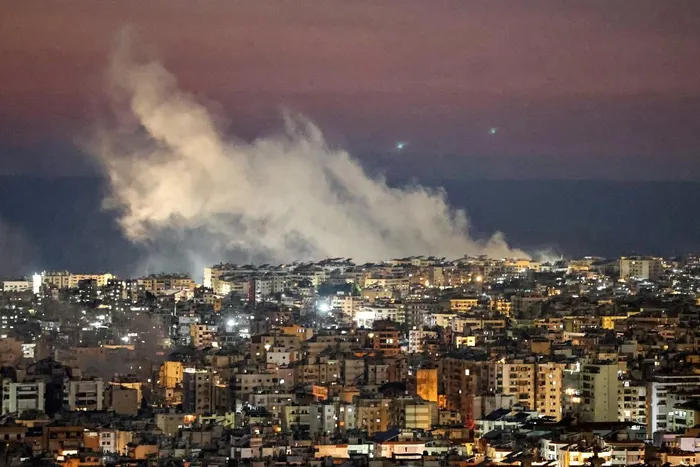
War exposes the fragility of nations and the quiet fears we carry. As tensions rise in the Persian Gulf and beyond, how much longer can we ignore the global consequences? Armstrong Williams explores the urgent need for restraint and the impact of conflict on everyday life.
Image: Ibrahim Amro / AFP
War has a way of exposing not only the fragility of nations, but the quiet fears we carry within ourselves. It strips away the illusion of distance between “over there” and “right here”. And in moments like this when energy infrastructure burns, missiles cross borders, and global supply routes hang in the balance we are forced to confront a question many would rather avoid:
How much more are we willing to carry before we choose a different path?
The latest escalation in the Persian Gulf is not simply another chapter in a distant conflict. It is a warning. When major oil and gas facilities become targets, and the Strait of Hormuz a passageway responsible for roughly a fifth of the world’s energy supply is threatened, this is no longer regional. This is global. This is personal.
Now, with tensions expanding beyond the Middle East including renewed instability surrounding Cuba and its strategic proximity just 90 miles from American shores we are reminded that geopolitical fault lines do not remain contained. They connect. What ignites in one region can quickly ripple across others, pulling the United States into a broader and more unpredictable web of consequence.
And from Cape Town to Johannesburg, from London to Lagos, the world is watching.
Nations like South Africa deeply connected to global markets, energy flows, and diplomatic currents understand that instability in one region rarely stays there. When major powers move toward escalation, the ripple effects are felt in currency markets, trade routes, fuel prices, and food security across continents. There is an unspoken expectation, even now, that the United States will act not only in its own interest, but as a stabilising force in an increasingly volatile world.
Whether fairly or not, the burden of that expectation remains.
Every American will feel the consequences. At the gas pump. At the grocery store. In retirement accounts. And perhaps most profoundly, in the quiet anxiety that settles in when the world feels increasingly unstable.
But the impact does not stop at inconvenience it cuts into stability.
Small businesses already operating on thin margins begin to absorb rising fuel and transportation costs they cannot pass on without losing customers. Supply chains tighten. Hiring slows. Expansion plans are shelved. For many, survival not growth becomes the immediate priority.
For working families, the pressure is even more direct. The cost of essentials rises while wages remain largely fixed. Savings are stretched. Credit balances grow. Financial security something that once felt within reach begins to slip away.
And for the poor and the middle class, this moment can feel less like strain and more like reversal.
Years of incremental progress paying down debt, building modest savings, gaining a foothold in stability are suddenly at risk. Economic shocks tied to global conflict do not fall evenly. They land hardest on those with the least cushion to absorb them.
This is how distant wars quietly reshape domestic life not through headlines alone, but through erosion. Through the slow tightening of options. Through the growing realization that forces far beyond one’s control are beginning to dictate everyday survival.
But beyond economics, there is something deeper something harder to admit.
This war frightens you.
Not in the abstract way we discuss conflict on television panels or in policy briefings, but in a deeply human way. In quiet moments. In the early hours of the morning. In the uneasy silence before sleep.
You hear the rhetoric sharpened, escalating, unyielding. You watch leaders posture and threaten, from the unmistakable tone of Donald Trump to the equally defiant responses from Iran. And beneath the analysis, something inside you tightens.
Because history has taught us that words like these rarely lead to calm outcomes.
They lead to miscalculation.
They lead to overreach.
They lead to wars that expand far beyond their original intent.
And if you are honest truly honest you have wondered where this could go.
You have considered whether this is how larger unravellings begin not all at once, but through a steady chain of escalation that feels manageable until suddenly it is not.
These are not thoughts we easily share. They feel too heavy. Too uncertain. Too revealing.
But they are there. And they are growing.
They show up as restless days and sleepless nights. As a persistent hum of concern that never quite fades. As the recognition that the line between foreign conflict and domestic consequence is far thinner than we would like to believe.
Because deep down, many understand something else we hesitate to say:
If this continues, it will not stay contained.
We have seen what war costs not just in strategy or headlines, but in human lives. We have watched soldiers return home in flag-draped coffins. We have seen others come back changed forever wounded in body, burdened in spirit, carrying the unseen weight of what they endured.
And we have not been immune here at home or anywhere else in the world.
Conflict has a way of reaching beyond borders, reshaping societies, testing institutions, and challenging the very idea of stability.
This is not fear-mongering. It is recognition.
It is the sober understanding that war, once set in motion, rarely asks for permission before expanding its reach and that its consequences are felt not only on battlefields, but in households, businesses, and communities across the globe.
Yet even now, we are pulled toward louder rhetoric instead of quieter wisdom. Toward escalation instead of restraint. Toward proving strength rather than preserving stability.
But strength is not measured by how far we are willing to go. It is measured by what we are wise enough to prevent.
This is the moment that demands something different.
It calls for leaders willing to lower the temperature rather than raise it. For diplomacy that is persistent, not performative. For a collective pause one that asks not what we can do, but what we should do.
Because the alternative is no longer theoretical.
It is already beginning to take shape.
And the cost, as always, will not be carried by nations alone but by people.
War exposes the fragility of nations and the quiet fears we carry. As tensions rise in the Persian Gulf and beyond, how much longer can we ignore the global consequences? Armstrong Williams explores the urgent need for restraint and the impact of conflict on everyday life.
Image: IOL
* Armstrong Williams is the manager and Sole Owner of Howard Stirk Holdings I & II Broadcast Television Stations and the 2016 Multicultural Media Broadcast Owner of the year.
** The views expressed do not necessarily reflect the views of IOL or Independent Media.