

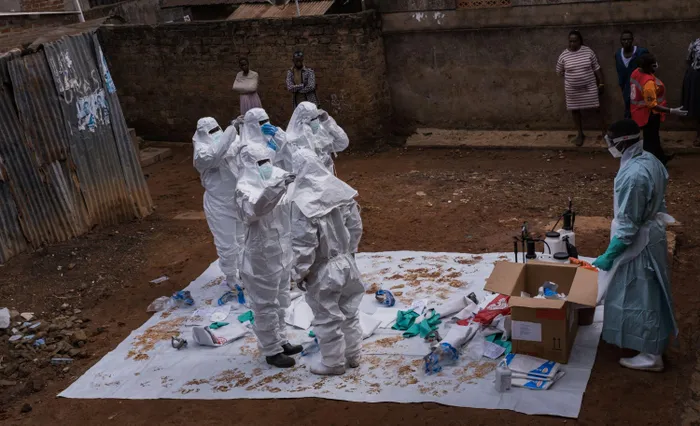
Workers from the Uganda Red Cross Society don protective suits as they prepare to evacuate the body of a suspected Ebola victim in Kampala on May 26, 2026. Ebola draws the world's attention to Africa, but the true story lies in the ongoing struggles against poverty and inequality. Armstrong Williams explores how the crisis reveals deeper issues that demand our attention and action.
Image: Badru Katumba / AFP
Whenever the world hears the word Ebola, attention immediately turns to Africa. Headlines appear. International organisations mobilise. Experts conduct briefings. Governments issue warnings. For a moment, the world’s attention focuses on a region that is too often overlooked until a crisis emerges.
Yet Ebola is not the real story.
The real story is the millions of people whose lives are defined not by a virus, but by poverty, inadequate healthcare, fragile infrastructure, limited housing, and a lack of opportunity. Ebola merely exposes conditions that have existed long before any outbreak and that will remain long after the headlines disappear.
Disease does not create inequality. It reveals it.
When an outbreak occurs in a wealthy nation, society relies on hospitals, clinics, laboratories, transportation networks, and public health systems that have been built over generations. When an outbreak strikes some of the poorest communities in Africa, those same protections are often limited, underfunded, or entirely absent. The result is not simply a medical challenge. It becomes a test of human dignity.
Too often, discussions about Africa focus on statistics rather than people. We discuss infection rates, mortality rates, economic losses, and aid packages. What is frequently forgotten is that behind every number is a mother caring for her children, a farmer trying to feed a family, a student pursuing an education, or an elderly grandparent hoping to live out their remaining years with dignity and peace.
The poor are not asking for sympathy. They are asking for opportunity.
They are asking for access to healthcare that treats illness before it becomes a crisis. They are asking for safe housing where families can live without fear of disease spreading through overcrowded conditions. They are asking for educational opportunities that allow young people to build a future. Most importantly, they are asking for a voice in decisions that directly affect their lives.
One of the greatest failures of modern development efforts has been the tendency to speak for people rather than listen to them.
Solutions designed in distant capitals often overlook the wisdom, resilience, and experience of the communities they seek to help. Lasting progress occurs when local leaders, healthcare workers, faith communities, educators, and families become partners in creating solutions rather than passive recipients of them.
Africa does not lack talent. It does not lack ambition. It does not lack innovation.
Across the continent, entrepreneurs are building businesses, physicians are improving healthcare delivery, educators are transforming schools, and young people are demonstrating extraordinary creativity despite significant obstacles. The challenge is not a lack of human potential. The challenge is ensuring that opportunity reaches those who have historically been excluded from it.
The Ebola outbreaks that periodically capture international attention should remind us of a broader moral obligation. Every human being possesses inherent worth and dignity regardless of income, geography, race, religion, or social status.
That principle sounds obvious, but our actions often tell a different story.
If we truly believe in human dignity, then access to basic healthcare cannot be viewed as a luxury reserved for the fortunate. Safe housing cannot be considered optional. Clean water cannot be treated as an aspiration. Education cannot be reserved for those born into privilege. These are not merely policy objectives. They are expressions of respect for human life itself.
The measure of a society is not how it treats its most powerful citizens. It is how it treats those with the least power.
Throughout history, some of humanity’s greatest moral advances occurred when societies expanded the circle of concern to include those who had previously been ignored. The challenge before the global community today is to ensure that the poor are not viewed as statistics to be managed, but as individuals whose lives matter equally.
Faith traditions around the world have long understood this truth. The poor, the sick, the vulnerable, and the marginalised occupy a special place in the moral imagination of humanity. Their struggles remind us that prosperity carries responsibilities as well as privileges.
Ebola should therefore serve as more than a public health warning. It should serve as a moral wake-up call.
The world should not wait for an outbreak to notice the conditions in which millions of people live. Compassion that appears only during a crisis is incomplete. Genuine concern requires sustained investment in healthcare systems, housing, education, sanitation, economic development, and local leadership.
Most importantly, it requires listening.
The poor deserve more than charity. They deserve dignity.
They deserve more than temporary assistance. They deserve opportunity.
They deserve more than being spoken about. They deserve to be heard.
The future of Africa will not be determined solely by governments, international organizations, or foreign aid. It will be determined by whether ordinary people are given the tools, resources, and voice necessary to shape their own destiny.
That is not simply an economic imperative. It is a moral one.
And in a world increasingly defined by wealth, technology, and power, perhaps the greatest measure of our humanity will be whether we remember those whose voices are too often drowned out by all three.
Ebola draws the world's attention to Africa, but the true story lies in the ongoing struggles against poverty and inequality. Armstrong Williams explores how the crisis reveals deeper issues that demand our attention and action.
Image: IOL
* Armstrong Williams is the manager and Sole Owner of Howard Stirk Holdings I & II Broadcast Television Stations and the 2016 Multicultural Media Broadcast Owner of the year.
** The views expressed do not necessarily reflect the views of IOL or Independent Media.