

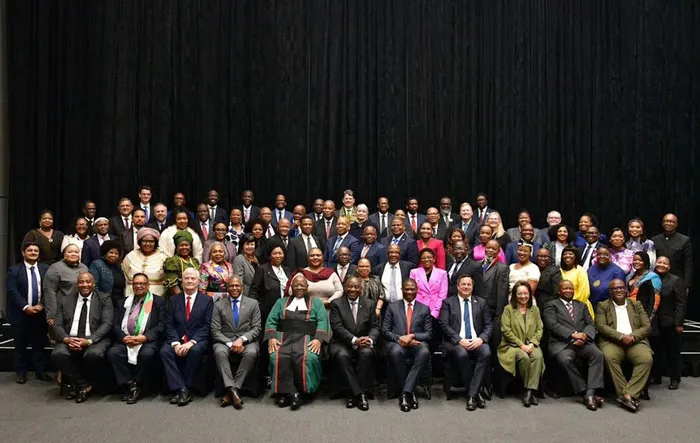
Deputy president Cassel Mathale reveals no duties assigned, reigniting debate over costly, ceremonial positions. Analysts and opposition call on Ramaphosa to trim South Africa’s bloated Cabinet.
Image: X / South African Government
Pressure is mounting to abolish South Africa’s deputy minister positions after Deputy Police Minister Cassel Mathale revealed that he and fellow deputy minister Polly Boshielo have had no official responsibilities for over a year since their appointment by President Cyril Ramaphosa.
Testifying before Parliament’s Ad Hoc Committee on Wednesday, which is investigating allegations of corruption and political interference within South Africa’s criminal justice system, Mathale revealed that suspended Police Minister Senzo Mchunu had yet to delegate any duties to either of them since their appointments in June last year.
“The minister is still getting to grips with his role, and no tasks have been assigned to me or Deputy Minister Boshielo,” Mathale told the committee.
His testimony has sparked fresh criticism from activists, economists, and political analysts, who argue that deputy minister positions are largely ceremonial, financially burdensome, and politically motivated.
Speaking on the matter, activist and Citizens Forum spokesperson Dennis Bloem said the country does not need deputy ministers.
“I want to repeat that I don't even know some of these Deputy Ministers and what they are doing,” Bloem said.
He urged Ramaphosa to remove all deputy ministers, arguing that they “are just a burden to the taxpayers of this country” and “add no value at all.”
Political analyst Good Enough Mashego also chipped in and offered historical context of the under-fire deputy ministers.
Mashego explained that the role of deputy ministers was initially meant for mentorship during South Africa’s first Government of National Unity (GNU) in 1994 ,not for executive authority.
“The reason deputy ministers don’t have executive power is that you can’t give executive authority to someone who’s essentially an understudy. The minister holds executive power, the deputy minister does not,” Mashego told IOL News.
He said that the role was also about mentorship and political balancing in the early GNU but argued that in the current dispensation, the posts have become a form of political patronage.
Mashego voiced concerns about public confidence and government efficiency, pointing to the cost and perceived irrelevance of deputy ministers.
“It erodes public confidence because when you are going to dissolve units of the CPS to save money, when people know that their biggest fruitless expenditure is that of deputy ministers and their staff, it makes people wonder to say, why should we tighten belts when government is not tightening its belt?” he said.
Financially, deputy ministers are a costly component of the executive.
Each deputy minister receives an annual salary of R2.22 million, up from R2.16 million following a 2.5% salary increase gazetted by The Presidency, retroactive to April 1, 2024.
This translates to a monthly salary of R185,000 per deputy minister.
With two deputy ministers in the South African Police Service (SAPS), the total monthly cost to the Cabinet is R370,000, or R4.44 million annually.
Across 43 deputy ministers, the collective salary bill exceeds R94 million per year, excluding staff and operational costs.
Meanwhile, economic expert, Professor Jannie Rossouw of Wits Business School supported the critique, saying that South Africa’s executive is “simply too big” and that deputy minister positions often represent avoidable expenditure.
Rossouw told IOL News that the lack of defined responsibilities among senior officials undermines the efficiency and cost-effectiveness of government programs.
“The government cannot raise taxes any further. It is therefore necessary to embark on a savings programme and reducing the size of the executive will set an excellent example,” he said.
Political parties, including ActionSA has long called for constitutional reform to abolish deputy ministers.
ActionSA parliamentary leader and MP Athol Trollip said Mathale’s testimony before Parliament’s Ad Hoc Committee underscores the redundancy of the posts.
“This is not only an admission of redundancy but also a damning reflection of how bloated and wasteful our executive has become under the GNU, where all parties appear more interested in appeasing political interests than serving South Africans,” Trollip said.
He highlighted the practical consequences of the current system, saying that when the Mchunu was placed on leave, Ramaphosa appointed an acting minister, Professor Firoz Cachalia from outside Cabinet rather than one of the deputy ministers.
“This extraordinary decision underscores the utter irrelevance of these posts and the absence of confidence in those occupying them,” he said.
The party’s proposed constitutional amendment aims to remove deputy ministers entirely.
Trollip emphasised that South Africa cannot afford “ceremonial positions that serve no practical function while our schools are overcrowded, our hospitals understaffed and our police under-resourced.
''Every cent that sustains this wasteful layer of bureaucratic excess is a cent stolen from the fight against poverty, unemployment and crime.”
Pressure continues to build on Ramaphosa to reduce his Cabinet, which critics say is bloated with 32 ministers and 43 deputy ministers.
hope.ntanzi@iol.co.za
IOL Politics