

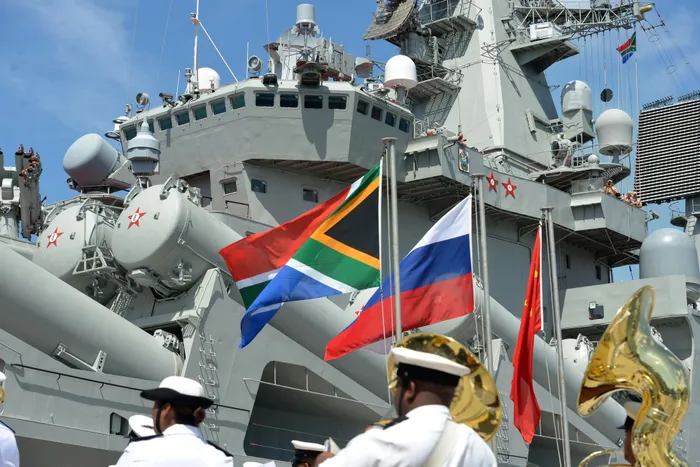
The SANDF earlier this week announced that China will lead the “Joint, Interagency, Inter-departmental, Multinational Exercise” that will be hosted in South African waters from January 9 to 16.
Image: File
The DA has raised concerns about South Africa hosting the joint naval exercise, which is called Will for Peace 2026, with other countries of the BRICS Plus group later this month.
This comes after the South African National Defence Force (SANDF) earlier this week announced that China will lead the “Joint, Interagency, Inter-departmental, Multi-national Exercise” that will be hosted in South African waters from January 9 until the 16th.
“Exercise Will for Peace 2026 brings together navies from BRICS Plus countries for an intensive programme of joint maritime safety operations, interoperability drills, and maritime protection serials,” said a statement issued by Brigadier General Nditsheni Singo, acting general officer Commanding Joint Operational Headquarters.
Singo also said the participating nations - which include South Africa, China, Russia, and Iran - have jointly agreed on the exercise theme “Joint Actions to Ensure the Safety of Shipping and Maritime Economic Activities”.
“This theme reflects the collective commitment of all participating navies to safeguard maritime trade routes, enhance shared operational procedures, and deepen cooperation in support of peaceful maritime security initiatives,” he said.
Last year, a multinational naval exercise called Exercise Mosi, which was scheduled for November 2025, was postponed to avoid clashing with the G20 Summit.
DA MP Chris Hattingh said in a statement that the SANDF’s announcement of Exercise Will for Peace 2026 did not address the concerns raised when the November exercise was postponed.
“MOSI III was postponed because of its political and diplomatic sensitivity ahead of the G20 Summit. That sensitivity has not disappeared. It now appears the same strategic exercise is simply continuing under a new name and softer language,” Hattingh said.
He also said the Will for Peace exercise was being led by China and included participation by Russia and Iran, which were both heavily sanctioned and both involved in active conflicts.
“Hosting and training with such forces cannot be described as neutral or non-aligned. It is a political choice, whether the government admits it or not.”
Hattingh said calling the exercise “Will for Peace” does not change the reality.
“At the same time, China is conducting large-scale military exercises rehearsing a possible invasion of Taiwan. Using the language of peace to describe this kind of military alignment is misleading,” he said, adding that South Africa’s policy of non-alignment was losing credibility because its words and actions no longer matched.
He noted that Parliament has not been properly briefed on the “Will for Peace” exercise, its costs, command structure, legal status, or diplomatic consequences.
He described such a move as being unacceptable.
“These decisions affect South Africa’s foreign relations, trade, security, and reputation. And they cannot be made behind closed doors.”
Hattingh said he would request a full parliamentary briefing on exercise Will for Peace 2026, including its objectives, participants, leadership, costs, and implications.
“South Africa’s defence and foreign policy must be transparent, constitutional, and principled, and certainly not quietly reshaped through military exercises that contradict our stated neutrality and damage our standing in the world.
“As more time goes on, South Africa’s BRICS membership has rendered South Africa a pawn in the power games being waged by rogue states on the international stage,” said Hattingh.
mayibongwe.maqhina@inl.co.za