

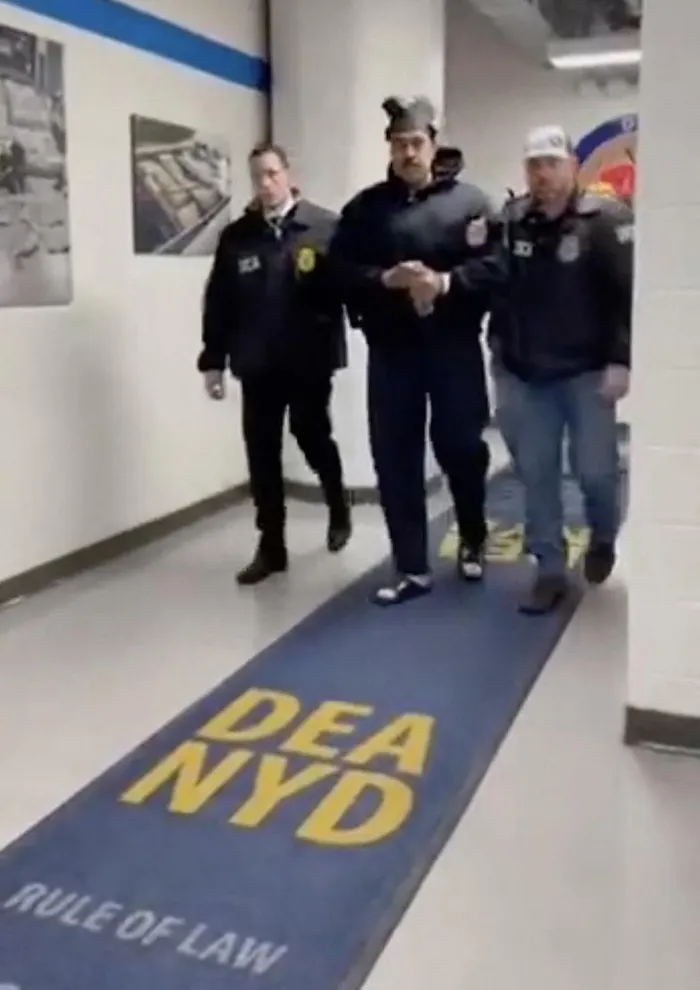
This screengrab taken from the X account of Rapid Response 47, the official White House rapid response account, shows Venezuelan President Nicolas Maduro escorted by DEA agents inside the headquarters of the US Drug Enforcement Administration (DEA) in lower Manhattan, New York, on Saturday.
Image: AFP
South Africa has accused the United States of abducting Venezuelan President Nicolás Maduro and his wife during a military operation in Venezuela, warning the move risks normalising the unlawful use of force in international relations.
Delivering South Africa’s statement to the United Nations Security Council on Monday, acting Deputy Permanent Representative Jonathan Passmoor said the unilateral action by the US violated the sovereignty, territorial integrity, and political independence of Venezuela.
“The unilateral military strikes carried out by the United States of America against Venezuela and the abduction of President Nicolás Maduro and his spouse from Venezuelan territory wantonly violates the sovereignty, territorial integrity and independence of Venezuela,” Passmoor told the Council.
South Africa said the actions were contrary to the United Nations Charter, which prohibits the use of force except in cases of self-defence or when authorised by the Security Council.
“The prohibition on the use of force is a cornerstone of the United Nations Charter,” Passmoor said. “Its violation undermines the very foundations of the rules-based international order.”
South Africa's statement rejected any suggestion that the operation could be justified as law enforcement or accountability for alleged criminal conduct.
“No state may enforce its domestic laws on the territory of another sovereign state without its consent or authorisation from this Council,” Passmoor said.
“Allegations of criminality, governance failures or human rights violations — however serious — do not justify the use of force.”
South Africa warned that failure to challenge such actions would entrench a dangerous precedent in international relations.
“If such actions are allowed to stand, we risk normalising the use of force outside the strict confines of international law,” Passmoor said.
“This would signal a return to a system where might makes right.”
The statement said the consequences of such a shift would be particularly severe for smaller and developing states, which rely on international law for protection against coercion.
South Africa also cautioned that military interventions have repeatedly resulted in prolonged instability rather than peace.
“We have seen this movie before,” Passmoor said. “From Iraq to Libya, the use of force has often deepened crises, destroyed institutions and left lasting instability.”
Calling for restraint, South Africa urged the Security Council to uphold its responsibility to maintain international peace and security and to prioritise dialogue and peaceful resolution.
“The future of Venezuela must be determined by the Venezuelan people themselves,” Passmoor said. “It cannot and must not be decided through external military intervention.”
The United States has defended its actions as necessary, but several Security Council members have raised concerns about the legality of the operation and the precedent it may set for the international system.
jonisayi.maromo@iol.co.za
IOL News