

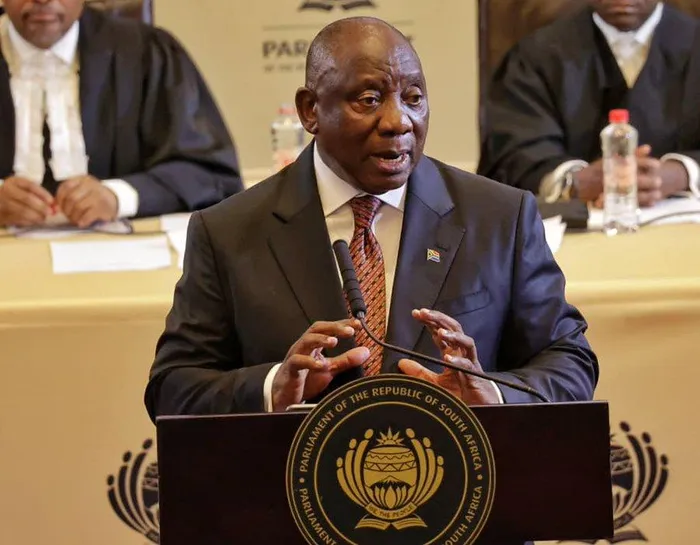
President Cyril Ramaphosa will deliver the 2026 State of the Nation Address at the Cape Town City Hall next Thursday at 7pm.
Image: GCIS
As South Africa braces for President Cyril Ramaphosa’s 2026 State of the Nation Address (SONA) at the Cape Town City Hall on Thursday, various parties, unions, and civil society organisations have articulated their hopes and expectations.
SONA is anticipated to not only reflect on government promises from the last year, but also outline new priorities for the coming year at the opening of Parliament.
Parties will debate SONA on February 17 and 18, followed by a reply from Ramaphosa on February 19.
In an engagement with labour leaders, Ramaphosa expressed a commitment to being candid about the nation’s progress in achieving set goals as encapsulated in the Medium Term Development Plan.
“We will also seek to look back and see how far we have gone. Have we been able to move the needle? Have we been able to achieve certain things we said we would do? We will delve more directly into the state of the people of South Africa and the challenges we face as a nation.
“We do so in an honest and measure of humility as well and look at shortcomings, including failures we had to go through as it happens in life that as you set goals, there are times where you don’t achieve the goals you would have set,” he said.
Among the key voices shaping expectations is Build One South Africa leader Mmusi Maimane, whose primary concern is crime.
“The president can make many promises, including job creation. What the president needs to do is to stabilise the police. There can be no economy if there is crime,” Maimane said.
He urged Ramaphosa to present a concrete plan for the South African Police Service (SAPS), including the announcement of a permanent Police Minister and additional resources for police operations.
Maimane also highlighted the pressing need for improvements in education and attracting investment to bolster the economy.
DA spokesperson on Home Affairs Adrian Roos said his party expected the Department of Home Affairs to feature prominently in the address.
Roos noted that Home Affairs is one of the few departments that was able to point to measurable progress in reforming service delivery and supporting economic growth.
“The DA expects the SONA 2026 to reflect advances made by Home Affairs under Minister Leon Schreiber in clearing long-standing visa and permit backlogs, cutting down illegal border crossing attempts, expanding visa schemes, and rolling out digital systems aimed at reducing red tape while strengthening security,” Roos said.
He also said the DA expected progress on integrating Home Affairs services into bank branches and digital platforms to be highlighted.
“Equally important is the replacement of the green ID book and the rollout of secure digital identity systems to protect the integrity of the National Population Register and combat identity fraud,” said Roos.
Cosatu said it was fundamental that the government respond decisively to the cries and hopes of the working class and society in general.
“SONA and government’s plans for the year must be anchored upon tackling our dangerously high unemployment rate of 42.4% and sluggish 1% economic growth, entrenched levels of poverty and inequality, and endemic crime and corruption,” said Cosatu’s parliamentary coordinator Matthew Parks.
Parks highlighted the encouraging progress in tackling load shedding.
“It is critical that further support be given towards reducing the increasingly unaffordable price of electricity.”
He added that the positive turnarounds being achieved at Transnet and Metrorail should be accelerated, including helping Transnet reduce its debt burden, expediting infrastructure investments, and putting in place tight security to protect commuters and property.
“Decisive turnaround plans need to be actioned for struggling state-owned enterprises, in particular Denel, the South African Broadcasting Corporation, Post Office, and Postbank, which continue to struggle under incompetent and weak management.”
Parks said while the obstacles hindering economic growth are tackled, relief for the poor and unemployed must be enhanced, in particular raising the SRD Grant to the food poverty line and expanding the Presidential Employment Stimulus.
“Other public employment programmes must be overhauled to ensure compliance with the National Minimum Wage and that they deliver the skills, experience and confidence needed for their participants to find permanent decent work or become entrepreneurs,” he said.
Lobby group Amandla.mobi called on Ramaphosa to prioritise the marginalised majority and restore their humanity and dignity by implementing the Basic Income Grant.
“We hope your 2026 SONA will bring real solutions for the unaffordable cost of living. Food is expensive. Month to month, millions in Mzansi cannot afford to buy healthy, nutritious food for themselves and their families,” said the lobby group.
mayibongwe.maqhina@inl.co.za