

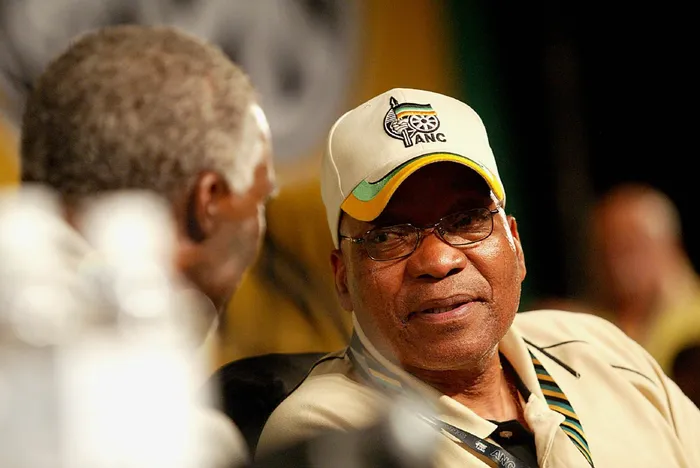
Former presidents Thabo Mbeki and Jacob Zuma, as Parliament hears testimony alleging that law enforcement structures were used during their feud in an attempt to prevent Zuma from ascending to the presidency.
Image: Bongiwe Mchunu
Former police reservist Paul O’Sullivan has told Parliament that former national police commissioner Jackie Selebi flouted the South African Police Service Act by simultaneously serving as a senior African National Congress (ANC) politician while leading the police.
Testifying before Parliament’s ad hoc committee probing alleged interference, corruption and misconduct within the South African Police Service (SAPS) and the broader law enforcement apparatus, O’Sullivan said Selebi’s role as a member of the ANC National Executive Committee directly contravened legislation prohibiting police officials from active political involvement.
“Part of the problem is the Police Service Act makes it clear that no police official may be an active politician. At the time Jackie Selebi was the commissioner of the police, he was also a member of the National Executive Committee of the ANC. So now suddenly the rules of the Police Service Act were being flouted,” O’Sullivan said.
He told the committee that this breach of the law had far-reaching consequences for policing and criminal justice, particularly during the period of intense political rivalry between former president Thabo Mbeki and his deputy and successor Jacob Zuma.
O’Sullivan told the committee that the political feud between former president Thabo Mbeki and Jacob Zuma, which came to a head in the run-up to the ANC’s decisive 2007 Polokwane conference, created conditions in which law enforcement and prosecutorial processes were allegedly used in an attempt to prevent Zuma from ascending to the presidency in the period between 2005 and 2008.
O’Sullivan said the feud created fertile ground for political interference in criminal investigations, especially at a time when the now-disbanded Scorpions were investigating high-level corruption cases.
“Not only that. You have heard of the so-called spy tapes. The spy tapes make it clear that there was a concerted effort on the part of certain persons, one of them being the then head of the Scorpions, a chap by the name of Leonard McCarthy,” O’Sullivan said.
“The spy tapes show his conversation with a person by the name of Andre Pienaar who is based in London. They used code words, but it demonstrated their plan to get Selebi off the hook and get Zuma on a hook.”
The so-called spy tapes later became central to legal challenges involving Zuma, who argued that political interference had tainted the timing of corruption charges against him. The recordings were cited when charges against Zuma were controversially withdrawn in 2009, a decision later overturned by the courts.
The recorded conversations were cited as the basis for withdrawing fraud and corruption charges against Zuma shortly before he was sworn in as president in 2009. At the time, acting National Director of Public Prosecutions Mokotedi Mpshe said the recordings indicated a political conspiracy against Zuma, rendering the prosecution untenable.
O’Sullivan said the recordings also reflected hostility towards him as an investigator.
“In the process, the problem that they had was this individual by the name of O’Sullivan. In those spy tapes, it is stated categorically, ‘Let us not worry about O’Sullivan, we will bring somebody in that will deal with him decisively.’ I felt that I did the right thing,” he said.
O’Sullivan said his investigation into Selebi was driven by principle rather than politics.
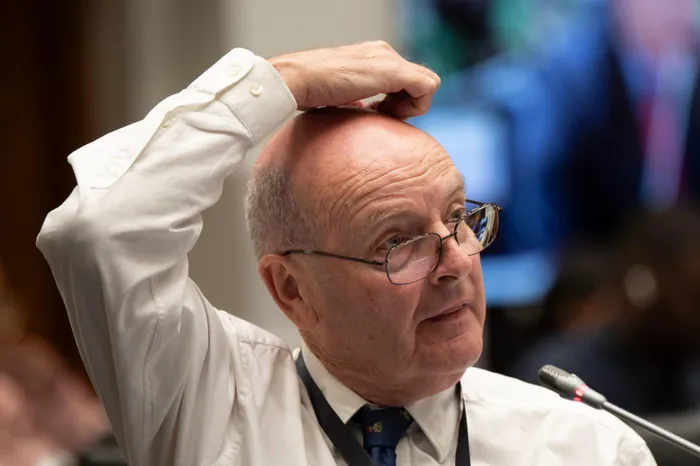
Private forensic investigator and self-described whistleblower Paul O'Sullivan appearing before Parliament's Ad Hoc Committee probing allegations of corruption, interference, misconduct, and systemic failures within the South African Police Service (SAPS) and the broader criminal justice system.
Image: Armand Hough / Independent Newspapers
“I had carried out the investigation which triggered the production of the evidence which led to Jackie Selebi being arrested and charged. I had started the work which became the catalyst for the criminal charges which he faced,” he said.
“I wanted to live in a country where there is the rule of law. I didn’t want to live in a country where a chief of police could be so corrupt that he could enter into an agreement that could assist a sitting president to arrest and charge a future possible president.”
“At the time I didn’t know who was to become president. I didn’t know Jacob Zuma from a bar of soap,” he added.
Selebi was convicted of corruption in 2010 and sentenced to 15 years’ imprisonment after being found guilty of receiving payments from convicted drug trafficker Glen Agliotti. He later died in 2015 after being released on medical parole.
O’Sullivan also outlined his involvement in investigations that led to the seizure of drugs valued at about R200 million and the arrest of Agliotti, whose prosecution became central to the case against Selebi.
Following Agliotti’s arrest, several individuals linked to the drug trafficker entered plea agreements with prosecutors, disclosing evidence of payments allegedly made to Selebi, which were later presented during his trial.
The committee is examining whether political interference and senior-level misconduct undermined key investigations within SAPS and other law enforcement agencies, with O’Sullivan’s testimony forming part of a broader inquiry into systemic failures during one of the most politically charged periods in South Africa’s democratic history.
jonisayi.maromo@iol.co.za
IOL News