

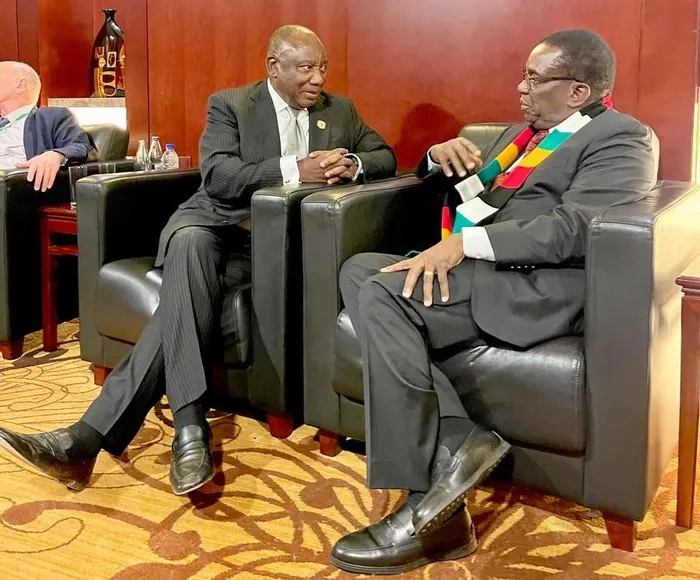
President Cyril Ramaphosa and Zimbabwean President Emmerson Mnangagwa during a meeting on the sidelines of the AU Summit in Addis Ababa, an image that sparked discussion on social media.
Image: PresidencyZA
President Cyril Ramaphosa has sparked mixed reaction online — not only for calling Zimbabwean counterpart Emmerson Mnangagwa “my brother”, but for the image and body language captured during their meeting on the sidelines of the African Union Summit in Addis Ababa.
Ramaphosa, who was attending the 39th Ordinary Session of the African Union Assembly, posted on X and Facebook that he had enjoyed “good catching up with my brother President @edmnangagwa on the margins of the #AUSummit”.
The Presidency also shared images of the engagement, stating that the two leaders met at the AU Headquarters in Addis Ababa and adding the hashtag #BetterAfricaBetterWorld.
The summit itself has focused on peace and security across the continent. In his address, Ramaphosa raised concerns about unconstitutional changes of government and instability in Sudan, South Sudan and the Democratic Republic of Congo, reaffirming South Africa’s commitment to constitutional order and continental stability under Agenda 2063.
Mnangagwa had earlier posted about his own arrival in Ethiopia, writing: “I have arrived in Addis Ababa, Ethiopia, to attend the 39th Ordinary Session of the African Union Summit of Heads of State and Government. The Summit provides an important platform for advancing continental priorities and strengthening cooperation among Member States as we shape Africa’s collective future.”
While bilateral meetings at continental gatherings are routine, Ramaphosa’s picture of the two leaders in deep "brotherly" conversation prompted varied responses online.
Outspoken Zimbabwean opposition activist and former MP Fadzai Mahere described the optics as “a slap in the face to the masses”.
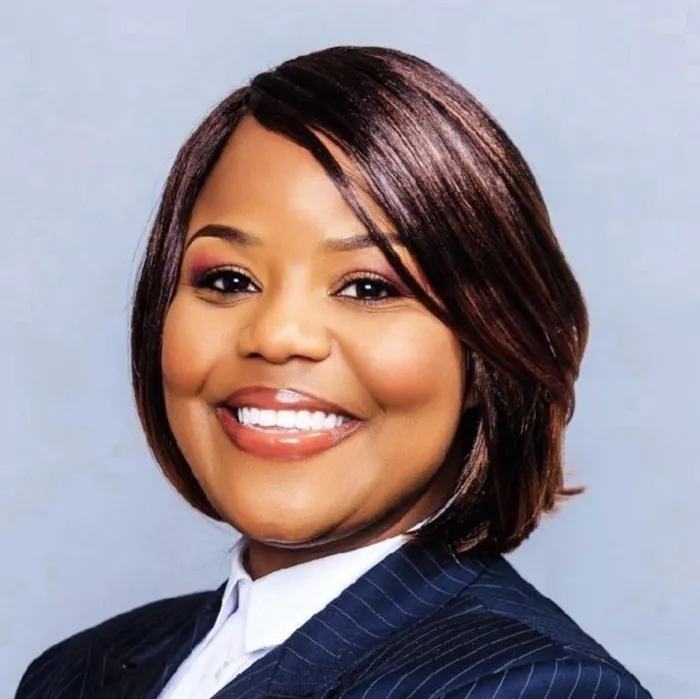
Outspoken Zimbabwean opposition activist and former MP Fadzai Mahere
Image: Facebook
In a lengthy Facebook post, Mahere argued that there could be no “better Africa” or “better world” if African leaders fail to hold one another accountable. She accused political elites of prioritising staying in power over addressing corruption, governance failures and economic hardship.
She questioned why young Africans should have to fight repeated battles over issues such as presidential term limits and credible elections instead of focusing on technological advancement and economic expansion.
“How many wars of liberation must be fought in a single generation?” she asked.
Mahere further criticised what she described as corruption and self-inflicted poverty, arguing that future generations would one day calculate “reparations” owed to them for lost opportunities. She also pointed to service delivery challenges, saying access to clean tap water in capital cities such as Harare and Johannesburg should not be a luxury.
“There’s nothing in it for the people,” she concluded. “We need new leaders.”
Others, however, welcomed the meeting.
On Facebook, Motumi Mokoena said he hoped discussions would focus on Southern African integration and improved regulation of movement between countries.
“I hope they speak about Southern integration to make it easier to regulate free movement between countries. We need one type of ID,” he wrote, adding that Zimbabwe needed to improve financially and economically to create greater regional stability.
Another Facebook user, Mims Gilroy Mpetha, described the interaction as “The Real Rainbow Nation.”
Mpho Raphunga reflected on the imagery of the two leaders seated together, writing: “If you cannot see the way they sit, you will never understand why we are neighbours.”
Fungai Kaparadza struck a historical tone, saying: “Zimbabwe carries a powerful history of liberation and strength. As Africa rises, Zimbabwe stands as a reminder that true independence, unity, and self-belief will shape our continent’s future.”
However, Kaparadza added that Ramaphosa’s remark could also be seen as “a form of diplomatic deflection.”
At the summit, the official focus has been continental peace, security and cooperation.
Online, however, it was one word — “brother” — that generated the most conversation.
jonisayi.maromo@iol.co.za
IOL News