

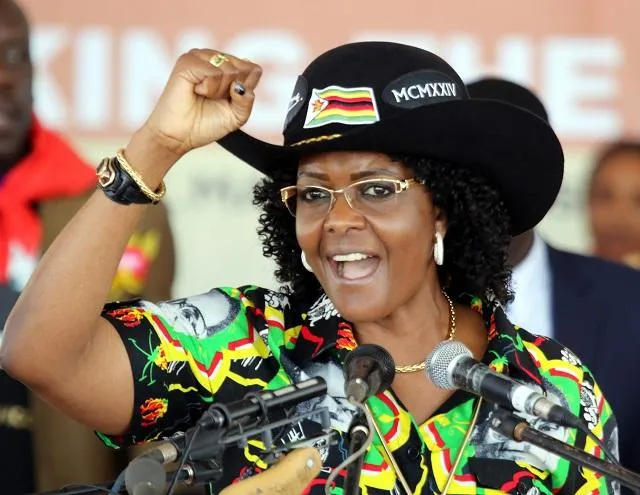
Grace Mugabe’s 2017 assault case in Johannesburg involved her sons and ended with a controversial grant of diplomatic immunity by then minister Maite Nkoana-Mashabane, which was later dismissed by the courts.
Image: The Herald Zimbabwe
As late former Zimbabwean president Robert Gabriel Mugabe's youngest son Bellarmine Chatunga Mugabe prepares to appear in court on charges of attempted murder, renewed attention has turned to his family’s previous legal controversy in South Africa.
Nearly nine years ago, his mother, Grace Mugabe, was at the centre of one of the most politically charged legal disputes involving a foreign dignitary in democratic South Africa.
In August 2017, IOL reported that Chatunga and his older brother, Robert Mugabe Jr., were in Johannesburg when an alleged altercation involving acquaintances escalated into a high-profile assault case against Grace Mugabe.
South African model Gabriella Engels alleged that she was assaulted at a luxury hotel in Sandton. IOL reported at the time that Engels claimed she was struck with an extension cord during a confrontation.
Reports indicated that the incident occurred at a hotel where Chatunga and his brother were staying. Photographs of Engels’ injuries were widely circulated in the media, sparking public outrage and prompting police to open a case of assault with intent to cause grievous bodily harm.
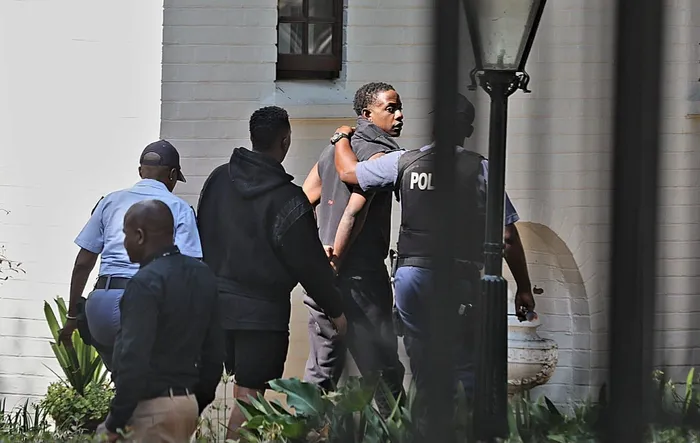
After a gardener was shot and seriously hurt at a Hyde Park property connected to Bellarmine Chatunga Mugabe, Gauteng police have detained two men for interrogation.
Image: Timothy Bernard/ Independent Newspapers
The matter quickly escalated into a diplomatic storm.
Then Minister of International Relations and Cooperation, Maite Nkoana-Mashabane, granted Grace Mugabe diplomatic immunity shortly after the incident.
The decision allowed her to leave South Africa while the criminal matter remained pending and triggered widespread criticism from civil society organisations and opposition parties, who argued that the immunity was improperly granted.
Grace Mugabe departed South Africa soon after the immunity decision, in what was widely described as a hasty exit amid mounting legal and political pressure.

Former minister of international relations and cooperation, Maite Nkoana-Mashabane
Image: GCIS
In 2018, the High Court in Pretoria ruled that the decision to grant Grace Mugabe diplomatic immunity was unlawful and unconstitutional.
The court found that she did not qualify for immunity under the Vienna Convention on Diplomatic Relations and that the minister’s decision was inconsistent with South Africa’s legal framework.
The judgment was widely viewed as a significant affirmation of the rule of law and clarified that diplomatic immunity is not automatic and must comply with strict legal requirements.
An arrest warrant was subsequently issued in connection with the assault case, but Grace Mugabe has not returned to South Africa since leaving the country in 2017.
The assault saga unfolded during a turbulent period in Zimbabwean politics.
Just months after the incident, her husband, Robert Mugabe, was unceremoniously removed from office in November 2017 after 37 years in power. He died in Singapore in 2019.
At the time, analysts noted that the legal controversy in South Africa added to the mounting political pressure surrounding the Mugabe family during the final months of his presidency.
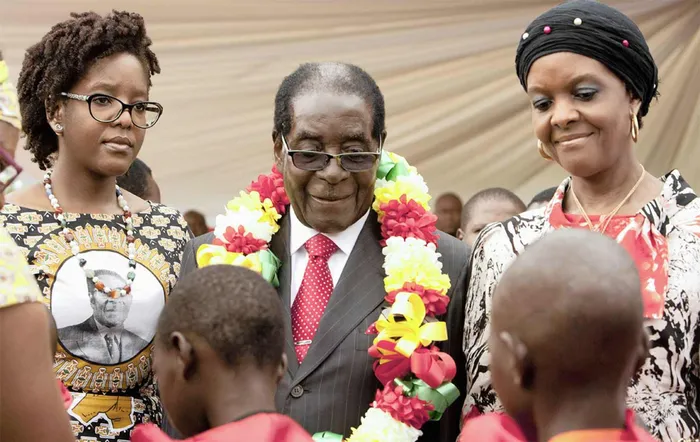
President Robert Mugabe with first lady Grace Mugabe and his daughter, Bona, left, at his 91st birthday celebrations in Victoria Falls.
Image: AFP
“Primarily, there is no grounds for diplomatic immunity. Robert Mugabe is just a former president and he is gone. There are no treaties that really address a situation like this. Secondly, this is a purely criminal act and you cannot invoke the Vienna Convention or any diplomatic immunities under these circumstances,” Chitanga said.
He stressed that members of the Mugabe family residing in South Africa do so as private individuals rather than as accredited representatives of the Zimbabwean government.
“This is why Grace Mugabe is facing prosecution in South African courts. This is the family of a former president. They might live in South Africa but not as officials of the government of Zimbabwe, but as individuals. The Vienna Convention and any other instruments that cover diplomatic immunity tend to relate to the role of individuals as state actors, representatives of sovereign governments,” he said.

International Relations expert, Dr Gideon Chitanga.
Image: Screengrab/SABC
Chitanga added that even if a diplomatic passport is held, that does not automatically confer immunity from prosecution.
“He must be on a diplomatic passport. That status may not have changed after the death of his father. Diplomatic passports have different terms. Under the circumstances, he is not a representative or associated with any representative of any government. Secondly, he faces serious crimes in South Africa. I do not see any legal route that could let him escape this situation,” Chitanga said.
“The only thing that can happen, subject to the rule of law in South Africa, you could think of some political kind of intervention from the government of Zimbabwe. They may reach out to the government of South Africa to manage the issue in a different way. But in strict legal terms, he is really facing a serious situation.”
“Diplomatic passports do provide different levels of immunity to the passport holders. However, in this case, there are serious criminal allegations, so I don't think that there is any room to invoke diplomatic immunity status. The law will have to apply as is, even if you hold some diplomatic status that is protected. Remember the Grace Mugabe case. Her diplomatic status was suspended in South Africa to allow for her to go for trial.”
jonisayi.maromo@iol.co.za
IOL News