

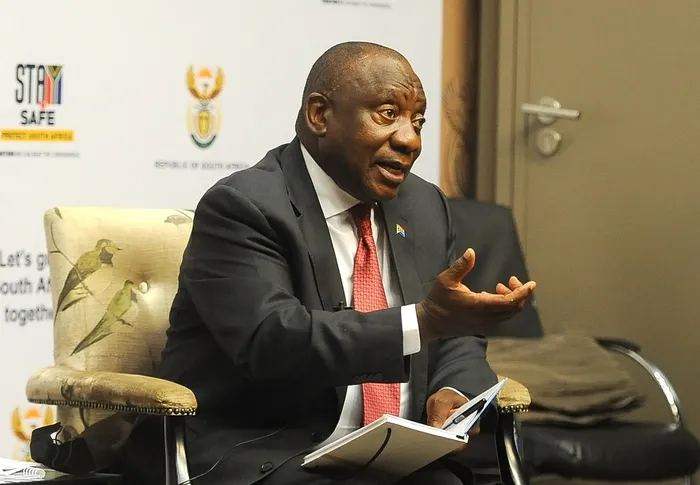
President Cyril Ramaphosa has been fighting to keep the CR17 and Phala Phala records out of the public space.
Image: Phando Jikelo
Since taking office, President Cyril Ramaphosa has secured court orders to keep several sensitive records confidential, most notably those linked to his 2017 ANC presidential campaign, widely known as the CR17 campaign.
He has also barred access to information relating to the Phala Phala farm robbery. These records have been the subject of multiple court battles regarding transparency and financial oversight.
The Pretoria High Court ruled that the bank statements and records, which detailed nearly R1 billion in funding, should remain confidential, a decision later upheld by the Constitutional Court. Political analyst Professor Sipho Seepe said an “entire establishment had everything to do with the CR17 campaign”.
He said this led to Ramaphosa not being “in a position to serve the interests of the public, but to advance the interests of those who campaigned for his presidency”.
“This is all about his donors, and what is more dangerous is the privatisation of the state-owned entities. He is essentially selling the country and the capacity of the state to deliver so that the interests of donors are advanced,” said Seepe, following Ramaphosa's announcement during his State of the Nation Address that the government is pushing ahead with the full unbundling of Eskom.
Another political analyst, author, and researcher, Prince Mashele, said Ramaphosa received approximately R1 billion from “white business interests” to secure his position as ANC president, at the expense of investing in the country and the economy.
Speaking on the Truth Report podcast, Mashele said this funding was a primary source of Ramaphosa's power during the 2017 ANC elective conference.
In August 2019, Deputy Judge President Aubrey Ledwaba ordered that the bank statements and documents regarding the R1 billion CR17 campaign funding be sealed from public access primarily because Ramaphosa’s legal team argued that the documents contained confidential, private third-party information and were unlawfully obtained by the Public Protector.
Ramaphosa’s lawyers argued that the bank statements, including those from the Ria Tenda Trust, Linked Environmental Services, and the Cyril Ramaphosa Foundation, contained sensitive, private information about donors who did not consent to their details being made public.
The legal team argued that there was no evidence that the then Public Protector, Busisiwe Mkhwebane, had subpoenaed the records from banks like Standard Bank and Absa, casting doubt on the legality of how she obtained the documents in the first place.
Ledwaba facilitated the sealing following a request from the president’s lawyers, with the intention of allowing them to review the Rule 53 record (the documents used by the Public Protector to reach her findings) and identify which specific documents they objected to being public.
The sealing was initially intended to allow for a proper legal determination of whether the records should be public, particularly in light of the argument that the Public Protector had acted outside her powers by accessing them.
The decision was highly contentious because the documents were believed to reveal the names of prominent donors who contributed to the campaign before the 2017 ANC elective conference.
The Economic Freedom Fighters (EFF) and other parties later challenged the seal, arguing for transparency and the public's right to know, but the High Court subsequently upheld the decision, partly because the initial investigation by the Public Protector was found to be unlawful.
Sensitive communications, including emails from campaign managers to Ramaphosa, were sealed following their publication by media outlets, which suggested he was more involved in fundraising than previously stated.
Another political analyst, Zakhele Ndlovu, said there is no transparency when it comes to campaign finance in South Africa.
“This is very dangerous because voters will never know who funds individual candidates and political parties. Who knows, maybe the country was sold to the highest bidder a long time ago, said Ndlovu.
The Sunday Independent broke the story of the CR17 statements, which showed the flow of money from the accounts to various individuals within the ANC, politics, media, and private sector. They also contained the names of prominent South Africans making donations. Some of those ended up being part of the boards of state-owned enterprises.
The Phala Phala Tax Records were also barred from being in the public domain. Despite this, there has been significant pressure to reveal tax records for the Tshivhase Trust, owner of the Phala Phala farm.
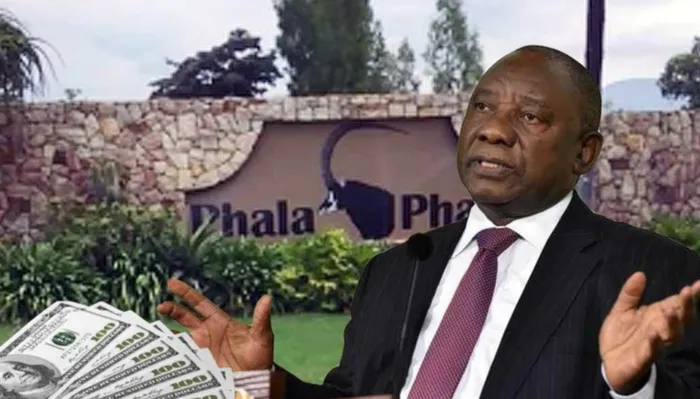
The Phala Phala saga, where millions in undeclared foreign currency were stolen from the farm of President Cyril Ramaphosa.
Image: Supplied
The Phala Phala scandal came to the fore when former head of the State Security Agency, Arthur Fraser, lodged a criminal complaint against Ramaphosa for defeating the ends of justice by committing breaches of the Prevention of Organised Crime Act and the Prevention of Corrupt Activities Act. This was after a robbery at his farm, which was not reported to the police.
Fraser revealed that thousands of American dollars were stashed in couches and mattresses and were stolen from the farm. While the president maintained the money was linked to a legitimate game sale, questions persisted about possible money laundering, tax compliance, and the conduct of security officials who handled the matter outside normal policing processes.
In January, ActionSA said it was preparing a legal challenge that could force fresh scrutiny of events the state has tried to seal off from public view. ActionSA National Chairperson, Michael Beaumont, said they had begun preparing legal papers to challenge the Independent Police Investigating Directorate’s (IPID) decision to classify its investigation report as “Top Secret”.
The party’s action follows an appeal lodged in December, which IPID failed to respond to. ActionSA said the silence forms part of a broader pattern of obstruction that has marked its efforts since April 2025 to obtain the report. Those efforts were repeatedly delayed, including explanations from IPID that its email systems were down.
Beaumont said the party’s legal challenge would take a three-pronged approach. It will contest the constitutionality of the Minimum Information Security Standards (MISS) Cabinet policy governing document classification, challenge the rationality of IPID’s decision to label the report Top Secret, and ask the court to compel IPID to release it.
Beaumont argued that the MISS policy grants excessively broad powers to state officials to withhold information from the public, powers he said were incompatible with constitutional requirements for transparency.
He pointed to provisions allowing classification where disclosure may “seriously damage operational relations between institutions”.
“It was ridiculous that a wide number of state officials are free to keep government reports out of public scrutiny if a report may offend another government institution,” Beaumont said.
In response to a parliamentary question, then Police Minister Senzo Mchunu said the report was classified because its release could damage inter-institutional relations or disrupt operational planning.
“The Investigation Report has been classified ‘Top-Secret’ in terms of paragraph 3.4.4 of the Minimum Information Security Standards (MISS), and as such, until it is accordingly declassified, it would not be released for public consumption,” Mchunu had said.
ActionSA rejected the justification, arguing there is no credible basis to claim operational harm nearly six years after the robbery.
During his testimony before the Madlanga Commission and Parliamentary Ad Hoc Committee, KwaZulu-Natal Police Commissioner Nhlanhla Mkhwanazi said Mchunu did not have the authority to classify the report.
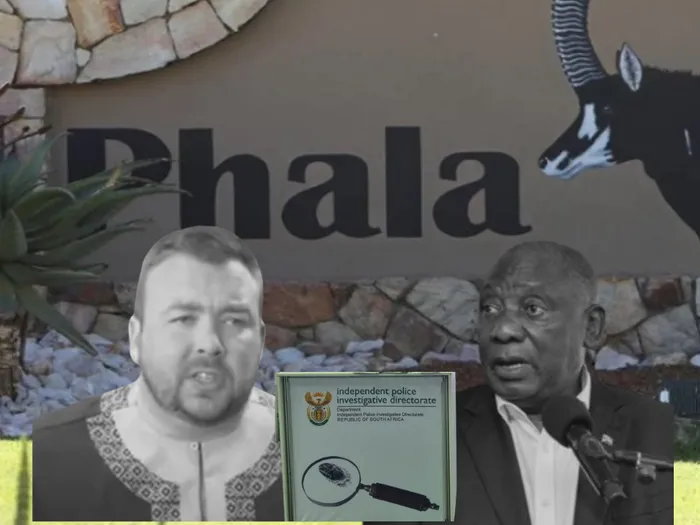
ActionSA has lodged a formal appeal against the Independent Police Investigative Directorate’s decision to refuse the unsealing of its investigation report into the conduct of members of the Presidential Protection Unit in relation to the Phala Phala matter.
Image: IOL Graphics
Mkhwanazi questioned why the report would be classified as “Top Secret” by the minister when IPID is not an intelligence agency.
He also questioned whether Mchunu himself had the necessary security clearance to classify a document as “Top Secret”, suggesting that if a minister could simply decide to classify a document and withhold it from the public, the system could be manipulated.
In October 2024, the National Prosecuting Authority (NPA) announced that it would not pursue criminal charges against Ramaphosa, citing insufficient evidence of money laundering or tax evasion after investigating the $580,000 cash theft.
The trial against three individuals accused of breaking into the farm and stealing the foreign currency is active and has been adjourned to February 2026. Testimony in this trial has included details about large, suspicious deposits into the accounts of the suspects after the robbery.
While not currently “sealed” in the same manner as the CR17 records, they remain a subject of intense legal and public scrutiny regarding transparency.
According to an article penned in 2023 for Webber Wentzel by Carryn Alexander and Sakiwe Canca, ordinary citizens are able to request access to a taxpayer's tax records using the mandatory 'public interest override' provision in Section 46 of PAIA (Promotion of Access to Information Act).
However, a person who seeks to successfully invoke the benefits of Section 46 has formidable substantive and procedural hurdles to overcome.
“A requester would first have to convince SARS that the information contained in the records sought would (i) reveal evidence of a substantial contravention of the law or an imminent or serious public safety or environmental risk; and (ii) that the public interest in disclosure clearly outweighs any harm which that disclosure might cause. In addition, the provisions of Part 4 of PAIA mean that the individual, company, or trust whose records are the subject of a Section 46 request must be notified of it and, if the request is granted, they will be afforded an opportunity to appeal that decision,” they wrote.
Ultimately, the effect of the 'public interest override' is to provide taxpayers with a high level of confidentiality, while at the same time allowing a limited and relatively onerous basis for the lifting of confidentiality in the public interest.
Justice Narandran Kollapen pointed out that “serious criminality undermines the values of the Constitution, just as a serious and imminent environmental or health risk poses a high level of threat to the populace”.
If President Ramaphosa has, in fact, done nothing wrong with Phala Phala, then providing the public with access to the tax records of the Tshivhase Trust will conclusively prove his innocence. | Additional reporting by Manyane Manyane
karabo.ngoepe@inl.co.za