

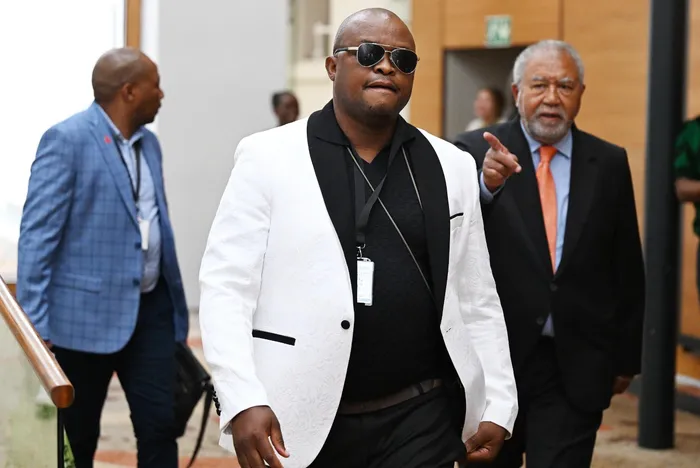
North West businessman Brown Mogotsi walking into the public hearing of the Ad Hoc Committee.
Image: Supplied / Parliament
After a two-week hiatus, the Ad Hoc Committee investigating allegations made by KwaZulu-Natal Police Commissioner Nhlanhla Mkhwanazi resumed its public hearings with a tumultuous two-day session that unfolded this week.
Witnesses included forensic fraud examiner Paul O’Sullivan, former acting national commissioner Khomotso Phahlane, and North West businessman Brown Mogotsi, whose claims and actions sparked heated exchanges and unexpected drama.
Mogotsi, who was the first to testify, stirred controversy with his remarks and admissions.
He acknowledged during his testimony that he possessed no formal qualifications and described himself as a businessman involved in food production and meat distribution.
His long history with Crime Intelligence since 1999 was disclosed as he asserted that he had been an informant and later a contact agent. Mogotsi was quizzed about the cases he mentioned in his affidavit as investigations he purportedly conducted, calling himself a government employee in the Office of the Police Minister and a complainant.
He said this was part of what he termed “legend building”.
“You create any false life provided your handler knows the operation.”
Mogotsi apologised for making statements that Mkhwanazi and Zulu King Misuzulu were Central Intelligence Agency (CIA) agents.
“I hereby apologise for casting aspersions on Lieutenant-General Mkhwanazi and King Misuzulu,” he said.
Mogotsi claimed his information that Mkhwanazi and Zulu King Misuzulu were recruited and worked for the CIA came from his handler.
“It does not necessarily mean it came from me. It came as a task to establish that since a case was opened by a royal house member,” he said.
During his testimony, Mogotsi, who previously faced attempted murder charges, said he did not believe attempted murder tenderpreneur Vusimuzi "Cat" Matlala was a criminal.
“I do not believe Cat Matlala is a member of the Big 5 and stuff,” he said.
O’Sullivan’s testimony, which followed Mogotsi’s, centred around allegations that he was a spy.
“If I was a spy, I have not done a good job of keeping a low profile. The reality is, I have never been a foreign spy. I took the oath of allegiance in South Africa when I became a citizen in 1995,” he said.
He said Mkhwanazi’s July 6, 2025 media briefing was a distraction for the alleged criminal activity at Crime Intelligence.
O’Sullivan apologised for the statement he made when he initially refused to appear before the committee, calling MPs crooks and that they rather kiss his ass.
“In the interest of peace, I withdraw the comment, and I apologise most humbly.”
O'Sullivan did not conclude his evidence because he walked out, claiming his extended testimony time expired, and that rearranging his flight would cost him.
His walkout sparked outrage from MPs, with MK Party's David Skosana appearing to block him from leaving the committee room.
The EFF has since opened a criminal case against him, and National Assembly Speaker Thoko Didiza is waiting for legal advice from Parliament before deciding on the next action to take amid calls for O’Sullivan’s arrest and contempt of Parliament.
Phahlane’s session was equally combative, as he resisted inquiries regarding a Labour Appeal Court ruling.
“My plea is, can I be allowed to traverse my affidavit?” he asked.
His request was rejected just as it was done with O’Sullivan, when he stated that he did not want to answer questions about his past.
“You are not going to write your own exam paper. You are not going to do that,” said EFF leader Julius Malema.
While evidence leader Advocate Norman Arendse was leading him through the evidence, Phahlane complained about selective references to the judgment when the dismissal of his appeal application was discussed.
“I have said it is a matter which is now before the Constitutional Court, and I don’t want to deal with issues of the judges here, respectfully.”
This set the tone of engagement between the two, as Arendse wished him good luck.
“We know that is going to be a hard road to toe,” he said.
At one stage, Phahlane took issue when probed about a forensic report that implicated him.
“You are representing Robert McBride, and you are representing the cabal you are party to. It is very clear I am not before the committee. I am before counsel,” he said.
When he was asked by committee Chairperson Soviet Lekganyane to withdraw, Phahlane did “so that we can make progress”.
Arendse expressed his disappointment with the allegation, stating that he was appointed to present evidence to the committee.
He also stated that he never met McBride until the interview for proceedings and saw O’Sullivan for the first time before the committee.
“If I were dead, I would be turning in my grave to hear I am in a cabal with Paul O’Sullivan,” said Arendse.
Phahlane would later say: “I unconditionally withdraw the comment and apologise to the honourable members of this committee and the evidence leader.”
The Ad Hoc Committee will meet to consider its programme and schedule of remaining witnesses.
mayibongwe.maqhina@inl.co.za