

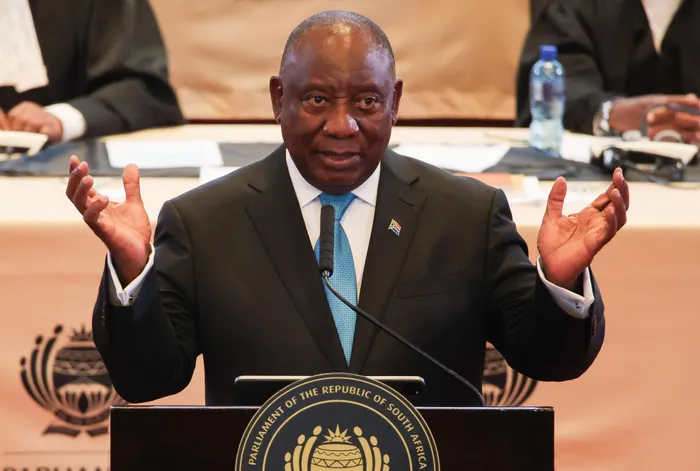
BOSA is calling for parliamentary changes to ensure President Cyril Ramaphosa answers Q&As more frequently instead of once per quarter.
Image: IOL
Build One South Africa (BOSA) has called for changes to the rules of the Parliament of South Africa that would compel the president to answer questions from lawmakers more often, arguing that the current system provides too little time for meaningful oversight.
The call comes as Cyril Ramaphosa prepares to appear before the National Assembly of South Africa for his first oral question-and-answer session of the year.
BOSA says the existing framework allows the president to spend less than ten hours annually responding to questions from Members of Parliament (MPs), which it believes is insufficient for proper accountability.
“This is a fraction of the time necessary for meaningful oversight and accountability of the country's first citizen,” BOSA spokesperson Roger Solomons said.
Under Rule 140 of the National Assembly, the president is required to appear before MPs at least once every quarter to answer questions. During these sessions, only six MPs are allowed to pose questions, and the president’s replies are typically submitted in advance. MPs may ask follow-up questions, but these are often limited by time constraints and parliamentary procedures.
Solomons argued that this structure weakens Parliament’s ability to scrutinise the executive.
“For a government that now operates with roughly 70% of Parliament forming part of the Government of National Unity, and with about one in five MPs serving as ministers or deputy ministers, this limited exposure is inadequate,” he said.
“Too often, our plenaries become political theatre filled with petty exchanges, personal vendettas and political protectionism. It leaves South Africans asking when the work of this house will truly be about them.”
BOSA says South Africa’s current approach contrasts sharply with other parliamentary democracies.
In the Parliament of the United Kingdom, for example, the prime minister appears before lawmakers every week during sitting periods for the well-known Prime Minister’s Questions session. Held on Wednesdays in the House of Commons, the format allows MPs from across the political spectrum to directly question the head of government on policy, governance and current issues.
South Africa’s parliamentary system shares many structural similarities with the UK’s Westminster-style model, but presidential question sessions occur far less frequently.
“If we are serious about fixing this, we must change both the rules and the habits,” Solomons said.
BOSA says it will begin a formal process to amend parliamentary rules so that the president appears before the National Assembly twice per quarter instead of once. If adopted, the change would require the president to answer questions from MPs eight times a year.
The party plans to ask the Speaker of the National Assembly, Thoko Didiza, to refer the proposal to the Assembly’s Rules Committee for review and consideration.
Under the proposed amendment, the revised rule would state that presidential question sessions should be:
“Scheduled in accordance with Rule 210 for a question day twice per quarter during session time within the annual programme, and the President must appear before the Assembly on those occasions to reply to questions, except where the Speaker is satisfied that exceptional circumstances beyond the President’s control make such appearance impossible.”
Beyond increasing the number of question sessions, BOSA is also proposing several changes aimed at strengthening executive accountability.
These include:
Solomons said the party believes the current system risks becoming a procedural exercise rather than a genuine tool for oversight.
“Parliament exists to hold government accountable and ensure it delivers on its commitments,” he said.
“Yet it has increasingly become a stage for polite exchanges without real follow-through. BOSA will champion these reforms to ensure that the president and deputy president are substantively accountable to Parliament, which ultimately represents the people of South Africa.”
karabo.ngoepe@inl.co.za