

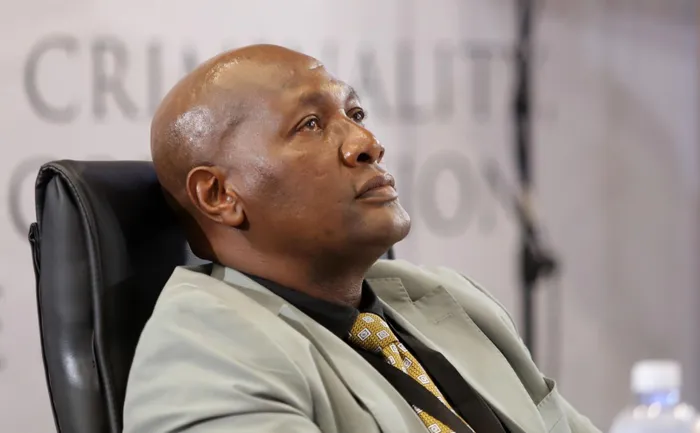
South Africa - Pretoria - 12 March 2026. Madlanga Commission of Inquiry witness Major-General Richard Shibiri testifies at the Madlanga Commission of Inquiry.
Image: Oupa Mokoena / Independent Newspapers
Suspended crime intel. Head, Maj-Gen. Richard Shibiri has rejected bribery claims linked to payments from Vusimuzi “Cat” Matlala, expressing concern after failing to clarify whether the money was meant for alcohol or to fix his son’s car.
Out of frustration, Shibiri told the Madlanga Commission on Thursday that at the Madlanga Commission, as he insisted, he is responding to questioning “out of respect”.
Shiburi came under intense cross-examination over claims that Matlala paid him tens of thousands of rand in what the commission suspects may have been a corrupt payment.
The commission heard that Witness C, in a recorded statement, alleged Matlala claimed he gave Shiburi R80,000 to assist with his promotion within the police’s crime intelligence division.
According to the statement, the payment was initially made through Black Ark Trading, but Shibiri allegedly reversed the transaction and asked that the money be provided in cash to “limit a paper trail”.
That version directly contradicts Shiburi’s explanation.
The suspended general told the commission the money was not a bribe, but a R70,000 loan from Matlala intended to help repair his son’s vehicle.
But the commission’s evidence leader, Adv. Lee Segeels-Ncube, pressed Shiburi on inconsistencies between the competing accounts.
Bank records presented to the commission revealed that Shiburi had more than R50,000 in his personal bank account shortly before he accepted the R70,000 loan from Matlala, raising questions about why he would need financial assistance.
Segeels-Ncube also referred to recordings made by Witness C in which Matlala allegedly said he would give Shibiri between R80,000 and R100,000 for “beverages”.
Earlier in his testimony, Shiburi acknowledged that some of the money had been used to buy alcohol for a celebration, further complicating his explanation.
The evidence leader also pointed out that financial records showed only one confirmed transaction linked to Shiburi’s son, despite Shiburi’s claim that the money had been transferred to his son’s account.
Matlala, according to the commission’s evidence, was uncertain about the exact amount transferred but maintained that he had made payments connected to Shiburi.
Shibiri rejected the version outright.“I gave you a bank statement showing Matlala depositing money to my son, which I gave to him,” he told the commission.
He argued that if he had intended to conceal the transaction, he could have easily routed the money through other accounts.
“If I wanted to use it because I was in Tzaneen, I could have given him my account or my sister’s account to access the money,” Shiburi said.
“So I didn’t do that and you have seen where the money went.”
At times, the exchange between Shiburi and Segeels-Ncube grew tense.
The evidence leader stressed that the commission was simply testing the different versions before it.
“We are trying to do a fact-finding here,” Segeels-Ncube told him. “We go with what we see and we put the proposition to you.”
Shibiri, however, suggested investigators were attempting to steer the narrative.
“I’m going to sit here and listen to choreographed things by investigators and whoever to switch a certain narrative,” he said.
“I deny everything here. I respond because I respect the commission.”
The proceedings are underway.
kamogelo.moichela@iol.co.za
IOL Politics