

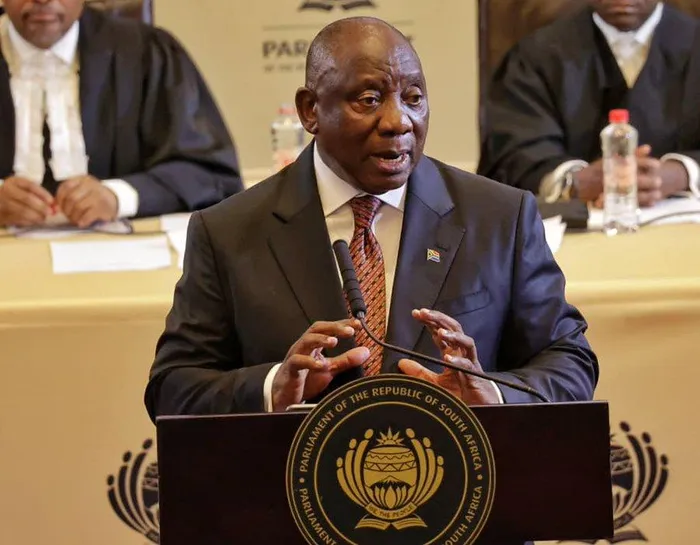
President Cyril Ramaphosa has defended his decision not to release the interim report of the Madlanga Commission.
Image: GCIS
President Cyril Ramaphosa says he will make the interim report of the Madlanga Commission public only after the commission has completed its work, and assured MPs that no one - including controversial businessman Hangwani Morgan Maumela - will be shielded from scrutiny.
Ramaphosa was responding to oral questions from members of the National Assembly on Thursday afternoon during a sitting at the Nieuwmeester Dome.
The president was replying to a question from ANC MP Ndumiseni Ntuli, who asked why the interim report of the Commission of Inquiry into Criminality, Political Interference and Corruption in the Criminal Justice System had not been released despite strong public interest.
The commission was established after KZN provincial police commissioner Lieutenant General Nhlanhla Mkhwanazi, made explosive allegations in July 2025 about corruption, political interference and the protection of criminal networks within the justice system.
Ramaphosa said the commission’s interim report, which he received in December, contained recommendations relating to matters where there was prima facie evidence of wrongdoing.
He said the recommendations fell into three main areas.
First, several matters where evidence of wrongdoing was found were referred to relevant institutions for immediate criminal investigation.
Second, the commission called for urgent decisions on prosecutions where required.
Third, where prima facie evidence implicated individuals employed in law enforcement or intelligence services, the commission made recommendations about their employment status, including whether they should be suspended pending further investigations.
Ramaphosa said he had directed acting police minister Professor Firoz Cachalia and national police commissioner General Fannie Masemola to establish a special investigation task team reporting directly to the commissioner.
”The team will institute investigations against those identified by the commission,” he said.
“Matters that require disciplinary action are currently being attended to by the relevant departments.”
He added that some cases had already resulted in suspensions, while others had led to immediate disciplinary proceedings.
However, Ramaphosa said releasing the interim report now could prejudice witnesses whose testimony had not yet been completed and could jeopardise ongoing investigations.
“Beyond the referrals and recommendations that I have made public, it would be unfair to witnesses whose testimony is not complete or individuals against whom the commission has not yet made any findings to publicise the information at this stage,” he said.
“It may also jeopardise investigations and lines of questioning if unconcluded avenues of investigation are made public.”
Ramaphosa said the commission was working within a tight timeframe and that all reports would be released once its final report had been submitted.
He added that publication would also depend on advice from the commission, particularly if releasing certain information could endanger witnesses.
“We have already seen how a number of people who appeared before the commission have been targeted, and some of them have been in serious danger,” he said.
Responding to a follow-up question from ANC MP Mikateko Mahlalula, Ramaphosa acknowledged that some individuals had been referred for action even though their testimony had not yet been completed.
He said this was precisely why the interim report could not yet be made public.
“Any witness who goes before the commission should not feel that they have been prejudiced by the upfront release of the information,” he said.
“They should go to the commission and present their story, even as the commission itself may already have made certain observations that led to actions being taken.”
Meanwhile, MK Party MP Des van Rooyen raised concerns that politically connected individuals might be protected, specifically referring to Maumela.
The Special Investigating Unit (SIU) previously revealed that more than R2 billion may have been siphoned from funds intended for Tembisa Hospital, exposing three coordinated syndicates allegedly responsible for the fraud.
The investigation linked Maumela to the scandal. According to the SIU, the most prominent group - dubbed the “Maumela Syndicate” - was allegedly led by the businessman, who had previously been linked to Ramaphosa through a former marriage.
Ramaphosa has previously denied knowing Maumela.
Van Rooyen also asked what action had been taken against those implicated, including Mchunu, who was suspended after being implicated by Mkhwanazi during a media briefing last year.
Ramaphosa said Cachalia was currently serving as acting police minister while overseeing the department.
He reiterated that no individual implicated by the commission would be protected.
“I have already gone in public to describe the relationship between myself and Maumela, and I do not wish to get into that again because the continuous peddling of that information, which is actually misinformation, is completely incorrect,” Ramaphosa said.
“In the end, when the report is issued, the South African public will be able to see what the commission said and what action we are going to embark upon.
“So no one - no big name or small name, or whoever, however they are connected - will be shielded.”
simon.majadibodu@iol.co.za
IOL Politics