

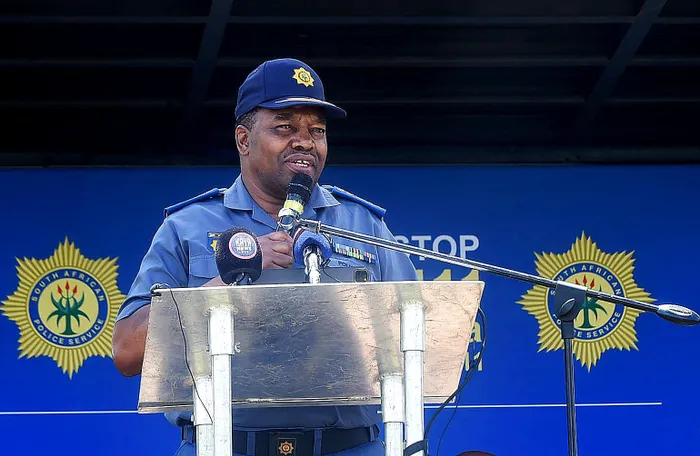
National Police Commissioner General Fannie Masemola is set to appear before Parliament’s ad hoc committee on Tuesday to answer questions about the controversial directive to disband the Political Killings Task Team.
Image: Itumeleng English / Independent Newspapers
National Police Commissioner General Fannie Masemola is currently appearing before Parliament’s ad hoc committee to respond to claims previously made against him and the police service.
He is expected to address issues that arose during earlier hearings.
Last year, Masemola testified about the disbandment of the Political Killings Task Team (PKTT).
He said suspended Police Minister Senzo Mchunu’s instruction to disband the unit encroached on his mandate.
Masemola defended his response to Mchunu’s directive, saying he eventually uncovered the minister’s motives.
Speaking during his testimony, he said he had repeatedly asked Mchunu why the unit was being closed, but received no explanation.
When asked by ActionSA MP Dereleen James whether the directive was unlawful, Masemola said it was up to the committee to decide.
“I interpreted it to mean he was going beyond his scope, and I emphasised the need for reasons for closing down the team. The directive was not a request; it was a direct instruction,” he said.
James suggested that Masemola had yielded to the minister by not firmly opposing the decision and instead opting to wind down the PKTT.
In response, Masemola insisted the task team was never closed.
“It is operational to this day. I did everything I could. There was no door I did not go to. I engaged him several times, but he shut the door,” he said.
KwaZulu-Natal police commissioner Nhlanhla Mkhwanazi also said he raised the matter at a meeting on January 16, where Mchunu told him it would be discussed when a plan for the disbandment was due.
“He shut the door and said there is a due date to submit the report,” Mkhwanazi said.
Masemola said that at another meeting on March 6, attended by senior management, he again told Mchunu he saw no reason to disband the team.
“On that day, I came with an alternative because the directive looked very suspicious. I proposed a strategy of winding down. Eventually, we discovered the reasons,” he said.
He added that the directive was leaked to the media on December 31.
“Those with an interest in political killings should have seen something was wrong,” he said.
Masemola argued that if the unit had been investigating farm murders, farming organisations would have raised concerns.
“But with this one, it seemed acceptable to analysts, including members of this House. I did the best I could alone. If I have to be blamed today, I accept it,” he said.
He maintained that the PKTT remains active.
“It is still working. I may have handled it differently, and others may have different views, but I handled it my way. The team is there and functioning,” he said.
Asked whether Mchunu should be arrested, Masemola declined to comment, citing an ongoing investigation.
“There is a case under investigation. One cannot comment on a matter that is under investigation,” he said.
Masemola also said his tenure has been affected by criminal cartels, despite being appointed by President Cyril Ramaphosa.
“There are always plans to remove national commissioners. Criminal cartels will meet and devise ways to fabricate cases against you,” he said.
“From day one of your appointment, there are those who work to see how they can remove you.”
He said he hoped to complete his term, although he claimed external forces continued to influence his position.
The top cop also described policing as increasingly complex.
“Policing today cannot be compared with policing 30 years ago. It is far more challenging and requires new approaches,” he said.
Masemola was appointed national police commissioner on March 31, 2022, succeeding General Khehla Sitole.
Mkhwanazi is expected to testify on Wednesday.
IOL Politics