

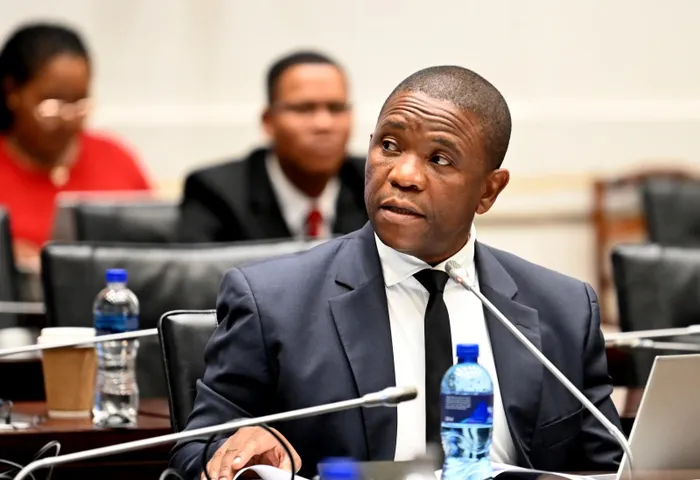
KwaZulu-Natal police commissioner Lt Gen Nhlanhla Mkhwanazi has told Parliament that suspended minister Senzo Mchunu personally authored the letter dissolving the Political Killings Task Team - but insists he was manipulated into doing so.
Image: Ayanda Ndamane / Independent Newspapers
KwaZulu-Natal provincial police commissioner Lieutenant General Nhlanhla Mkhwanazi has intensified his allegations against suspended Police Minister Senzo Mchunu, saying that Mchunu personally wrote the controversial letter disbanding the Political Killings Task Team (PKTT), but was “captured” into doing so.
Mkhwanazi was delivering what is expected to be his final appearance before the Parliamentary Ad Hoc Committe, where he has been responding to allegations against both himself and the PKTT.
His testimony follows his explosive media briefing on 6 July 2025, which triggered the current parliamentary inquiry into alleged corruption, political interference and institutional capture within the South African Police Service (SAPS).
During that briefing, Mkhwanazi implicated several senior officials, including Mchunu, who is currently on special leave, and suspended deputy national commissioner for crime detection Lieutenant General Shadrack Sibiya.
He also alleged that elements within the prosecutorial system had been captured.
Leading evidence, Advocate Norman Arendse SC pressed Mkhwanazi on why he had not named the prosecutors in question.
Arendse asked whether their identities were being withheld due to classification or uncertainty.
Mkhwanazi responded that some individuals were known but could not be publicly identified because of the ongoing investigation.
When asked whether the same applied to politicians, Mkhwanazi said certain individuals had already been named.
He referred to MPs Fadiel Adams (National Coloured Congress) and Dianne Kohler Barnard (Democratic Alliance) , as well as Mchunu, while arguing that political leaders are often manipulated by corrupt actors within the system.
Be said politicians may initially be unaware of wrongdoing but become complicit if they fail to act once informed.
“Once this is brought to their attention, they are expected to pull back and start asking questions,” he said.
Mkhwanazi maintained that Mchunu, who was new to the portfolio at the time, had been influenced to author the December 2024 letter that led to the disbandment of the PKTT.
“I believe the minister was captured to write that letter,” he said. “He does not accept that - he owns it.”
According to Mkhwanazi, forensic analysis shows that Mchunu drafted the letter on his iPad. Although the data was allegedly deleted, investigators were able to recover it.
“You delete, we retrieve,” he said. “We know he is the author.”
He outlined the document’s circulation process, stating that it was sent from the minister to his chief of staff, then to a personal assistant, where an electronic signature was added before distribution.
He also alleged that the document was sent to both official and private email addresses on the same day.
Mkhwanazi argued that the disbandment had serious operational consequences, including leaving SAPS without a head of crime intelligence for nearly a year and disrupting ongoing investigations.
He said arrests linked to the Crime Intelligence division, including that of Lieutenant General Dumisani Khumalo, brought key operations to a halt.
Officers involved were unable to work, access resources or receive payment due to funding constraints tied to intelligence structures.
He added that millions of rand from the secret services account were spent during this period, and that these expenditures are now under audit scrutiny.
Mkhwanazi also criticised the role of some politicians, claiming they were misled by individuals within Crime Intelligence.
He pointed to an example involving Barnard, who allegedly raised parliamentary questions based on incorrect information after being contacted by SAPS members.
“She was fed the wrong information,” he said.
“They pick up the phone, contact her, and she acts quickly without verifying.”
He said such incidents contribute to a perception that politicians are complicit, even when they may have been misinformed.
Mkhwanazi further criticised Adams, who had previously accused him of being a “constitutional delinquent”.
“Despite what he says, we still call him honourable,” Mkhwanazi said, adding that elected representatives must be respected as they represent millions of South Africans.
He added that political involvement, whether intentional or not, can enable corruption within the justice system, particularly when leaders fail to challenge questionable actions.
The committee is expected to conclude its hearings following Mkhwanazi’s testimony.
The fiery committee continues.
simon.majadibodu@iol.co.za
IOL Politics