

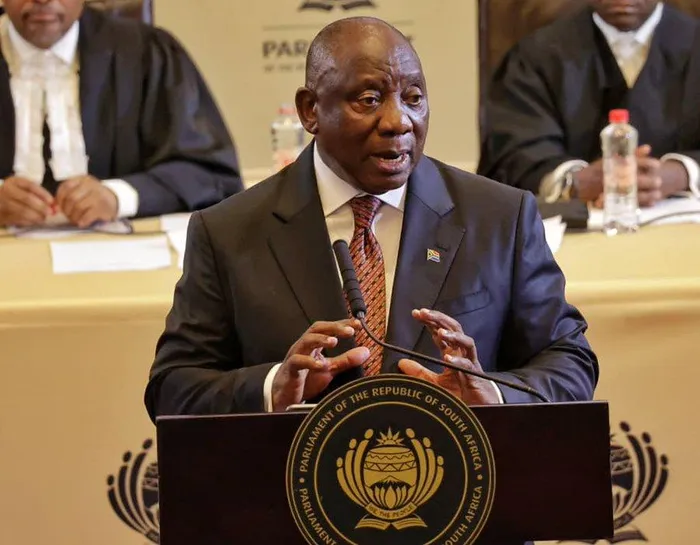
President Cyril Ramaphosa has criticised suspended police minister Senzo Mchunu for disbanding the Political Killings Task Team without consultation, saying the decision should have rested with the national police commissioner.
Image: GCIS
President Cyril Ramaphosa has said he did not approve the disbandment of the Political Killings Task Team (PKTT) and was dissatisfied that he had not been consulted by suspended Police Minister Senzo Mchunu beforehand.
Ramaphosa said this in written responses to Parliament’s ad hoc committee investigating allegations made by KZN provincial police commissioner Lieutenant General Nhlanhla Mkhwanazi. He submitted the responses on Tuesday.
He said the decision was taken by Mchunu and should have fallen under the authority of the national police commissioner General Fannie Masemola.
Ramaphosa said he was informed of the move on or about February 1, 2025 by Masemola, who indicated that Mchunu had instructed that the unit be disbanded.
Masemola also made it clear that he disagreed with the decision, Ramaphosa said.
“He further assured me that, notwithstanding this instruction, a disbandment could not be effected immediately, as this would negatively affect pending investigations,” Ramaphosa said.
The president said he subsequently requested a meeting with Mchunu, which took place on or about February 13, 2025.
“At this meeting, the minister informed me that he had given the instruction to disband the task team and his reasons for doing so,” Ramaphosa said.
“I conveyed my dissatisfaction at not having been consulted prior to this decision being taken. I further indicated that, in my view, this was a decision for the national commissioner to make.”
Ramaphosa said he made it clear that he expected to be kept informed of any further decisions affecting investigations into political killings.
“It was my understanding that the steps to be taken fell within the purview of the national commissioner’s authority,” he said.
He added that he understood from Masemola that the PKTT would not be disbanded and that its work would continue despite the directive.
Ramaphosa’s responses follow calls from members of the parliamentary committee for him to appear in person and be held fully accountable.
The presidency had missed an initial deadline to submit answers and requested an extension.
The committee was established after Mkhwanazi made explosive allegations in July last year, raising concerns about political interference and corruption within South Africa’s criminal justice system.
Mchunu previously told the committee that he had not consulted Ramaphosa before issuing the disbandment directive.
He said his decision was based on a police research study recommending the consolidation of violent crime investigations into the murder and robbery unit.
Meanwhile, Mkhwanazi has intensified his allegations, claiming Mchunu personally authored the December 2024 letter disbanding the PKTT but had been “captured” into doing so.
“I believe the minister was captured to write that letter,” Mkhwanazi told the committee on Wednesday
“He does not accept that - he owns it.”
Mkhwanazi said forensic analysis showed the letter was drafted on Mchunu’s iPad and later deleted, but investigators were able to recover the data.
“You delete, we retrieve,” he said. “We know he is the author.”
He outlined how the document was circulated, saying it was sent from the minister to his chief of staff, then to a personal assistant, where an electronic signature was added before distribution.
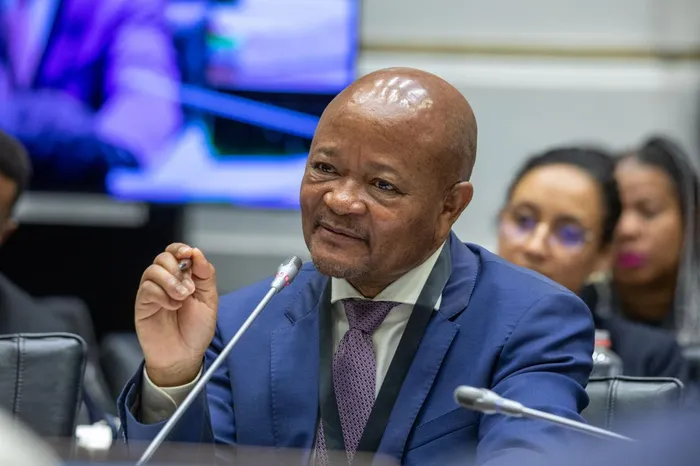
President Cyril Ramaphosa says suspended police minister Senzo Mchunu did not consult with him on the decision on issuing a disbandment letter of the Political Killings Task Team.
Image: Zwelethemba Kostile / Parliament of RSA
Mkhwanazi also alleged that the document was sent to both official and private email addresses on the same day.
He argued that the disbandment had serious operational consequences, including leaving the police service without a head of crime intelligence for nearly a year and disrupting ongoing investigations.
He said arrests linked to the Crime Intelligence division, including that of Lieutenant General Dumisani Khumalo, brought key operations to a halt.
Officers involved were unable to work, access resources or receive payment due to funding constraints tied to intelligence structures.
He added that millions of rand from the secret services account were spent during this period and are now under audit scrutiny.
Appearing before the committee on Tuesday, Masemola said Mchunu had ample opportunity to brief him on the decision but failed to do so.
“We had not yet agreed. I said ‘gradual’; the minister said ‘immediate’,” he said.
Masemola confirmed earlier testimony that the disbandment directive was sent via WhatsApp while senior officials were engaged in festive season safety operations.
He maintained that he had not been consulted before or after the directive was issued.
“It remains my evidence that the minister never consulted me about the directive, either before or after issuing it,” he said.
Masemola added that the stated aim of the disbandment was to halt investigations into murder accused businessman Vusimuzi ‘Cat’ Matlala, who is alleged to be linked to the so-called “Big Five” cartel.
He said he initially questioned the authenticity of the disbandment letter and, once it was verified, instructed departments to compile reports in response.
IOL Politics