

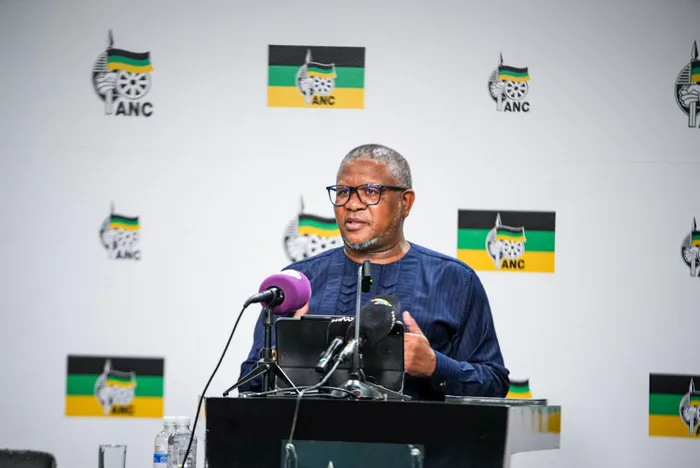
ANC Secretary-General Fikile Mbalula says that mayoral candidates for all metros will be announced by May 2026, ahead of the local government campaign, inviting civil society to join the process.
Image: MYANC X Account
ANC secretary-general Fikile Mbalula has confirmed that the party will announce its mayoral candidates for all metros by May 2026, ahead of its local government campaign in June and July.
Mbalula made the announcement during a briefing on Wednesday, where he outlined the ANC’s process for selecting candidates.
The party’s top seven leadership will be conducting interviews for mayoral positions in key cities, including Johannesburg, Ekurhuleni, and eThekwini, he said.
He also stated that the party’s new framework for selecting candidates would be presented next week, with civil society being invited to participate in the process.
“We will be inviting civil society to come and help us on this journey, what kind of mayor we need in Johannesburg, Ekurhuleni, eThekwini, and elsewhere, as we embark on interviewing candidates,” Mbalula said.
The decision to delay the announcement has raised eyebrows, especially as other political parties, including the Democratic Alliance (DA) and ActionSA, have already named their candidates.
The party’s cautious approach has raised questions about its internal dynamics and whether it is struggling to find suitable candidates for key municipalities.
While Mbalula sought to reassure the public that the process would be transparent, the delay in naming candidates has led to concerns over the ANC's ability to regain momentum in the face of fierce competition from opposition parties.
Political analysts have weighed in on the ANC’s decision to delay its mayoral candidate announcement, with many attributing it to the party’s ongoing internal struggles.
Dr Lubna Nadvi, a political analyst at UKZN, explained that the ANC has been grappling with a shift in the leadership mindset of some cadres.
“The ANC has had a challenge with leadership capacity as some of its cadres have opted for a more comfortable and lavish lifestyle than servant leadership,” she said.
''These individuals have tarnished the reputation of the ANC to some degree, and hence it makes sense for the party to go through some thorough and rigid processes of selecting mayoral candidates through interviews.''
Nadvi suggested that the party’s decision to interview candidates is a step in the right direction, as it indicates a commitment to finding the right leaders for the job.
She also pointed out that the delay in naming candidates could be part of a broader strategy to avoid revealing the ANC's 'cards' too soon.
“It may also be the case that it is taking its time to conduct its interview processes so the party does not rush things and finds the right people for the job,” Nadvi said.
Furthermore, she noted that the ANC has learned from past mistakes and now needs to approach the process with caution, especially given its declining dominance in some municipalities.
As a former ruling party, it has had to learn hard lessons regarding how it has managed party strategy in the past, and if it wants to retain or win back wards or claim new wards, it has to do things differently this time round.
Nadvi also noted that there have been differences in the past between some Regional Executive Committees (RECs) and the party’s national leadership, which is why it seems the national structures do not want to leave the process entirely to the RECs. Instead, they want a role in this crucial task.
"Executive mayors of metros and cities play an incredibly important role in the governance and management of cities, which are also areas where many eligible voters reside. If these areas are well-managed by a particular political party's mayor, the likelihood of that party maintaining control over the metro and specific wards is greater," Nadvi said.
Professor Theo Neethling, a research associate at the University of the Free State, pointed out that the delay in announcing mayoral candidates reflects the ANC’s internal divisions.
“Internal factional divisions and centralised decision-making by national leaders are the key reasons for the delay,” Neethling said.
He noted that the Democratic Alliance (DA) and ActionSA’s early announcements of mayoral candidates point to a shift towards a more competitive, candidate-driven local politics, especially in metros.
"The early announcement of mayoral candidates by the DA and ActionSA shows a shift toward more competitive, candidate-driven local politics, particularly in metros," Neethling said
He warned that the ANC's delayed candidate announcement could put the party at a political disadvantage. "Being late is not politically cost-free for the ANC. There is a narrative disadvantage: opposition defines the debate first," Neethling said.
“In modern campaigning, timing means momentum,” Neethling added.
He also pointed out that the longer the ANC waits to announce its candidates, the less time there will be to raise its visibility before voters head to the polls.
"The perception is that of disorganisation. There is a reduced campaign time for candidate visibility," he said.
This delay, according to Neethling, highlights the ANC’s declining dominance in South African urban politics, where the party is facing governance challenges and increasingly intense competition from opposition parties
Meanwhile, Zakhele Ndlovu, another political analyst at UKZN, expressed concern over the lack of transparency in the ANC’s candidate selection process.
“The secrecy of the process is concerning. Those interested in the position should throw their hats in and have a transparent process to select a suitable candidate,” Ndlovu said.
He attributed much of the delay to factionalism within the party, which he believes is hindering the selection of strong candidates.
“Factionalism is at the heart of the problem of identifying candidates,” he said.
Ndlovu also suggested that the ANC’s delay could be a tactic to buy time and avoid divisions within the party ahead of its elective conference next year.
“The ANC is trying to buy time here because this could prove to be a divisive issue ahead of its elective conference next year,” he said.
Mbalula also addressed speculation regarding Johannesburg Mayor Dada Morero’s position.
He stated that Morero was "going nowhere." "The mayor is there and is not removed," Mbalula said, putting to rest speculation that Morero could face a recall after reports surfaced over the weekend.
He emphasised that no mayor would be removed by the region, adding, "There’s no mayor that is going to be removed by the region. Let me tell you that."
Mbalula further explained that he would meet with regional leaders to address the matter, noting, "The National Working Committee (NWC) is clear. What the comrades in Joburg have done, it shouldn’t be done."
“We face challenges from time to time, but our structures will talk to them,” he said.
Mbalula’s comments follow reports that the Johannesburg ANC’s Regional Executive Committee (REC) had decided to recall Morero as mayor.
The decision came after the Johannesburg ANC was served with court papers challenging the legitimacy of its regional conference in December, where Deputy Mayor Loyiso Masuku defeated Morero for the position of regional chairperson.
IOL previously reported that insiders claimed that Morero’s involvement in the legal challenge, along with his alleged “parallel programmes,” was undermining the unity of the ANC.
However, Morero denied receiving any official communication regarding the recall, stating, “I have not received any official communication from the ANC about being recalled. I only became aware of the reports through social media.
hope.ntanzi@iol.co.za
IOL Politics