

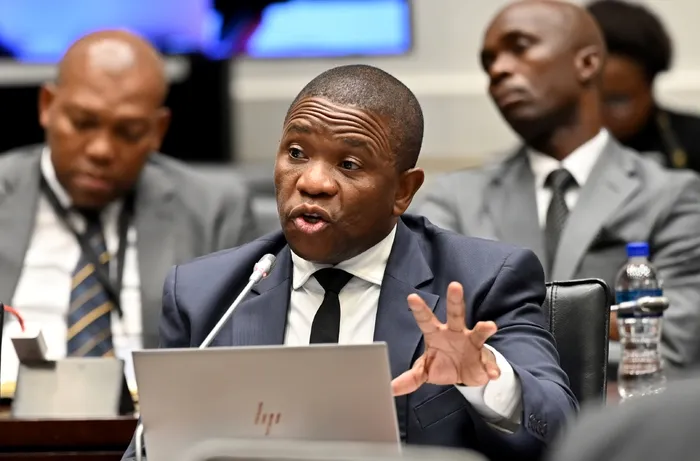
KwaZulu-Natal Police Commissioner Nhlanhla Mkhwanazi returned to the Ad Hoc Committee on Tuesday to complete his evidence.
Image: Ayanda Ndamane/ Independent Newspapers
KwaZulu-Natal Police Commissioner Nhlanhla Mkhwanazi has conceded that suspended Police Minister Senzo Mchunu was not part of the country's criminal syndicates and drug cartels.
Responding to questions when he returned to the Ad Hoc Committee on Wednesday, Mkhwanazi said the evidence gathered by the Political Killings Task Team (PKTT) suggested that Mchunu was aware of the intentions of “rogue people” within the SAPS and that these individuals wanted the task team disbanded.
He also said Mchunu's justification for his decision made them conclude that he was protecting people.
“He was assisting the (Shadrack) Sibiyas, who in turn are assisting the cartel squad. When you are assisting in that fashion, you may not be directly involved but indirectly allowing criminality to take place.”
Mkhwanazi said it was for that reason Mchunu should be honest.
Asked if Mchunu’s directive was lawful, the KwaZulu-Natal top officer said: “For me as a complainant, it was illegal in terms of the law.”
He also said it could be considered that Mchunu was defeating the ends of justice because his action affected investigations in KwaZulu-Natal.
Asked about Mchunu’s family trust account that he previously had said would be probed, Mkhwanazi stated that the team became aware of the trust account upon extracting communication from the phones of businessman Vusimuzi “Cat” Matlala.
Pressed on whether there was concrete evidence against Mchunu, Mkhwanazi said the assessment of activities that happened after the directives were issued on December 31, 2024, made them reach this conclusion.
“These three (directives on disbandment of PKTT, moratorium in filling Crime Intelligence posts and border-related issues) were strategically decided on December 31.”
He stated that when the PKTT wanted his electronic devices, Mchunu did not avail himself when visited at his official residence.
“They (the gadgets) were wiped off, and the team retrieved and uncovered things that were deleted. Why would the minister wipe information (from) state property?”
Mkhwanazi revealed that contrary to the claim by Mchunu that he had communicated with his legal advisor Advocate Vusi Pikoli on the day he issued the directives, this was not the case.
“We are not seeing communication between him and Vusi Pikoli on the day. What we have is communication between him and the Chief of Staff, from the download we retrieved.”
He added that they could not help but conclude that Mchunu was complicit, based on the reasons he provided to justify his decision.
“He might be part of the squad that was doing bad, but I give him the benefit of doubt that the minister was influenced,” said Mkhwanazi, adding that Mchunu was still new in the department and did not know much.
In his earlier evidence, Mkhwanazi said politicians might not necessarily be involved in the initial activities of corrupt members but they become captured and are used to the extent that when they become aware of these activities, they continued doing the wrong.
“Minister was new in the organisation. I believe and I still say that Minister Mchunu was captured to end up writing that letter.”
mayibongwe.maqhina@inl.co.za