

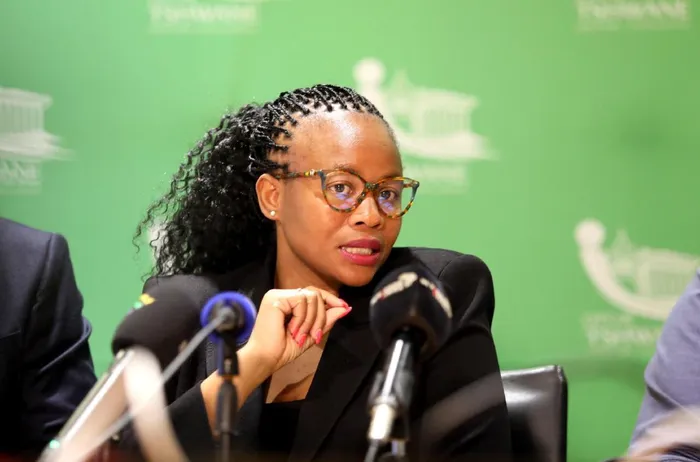
Tshwane mayor, Dr Nasiphi Moya, says the city will redirect R100 million towards intelligence-led policing over the Easter holidays.
Image: Oupa Mokoena / Indepedent Newspapers
The City of Tshwane is drawing a hard line on crime and corruption ahead of the Easter holiday rush, with Executive Mayor Dr Nasiphi Moya announcing over R100 million towards intelligence-led policing.
Speaking in Olievenhoutbosch on Tuesday, Moya framed the moment as a turning point for the capital, warning that failures within parts of the law enforcement system have left residents exposed.
“Corruption in law enforcement is not just misconduct. It is a betrayal of the people. In Tshwane, that betrayal will be confronted decisively and without hesitation,” she said.
Moya’s remarks come against the backdrop of findings emerging from the Madlanga Commission, which have raised concerns about corruption and inefficiencies within law enforcement structures. For residents, she said, the consequences are not abstract.
“This is real. It has consequences for every resident who expects protection and instead finds vulnerability.”
The choice of Olievenhoutbosch for the announcement was deliberate. The area has long struggled with violent crime, drug networks, and intimidation. However, Moya was clear that the community represents more than its challenges.
“Olievenhoutbosch is not a symbol of defeat. It is a symbol of resistance,” she said.
With increased travel and gatherings expected over Easter, the city is rolling out an expanded safety plan built around visibility, enforcement, and coordinated action.
As part of this, 24 new vehicles have been added to the Tshwane Metro Police Department fleet to improve patrol coverage and response times.
“These are not ceremonial additions,” Moya said. “They are operational tools.”
Emergency services will also be on high alert, with teams expected to respond to accidents and incidents across the city during one of the busiest periods on the calendar.
The city is also strengthening coordination with the South African Police Service and other law enforcement agencies, with operations set to be intelligence-driven and focused on priority hotspots.
At the centre of the city’s strategy is a significant financial shift.
Moya confirmed that more than R100 million will be cut from watchmen and private guarding services in the draft 2026/27 budget and redirected to strengthen the metro police.
“For too long, public money has been spent on fragmented guarding systems that do not prevent crime and do not deliver real protection,” she said.
The move signals a shift away from passive security towards active policing, with a focus on trained, accountable officers.
The mayor also pushed back against calls to privatise policing functions.
“Public safety is not for sale. Law enforcement is not a commodity,” she said, adding that the metro police will remain a public institution accountable to residents.
While acknowledging that many officers serve with integrity, Moya did not shy away from addressing misconduct within the ranks.
“Those who have chosen corruption over duty are no longer part of the institution and serve as a warning. A corrupt officer weakens the badge, endangers colleagues, and betrays the community.”
She warned that consequences for wrongdoing would be “swift, firm, and unavoidable”.
At the same time, the city committed to supporting officers who continue to serve under difficult conditions, arguing that a more empowered police force will be more visible and effective.
Moya said the city is moving away from reactive policing towards a more proactive, intelligence-led model, backed by stronger oversight and improved deployment strategies.
“This administration is not here to manage decline. It is here to restore order.”
Residents can expect increased patrols, roadblocks, and visible law enforcement presence across communities during the Easter period.
However, the mayor also stressed that safety cannot be delivered by the state alone.
“Communities must speak out. Partnerships must be active. A united front against crime is essential.”
The announcement positions Tshwane at a crossroads, with the city attempting to reset its approach to safety at a time of rising public frustration over crime and governance failures.
“This launch marks a turning point. A turning point away from complacency, away from corruption, and toward action, accountability, and safety,” Moya said.
karabo.ngoepe@inl.co.za