

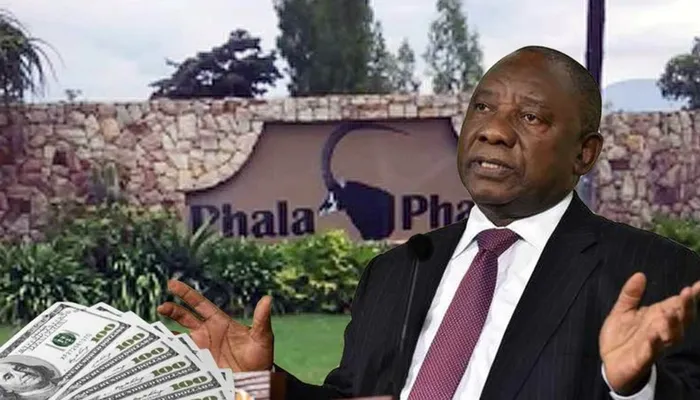
The EFF has written to the Chief Justice, questioning the delay in the judgment of the Phala Phala matter in court.
Image: IOL graphics
The EFF has written to Chief Justice Mandisa Maya, demanding answers over what it describes as an “unacceptable delay” in the long-awaited judgment on the Phala Phala matter.
EFF leader Julius Malema, in a letter to Maya, warned that the prolonged delay risks undermining public confidence in the judiciary and weakening constitutional accountability at the highest level of government.
At the centre of the dispute is the case Economic Freedom Fighters v Speaker of the National Assembly and Others, which relates to the handling of the Phala Phala scandal involving President Cyril Ramaphosa.
The matter has become one of the most closely watched constitutional cases in recent years, given its implications for executive accountability and parliamentary oversight.
In the letter, Malema outlines a detailed timeline that highlights the extent of the delay. The EFF first approached the Constitutional Court in February 2024.
The matter was heard in November of the same year. Yet, more than a year later, no judgment has been delivered.
“This matter has now become one of the most delayed judgments in the modern history of the Constitutional Court,” Malema wrote.
He noted that the delay has exceeded 480 days since the hearing, far beyond the judiciary’s own benchmark, which requires judgments to be delivered within three months unless exceptional circumstances apply.
“No explanation has been provided that could reasonably sustain a claim of ‘exceptional circumstances’ of this magnitude,” Malema stated.
The Phala Phala saga involves the theft of over $580,000 (US dollars) hidden in furniture at Ramaphosa's game farm in Bela-Bela, Limpopo, in February 2020.
The incident sparked major controversy regarding the concealment of the crime, potential money laundering, and the use of state resources to investigate the robbery, which was allegedly carried out by suspects who received millions of rand in their accounts afterwards.
The robbery was not reported to the police at the time, leading to allegations of covering up the incident.
The Independent Police Investigative Directorate (IPID) investigated the conduct of SAPS members involved in handling the case, rather than the theft itself, with reports recently declassified.
The suspects, including Immanuela David and the Joseph siblings, have been tried for the theft, with evidence suggesting large sums of money were received by the accused. The incident has been a significant political scandal for President Ramaphosa.
The EFF argues that the delay is not merely administrative but has direct constitutional consequences.
The Phala Phala case originated from a December 2022 decision by the National Assembly, meaning the matter has remained unresolved for over three years.
Malema warned that this prolonged uncertainty risks weakening the constitutional principle that Parliament must hold the executive accountable, with the courts acting as the ultimate safeguard.
“A delay of this magnitude risks functionally undermining the very accountability that the court is constitutionally mandated to enforce,” he wrote.
The party further argues that the absence of a ruling leaves both Parliament and the public in limbo, particularly in a case involving the conduct of the head of state.
The letter directly references the judiciary’s own rules, including the Norms and Standards for the Performance of Judicial Functions and the Code of Judicial Conduct. These require judges to deliver judgments “without undue delay” and to dispose of court business efficiently.
According to the EFF, the current delay exceeds these standards by more than five times.
“This delay cannot be characterised as ordinary or administrative,” the party said, adding that it raises “serious questions regarding compliance with the standards of judicial diligence and accountability”.
Malema went further, suggesting that the situation could potentially amount to “incapacity, gross incompetence, or gross misconduct” if left unexplained.
Beyond the legal arguments, the EFF frames the issue as a broader test of institutional credibility. The party warns that prolonged silence from the court risks fuelling perceptions of inconsistency or political influence.
“The continued delay in this matter risks creating a perception that the Constitutional Court is no longer immune from political pressures. Whether justified or not, such a perception is deeply damaging. It suggests that justice may not be applied evenly, and that certain matters are treated with greater urgency than others. In simple terms, it begins to appear as though justice has eyes and favourites,” the letter states.
This, the EFF argues, could erode public trust in one of the country’s most important democratic institutions.
The Constitutional Court has historically been regarded as a strong and independent arbiter, particularly in landmark rulings such as the 2016 judgment that affirmed the President’s constitutional obligations. Any perceived deviation from that standard carries significant political and legal weight.
The party has formally requested three key responses from the Chief Justice:
Malema stressed that the matter “goes to the heart of constitutional governance, the rule of law, and public confidence in the judiciary” and “cannot be allowed to drift into indefinite delay”.
karabo.ngoepe@inl.co.za