

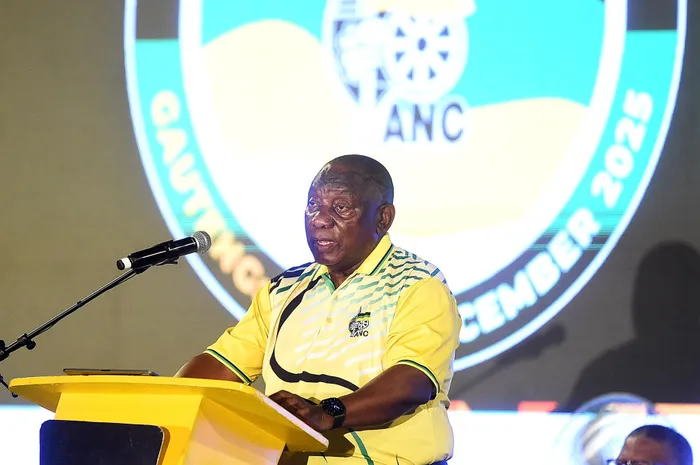
ANC president Cyril Ramaphosa says there has been progress in tackling corruption, however, he acknowledges it remains a major problem in the country.
Image: Itumeleng English / Independent Newspapers
ANC president Cyril Ramaphosa says there has been progress in tackling corruption, but he acknowledges it remains a major problem in South Africa.
Ramaphosa made the remarks on Saturday while delivering closing comments at the party’s 14th provincial conference at Mbombela Stadium.
“We’re also seeing some progress in fighting corruption. Yes, corruption is still a major problem in our country,” he said.
He added that efforts have been established to root out corruption.
“However, efforts are being made to fight corruption, and the revelations coming through the Madlanga Commission and the ad hoc committee should not discourage us.”
“Instead, we should see them as an opportunity to deal with the problems we have had in the police service and to get rid of the rot in our security cluster,” he said.
Ramaphosa said these efforts would help resolve issues within the police service.
“We are going to make sure that we have a police service and a security cluster that is fit for purpose and that our people can trust,” he told ANC members.
The Madlanga Commission and the ad hoc committee were established shortly after KwaZulu-Natal provincial police commissioner Lieutenant General Nhlanhla Mkhwanazi’s explosive media briefing on July 6 2025.
The ad hoc committee has since concluded its investigations.
Mkhwanazi alleged corruption, the shielding of criminal networks and political interference in the justice system.
He implicated several senior officials, including suspended Police Minister Senzo Mchunu, who is currently on special leave, and suspended deputy national commissioner for crime detection Lieutenant General Shadrack Sibiya.
Mkhwanazi said Mchunu wrote a letter in December 2024 demanding the disbandment of the Political Killings Task Team, an elite SAPS unit investigating politically motivated killings.
The move has sparked fierce debate over alleged political interference in police operations.
He also accused Mchunu of colluding with elements of the criminal underworld, including murder-accused businessman Vusimuzi “Cat” Matlala and North West political fixer Brown Mogotsi.
Mchunu, has vehemently denied the allegations.
He was placed on special leave by Ramaphosa and replaced by acting police minister Professor Firoz Cachalia.
Ramaphosa also told delegates there had been progress in addressing water shortages, although many residents across provinces continue to experience disruptions.
“We are making progress to address the water challenges in our country, as well as energy and innovation within the state,” he said.
He urged ANC members to take responsibility in combating corruption within party structures.
“We must, comrades, make all efforts to rid our structures of corruption,” he said.
Addressing the issue of water tankers and organised crime, Ramaphosa said municipalities should take control of water provision during service disruptions.
“In times of need, such as pipe bursts, municipalities must be the ones delivering water to our people,” he said.
He added that municipalities should own water tankers rather than rely on private providers.
“They must own the water tankers. I know that many people have invested heavily in this sector, and yes, I know that this is where corruption has been taking place,” he said.
“There is a water tanker mafia, and it must be brought to an end by ensuring municipalities take full responsibility.”
Meanwhile, provincial chairperson Mandla Ndlovu secured re-election unopposed at the conference. His leadership slate - including deputy chairperson Speedy Mashilo, provincial secretary Muzi Chirwa and deputy secretary Mpumi Hlophe - was also elected without opposition.
The only contested position was treasurer.
Mbombela mayor Sibongile Makhushe-Mazibuko defeated former treasurer Mandla Msibi in a tightly managed process that did not proceed to a vote.
Reports say tensions briefly surfaced when nominations from the floor were initially closed, prompting dissatisfaction among some delegates.
The situation was later corrected, allowing Msibi’s nomination.
However, he failed to meet the required 25% threshold of delegate support, falling short of the 194 nominations needed to trigger a ballot.
Makhushe-Mazibuko was subsequently declared elected unopposed.
IOL Politics