

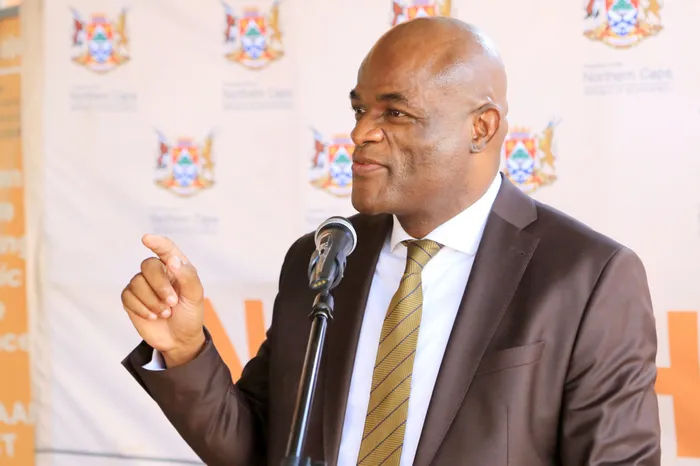
The Premier of the Northern Cape, Dr Zamani Saul.
Image: File / Danie van der Lith
At least five provinces gave an account of their efforts to implement the government’s directive on lifestyle audits to Parliament on Wednesday.
They shared the challenges ranging from resistance from civil servants to being subjected to scrutiny, lack of internal capacity, and the cost of blanket implementation of the initiative.
This happened when KwaZulu-Natal, Gauteng, Northern Cape, Western Cape, and North West appeared before the Public Service and Administration Committee to provide updates on the progress made in conducting lifestyle audits.
Briefing the committee, Northern Cape Premier Zamani Saul said that because they have no internal capacity, they roped in the Special Investigating Unit (SIU) in May 2023.
“We had a serious backlash because we were attacked for using SIU, which we are not using internal capacity at that time. But we feel much better now to learn that there are other provinces which are currently using SIU.”
The SIU was initially meant to conclude lifestyle audits in September 2025, but the contract was extended by the province.
Saul noted that the lifestyle audit process has proven to be expensive.
“The first phase of the lifestyle audit process in the province costs us close to R13 million to do that with the SIU, but that's what we've committed ourselves to do because it really helps as a critical buffer in fighting corruption,” he said.
“We agreed that our first target will be executive managers, senior managers, and officials who are in high-risk positions. Officials who are in high-risk positions are those who are in the pipeline of the procurement process,” said Saul.
Northern Cape Provincial Government Director-General Justice Bekebeke said while there were 100% financial disclosures by senior managers annually, it was not an indication that there was no corruption.
“The primary objective of our lifestyle audits is to effectively and efficiently deal with matters of fraud and corruption, but also to detect any wrongdoing at the time and in the future to ensure that nothing happens in the future.”
Bekebeke told the MPs that civil servants are refusing to be part of the lifestyle audits.
“I can assure you that we have been receiving several lawyers’ letters to say that we are not going to be doing that. We have enlisted the assistance of the Chief State Law Advisor, and we want to see as to how we can ensure that our officials are going to comply eventually,” he added.
Bekebeke stated that out of 52 senior managers in the Office of the Premier, 19 have complied, and the number of non-senior managers in the supply chain was 10.
He said the major hurdle that was currently experienced was the non-submission or inadequate information provided to the SIU.
“Our recommendation is that the SIU should be empowered to conduct routine audits systematically and independently without any regard to what we are doing,” he said, adding that they wanted to adopt a blanket lifestyle audit proclamation to fast-track implementation in our high-risk departments and officials.
Gauteng Premier Panyanza Lesufi said the province signed an agreement with the SIU to conduct lifestyle audits after the independent body, the Gauteng Ethics Advisory Council, urged them to enhance lifestyle audits.
“Because we are committed and we need to lead by example, we felt that the lifestyle audits must start from the highest office. So we did the lifestyle audits of the premier and all the MECs,” he said.
“We then went to all the DGs and heads of agencies, as well as CEOs of institutions that are owned by the government. We received the report, and it was quite clear that we need to go deeper. Anyone who is dealing with our contracts, procurement, or tenders, we did lifestyle audits of all of them.”
Western Cape Premier Alan Winde said his government appointed an independent audit firm to conduct lifestyle audits of the members of the provincial executive and senior managers.
“Our costing for a Cabinet lifestyle audit for myself and the 10 MECs runs at around R600,000 per audit. That's for the full audit; it's about 50,000 per audit per member, so it's a lot cheaper than what I'm hearing,” Winde said.
Western Cape Government Director-General Harry Malila said they don't follow just a blanket lifestyle audit kind of approach.
“We look at the triggers, and the triggers come from that documentation that has been declared, and also obviously the work that our own internal ethics officers are doing. As a province, we believe in a high level of compliance discipline as a default,” Malila said.
KwaZulu-Natal Government Acting Director-General Sibusiso Ngubane said they were taking quite seriously the matter of ethical governance.
Ngubane also said they have embarked on a training of the ethics officers and the investigators so that they are well-equipped to conduct these audits.
“We have also established a functional service delivery Complaints Management Unit, which is also responsible for entertaining whistle-blowers so that if there are matters that are being raised in relation to corruption and are located in the Office of the Premier.”
Ngubane said that since the inception of the lifestyle audits, they observed that no department reported any referral for further investigation as a result of the red flags.
“Recently, a benchmarking exercise was conducted by the Executive Council for provinces such as the Western Cape and Gauteng. We are currently in the process of researching in the Northern Cape and Free State, and part of the research includes the scope, as well as the cost of outsourcing the lifestyle audits.”
mayibongwe.maqhina@inl.co.za