

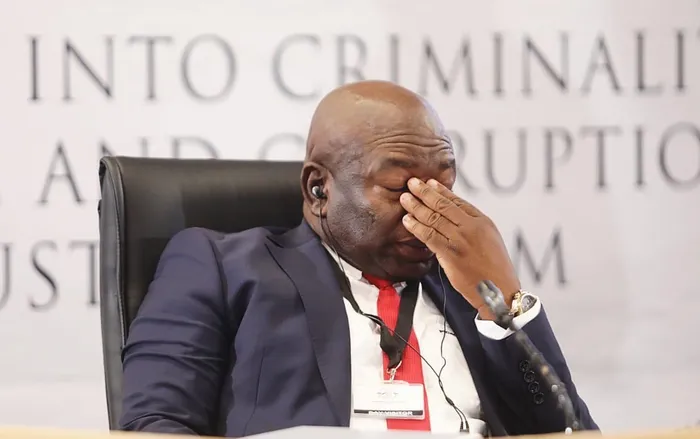
Director of Assets at the Tshwane Metro Police Department, Tshukudu Malatji, testified at the Madlanga Commission on Thursday on the alleged corruption in the department.
Image: Timothy Bernard / Independent Newspapers
Director of Assets at the Tshwane Metro Police Department, Tshukudu Malatji, has admitted that he defied clear instructions to terminate irregular contracts, allowing the City of Tshwane to bleed at least R14 million in unlawful expenditure.
Testifying before the Madlanga Commission on Thursday, Malatji conceded that he failed to act on direct orders to cancel all ad hoc service deployments, despite mounting concerns that the contracts were illegally awarded.
The instruction, issued by his superior, Deputy Chief of Police Revo Spies, was for him to terminate the contracts immediately. Malatji did not.
Instead, he continued processing and engaging on payments linked to the same service providers already flagged as irregular.
“I had a problem with the instruction,” Malatji told the commission, chaired by Justice Mbuyiseli Madlanga, an explanation that drew sharp criticism from the panel.
Madlanga did not mince his words.
“This is a serious oversight, more serious than an oversight,” he said, rejecting Malatji’s attempt to frame the failure as an administrative lapse.
“You failed. As a result, the municipality incurred a R14 million expense. I don’t think you should come and sit there and say it’s an oversight. You must take full responsibility.”
The R14 million in question was incurred over just two months, between January and February 2025, during which Malatji remained in a position to halt the payments.
The commission heard that Malatji had both the authority and the means to stop the financial losses.
He could have blocked further deployment letters, centralised approval processes, or instructed service providers to verify authorisation directly with him.
He did none of it.
Under sustained questioning from co-commissioner Advocate Sandile Khumalo, Malatji’s defence began to unravel.
Initially claiming there were ongoing discussions with superiors, he later suggested he was waiting for written confirmation—despite evidence that the instruction had already been issued in writing.
Khumalo pressed him on the contradiction.“You were given a direct instruction to cancel these deployments, and you did not do so because you say you had a problem with it,” Khumalo said.
“In other words, you were content for the City of Tshwane to continue incurring irregular expenditure.”
“It is not correct, Commissioner. I was not happy,” Malatji responded. “I am not happy.”
His testimony painted a picture of a breakdown in accountability at the senior level, where instructions were questioned, delayed, or simply ignored, with costly consequences.
Malatji has concluded his testimony before the commission.
kamogelo.moichela@iol.co.za
IOL Politics