

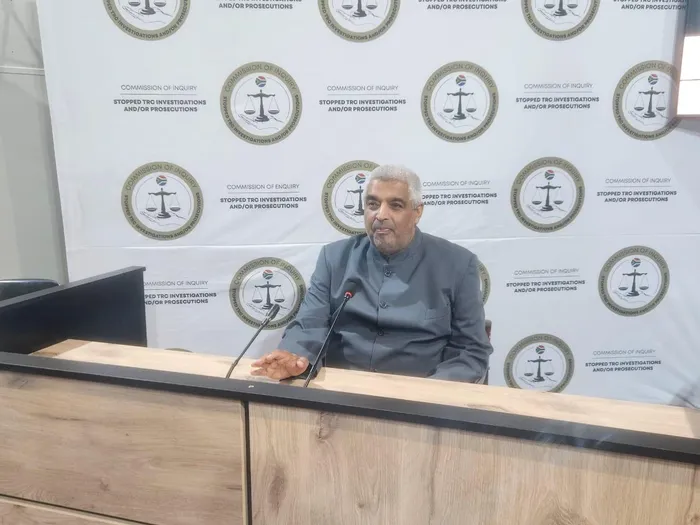
Ahmed Timol's nephew, Imtiaz Cajee, testifying at the TRC Commission on Thursday.
Image: Karabo Ngoepe
The nephew of slain anti-apartheid activist Ahmed Timol has made an emotional appeal for political restraint and decisive action, warning that continued delays in efforts to revisit unresolved Truth and Reconciliation Commission (TRC) cases are deepening the trauma of victims’ families.
Testifying before the commission of inquiry chaired by Justice Sisi Khampepe on Thursday, Imtiaz Cajee called on President Cyril Ramaphosa to avoid interfering in the process, while at the same time ensuring that the commission can function effectively.
Cajee, who has closely followed proceedings since their start, said he was “horrified” by what he described as disruptive sideshows that have slowed progress.
“It is very painful to see the prolonged delays and the challenges this commission has experienced. It comes at a huge cost for victims and families,” he told the inquiry.
“It’s not only those represented here, but people across the country who are still waiting to know what happened and why there was such a failure to investigate cases after the TRC.”
He urged Ramaphosa to support the process he initiated, distinguishing between interference and intervention.
“I want to request the president, who instituted this commission, not to interfere but to intervene in the ongoing court proceedings,” Cajee said.
“With court applications after applications, recusals after recusals, the process is being dragged out.”
Cajee said the drawn-out proceedings were reopening old wounds for families who have already endured decades of unresolved grief.
“As families, we are traumatised by what happened during apartheid. We were traumatised during the TRC because most perpetrators never came forward. We remain traumatised post-TRC because we never got justice,” he said.
“Now we have a commission meant to establish the truth, but the ongoing delays have a devastating effect on families.”
He also appealed directly to the commission’s leadership and legal teams to consider the human cost of procedural delays.
“Victims and affected families are forced to sit and watch these proceedings unfold. It is painful,” he said.
“Find a mechanism, find a way to address these issues. The longer this continues in this manner, the more damage it does to families.”
His statements come as former presidents, Thabo Mbeki and Jacob Zuma, have turned to the courts to call for the recusal of Khampepe as the chair, before they can come and testify.
The commission, formally known as the Truth and Reconciliation Commission inquiry into delayed apartheid-era cases, was established by Ramaphosa and is being led by Khampepe.
Its mandate is to investigate why hundreds of serious human rights violation cases identified during the TRC process were never properly pursued by prosecutors, despite recommendations for further investigation.
There have been longstanding allegations of political interference and institutional inertia within the National Prosecuting Authority that led to these cases being stalled or abandoned. Families of victims have argued that this amounted to a second injustice, compounding the failures of the apartheid era.
The case of Ahmed Timol remains one of the most high-profile examples. The anti-apartheid activist died in police custody in 1971, with apartheid authorities claiming he jumped from a building. Decades later, a reopened inquest found that Timol had been murdered, renewing calls for accountability and broader investigations into similar cases.
karabo.ngoepe@inl.co.za