

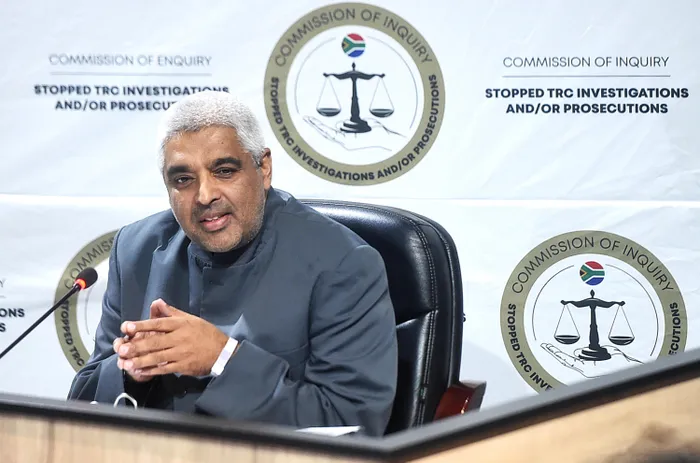
Imtiaz Cajee, nephew of anti-apartheid activist Ahmed Timol, appeared before the Truth and Reconciliation Commission (TRC), chaired by retired Justice Sisi Khampepe, at the Sci-Bono Discovery Centre in Newtown.
Image: Picture: Itumeleng English/ Independent Newspapers
Imtiaz Ahmed Cajee, the nephew of anti-apartheid activist Ahmed Timol, delivered a haunting and blistering testimony on Thursday at the Judicial Commission of Inquiry into TRC cases, calling on President Cyril Ramaphosa to intervene in the legal "sideshows" that he says are continuing to traumatise the families of apartheid victims.
Cajee, who has spent three decades pursuing the truth behind his uncle’s 1971 death in police custody, told the Commission that watching constant court applications for recusals and legal manoeuvring has a "devastating effect" on families still dying for closure.
“I would just like to plead to the President... please take into consideration that we as victims, as affected parties, must sit and watch these proceedings and it is very painful,” Cajee said, urging the President not to interfere with the law, but to find a mechanism to resolve the gridlock.
While many have blamed political interference for the failure to prosecute 300 TRC-related cases, Cajee presented a different, more chilling theory: internal sabotage by individuals within the National Prosecuting Authority (NPA).
Cajee specifically pointed to senior prosecutors such as Dr Torie Pretorius and Adv. Chris MacAdam. He referenced a 1993 letter allegedly penned by Pretorius to former President FW de Klerk, which Cajee described as a form of "insurance policy". The implication, he argued, can be interpreted as a mutual threat: "If you come after us, we will come after you".
"It served the interests of many individuals from either side of the political divide that these matters have a subsequent quiet, silent death," Cajee testified. He argued that placing former apartheid-era prosecutors in sensitive positions to investigate posthumous TRC cases made "suspicion and doubt" inevitable.
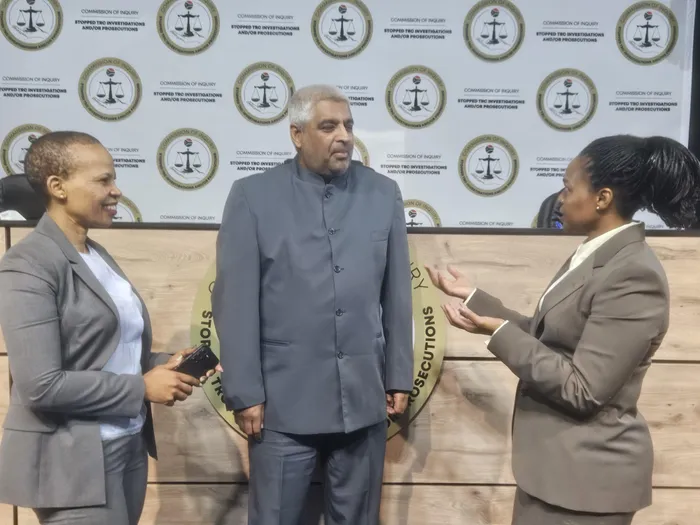
Baitseng Rangata, evidence leader and director at BR Rangata Attorneys, with Imtiaz Cajee and Advocate Nompumelelo Seme from Victoria Mxenge Group of Advocates at the TRC Commission, ahead of testimony
Image: Picture: Karabo Ngoepe
In a notable shift in narrative, Cajee also used his submission to analyse the role of Colonel Eugene de Kock, labelled by the media as the notorious "Prime Evil" of Vlakplaas. Cajee argued that the post-1994 focus on De Kock allowed the rest of the apartheid machinery to escape accountability.
"I sit and ask myself: how does one individual pay the price of all the crimes of an entire apartheid regime for three decades?" Cajee asked the Commission. He noted that while De Kock made a full disclosure at the TRC and showed remorse, the commanders and politicians who authorised his actions and awarded him commendations have largely remained unscathed.
The testimony was deeply personal, with Cajee recounting the "farce" of the 1972 inquest where Magistrate De Villiers ruled his uncle’s death a suicide and labelled his grandmother, Hawa Timol, a liar.
Cajee described his vow to his grandmother to preserve Timol’s legacy, a journey that led to the historic 2017 reopening of the Timol inquest, which finally reversed the apartheid-era suicide ruling.
However, he noted that even in 2021, on the 50th anniversary of Timol’s death, the Ahmed Kathrada Foundation, accompanied by the Minister of Justice at the time, Ronald Lamola, was denied access to commemorate the event inside the Johannesburg Central Police Station (formerly John Vorster Square).
"Post-apartheid, democratic South Africa, we do not have access to this building... who is in control, who is in power?" he questioned.
Cajee concluded by highlighting a "complete shift" in appetite for these cases since they were moved from the Priority Crimes Litigation Unit (PCLU) to a new TRC component in 2021, but warned that the clock is ticking for the ageing families of those who "paid the ultimate price".
karabo.ngoepe@inl.co.za