

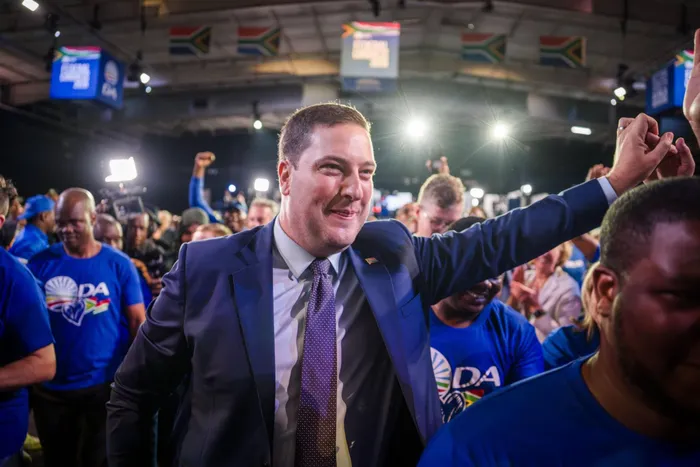
Cape Town Mayor Geordin Hill-Lewis was elected leader of the DA during the party's Federal Congress at the Gallagher Convention Centre in Midrand on Sunday.
Image: DA/Facebook
The newly elected leader of the DA, Geordin Hill-Lewis, has acknowledged a critical “trust deficit” at the heart of the party’s electoral ceiling, outlining a strategy focused on community presence, governance delivery, and disciplined messaging to position the DA as South Africa’s largest political force.
In his first media engagement following his election, Hill-Lewis struck a pragmatic tone, conceding that while the party is widely regarded as a capable governing alternative, it continues to struggle to convert that perception into votes.
Hill-Lewis stated that the party’s primary mission is no longer just participation, but the pursuit of a national majority to implement DA values. He outlined a four-pillar approach to achieving this growth, centred on proven governance and inclusivity.
"We have to show that we govern well and that we govern for everyone in South Africa," Hill-Lewis said. "No matter who you are or where you live, you must feel that the DA is the best party of government and see that benefit in your life."
A key challenge identified by the new leader is the gap between public perception of the DA’s competence and actual votes cast. Hill-Lewis noted that while internal and external polling often ranks the DA as the most efficient party in the country, that sentiment only translated to roughly 22% of the national vote in previous cycles.
He diagnosed this "trust deficit" as a result of the party being perceived as distant from many communities.
"People know intellectually that this is a party that is more efficient and more honest, but they don't feel they can still trust us with their vote," Hill-Lewis admitted. "We haven’t been present enough in their communities. We haven’t been vocal enough on the issues that give them anxiety about the future."
He pointed to issues affecting households directly, economic pressure, uncertainty about the future, and community-level challenges as areas where the party must become more visible and responsive.
The strategy, he said, is to build trust incrementally rather than expect rapid electoral shifts.
“It’s not like flipping a switch… it’s about steadily over time growing that trust relationship.”
To remedy this, Hill-Lewis committed to a "steady, over time" approach of community presence and disciplined messaging, focusing on the specific daily concerns of families rather than broad political rhetoric.
The leadership election results displayed a diverse front, which many analysts see as a step toward addressing long-standing criticisms regarding race. However, Hill-Lewis faces ongoing scrutiny regarding gender parity and allegations of a patriarchal culture within the party.
While acknowledging the work ahead, the new leader emphasised that the party must be relentless and disciplined to build a South Africa that "so many people know is possible, but that we are currently far away from."
Hill-Lewis also confirmed plans to reach out to the President to secure a formal discussion as he begins the process of restructuring the DA for the upcoming electoral cycles.
He made it clear that there would be little pause before shifting into campaign mode.
“There’s hardly any time to celebrate or relax. There’s a lot of work to be done this week,” he said, outlining an immediate schedule that includes visits to Soweto, Laudium and Mfuleni as part of ongoing campaign efforts alongside mayoral candidates.
“The thing that gives me the most energy is actually going out on the campaign and I'm spending the rest of the day going from Soweto to Laudium to Mfuleni and other places around the province to do what I love most, which is being out in communities and campaigning with our mayoral candidates. So that's going to be great fun. And then in between it, I've got to, you know, reach out to the President and secure a discussion with him. I've got to start to set up, set in motion all the things that have to happen in the DA. So there's a huge amount of work to be done, but you approach it with energy and with passion, and we can get through it,” he added.
Framing the DA’s growth ambitions as non-negotiable, Hill-Lewis said the party’s long-term objective is clear: to become the governing party of South Africa.
“I don’t think we have an option in that goal. That has to be our mission,” he said.
He argued that political relevance ultimately depends on the ability to implement policy and deliver change, positioning the DA’s expansion as central to “fixing South Africa” and realising what he described as an unrealised national potential.
While Hill-Lewis acknowledged progress in addressing racial diversity within the party’s leadership structures following the federal congress, questions remain around gender representation.
The issue was raised directly in the interview, referencing past criticism that the DA has struggled to shake perceptions of being “paternalistic and patriarchal.”
Although Hill-Lewis did not fully respond within the scope of the exchange, the question underscores an ongoing challenge for the party as it seeks to broaden its appeal and credibility across different demographics.
karabo.ngoepe@inl.co.za