

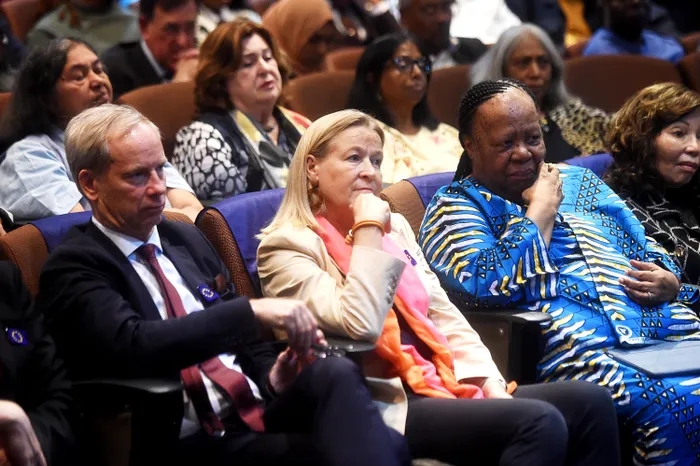
Deputy Secretary-General, European External Action Service Olof Skoog, European Union's Ambassador to South Africa, Sandra Kramer and Chairperson Nelson Mandela Foundation board and Chancellor of the Nelson Mandela University Dr Naledi Pandor, during the Threads of Solidarity, Europe's contribution to the struggle against Apartheid, a groundbreaking exhibition at the Nelson Mandela Foundation in Houghton on Wednesday.
Image: Picture: Itumeleng English/ Independent Newspapers
Against a backdrop of rising geopolitical tension and growing concern over the erosion of international law, leaders from the European Union and the Nelson Mandela Foundation gathered in Houghton on Wednesday to launch a major new exhibition, Threads of Solidarity: Europe’s Contribution to the Struggle against Apartheid.
Held at the foundation’s headquarters, the event was framed as more than a reflection on history. Speakers used the moment to draw direct parallels between the global solidarity that helped dismantle apartheid and the challenges shaping today’s international landscape.
Former Minister of International Relations Dr Naledi Pandor described the anti-apartheid movement as a powerful example of collective responsibility across borders.
“The immense support that distinguished the international anti-apartheid solidarity movement can only be recognised as an illustration of shared humanity,” she said, adding that “harm to humanity anywhere should be a concern to humanity everywhere.”
Pandor stressed that the exhibition recognises not just state actors, but the ordinary people who sustained the movement.
“It was ordinary men, women and youth who actively joined the struggle,” she said. “The threads of solidarity woven in the struggle against apartheid need reawakening to repel genocide, mass murder and devastating breaches of international law.”
Also addressing the gathering, Deputy Secretary General of the European External Service, Olof Skoog, reflected on Europe’s historical role while underscoring that the burden of the struggle was borne by South Africans themselves.
“It does not in any way take away or reduce the fact that the real struggle, the struggle for life and dignity, took place here in South Africa, where the real risks and sacrifices were made,” he said.
Skoog also shared a personal reflection from his early diplomatic career, recalling how senior Swedish officials described covert efforts to support the liberation movement. “Diplomacy counts for very little if it is not transformative,” he said.
A consistent thread throughout the evening was concern over the fragility of the current global order. Both speakers pointed to a pattern of intensifying crises and weakening adherence to international norms.
They highlighted ongoing conflicts and trends shaping the global environment: the humanitarian catastrophe in Gaza, violations of sovereignty in Ukraine, and a broader pattern of shrinking civic space alongside the re-emergence of intolerance and racism.
Skoog warned that the rules-based international system is under pressure from shifting power dynamics and a growing disregard for human dignity.
“In such a world, solidarity becomes not only comforting, but essential,” he said.
Pandor echoed that concern, describing the current geopolitical climate as deeply troubling and in need of renewed global cooperation. Drawing on the legacy of Nelson Mandela, she called for a new generation willing to act.
“The world needs men and women ready to make good trouble. We need those men and women greatly today,” she said.
Pandor urged a revival of the same coordinated global action that characterised the anti-apartheid struggle.
“The exhibition indicates what such commitment looks like and our freedom illustrates what we can achieve with it. We had decades of solidarity against apartheid. Let us use that cooperation and experience to set in motion processes that will lead to the creation of a better world.”
Now open to the public, the exhibition stands as both a historical record and a contemporary call to action. It underscores the enduring partnership between South Africa and the European Union, grounded in shared commitments to human dignity, equality and the rule of law.
As Skoog concluded, South Africa’s experience continues to offer a powerful lesson to the world.
“It reminds us that injustice can be challenged. That international solidarity matters. And that change is possible when people and nations act together with purpose and determination.”
karabo.ngoepe@inl.co.za