

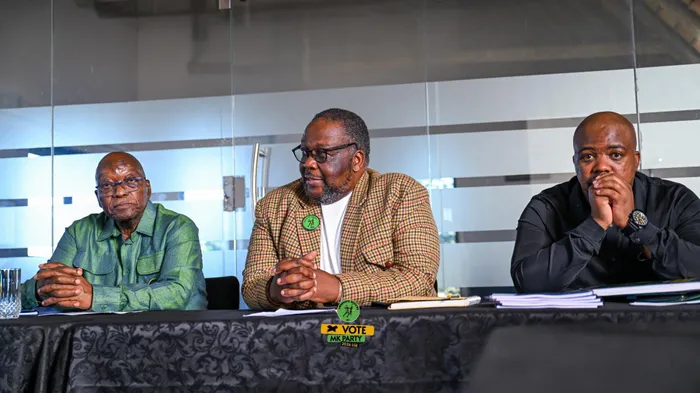
The IEC says consultations with political parties, including MK Party, aim to strengthen trust in elections, as concerns over credibility and public confidence continue to grow ahead of 2026 elections.
Image: MK Party / X
The Electoral Commission of South Africa (IEC) and the MK Party have moved to publicly frame their latest engagement as “constructive”, following a high-level meeting in KwaZulu-Natal where allegations of vote rigging, electoral credibility and declining public trust were placed on the table ahead of the 2026 local government elections.
The meeting on Monday in Nkandla, which forms part of the IEC’s ongoing stakeholder consultations in the province, brought together electoral officials led by Chairperson Mosotho Moepya and MK Party leadership, including its leader Jacob Zuma.
While both sides described the discussions as frank and forward-looking, no formal agreement was reached, with further engagements expected.
In a statement, MK Party national spokesperson Nhlamulo Ndhlela said the organisation approached the engagement as a key stakeholder committed to strengthening electoral integrity and safeguarding what it described as the democratic will of the people.
“The MK Party confirms that it held a constructive meeting with the leadership of the Independent Electoral Commission (IEC), where a range of electoral matters were discussed in a frank and progressive manner,” Ndhlela said.
He added that the party had raised serious concerns relating to alleged electoral irregularities and would continue pursuing legal and constitutional channels.
“The MK Party reiterates that it will proceed with its legal and constitutional processes regarding allegations of stolen votes and vote rigging against the IEC.
''This course of action remains essential in safeguarding the credibility of South Africa's electoral system and ensuring accountability,” he said.
Ndhlela further emphasised that the party remained committed to continued engagement with the IEC in pursuit of “free, fair and transparent elections”.
IEC Chairperson Mosotho Moepya said the meeting formed part of a broader programme of consultation with political parties and traditional leadership structures in KwaZulu-Natal, which has included engagements with the ANC, IFP, EFF, NFP and King Misuzulu kaZwelithini.
Moepya described the discussions with the MK Party as “refreshing” and “frank”, saying they reflected the importance of sustained dialogue even where differences exist.
“Consultation is not only when you agree. In the environment in which we work, we must consult and that is why we will consult. We leave this meeting with clarity and with our heads held up high knowing that we must still fashion out solutions for some of the challenges we face,” Moepya said.
The IEC reiterated that South Africa’s electoral system remains robust and that election outcomes cannot be manipulated, adding that preparations for the 4 November 2026 municipal elections were progressing.
The Commission further indicated that its stakeholder engagements were partly informed by findings from the Human Sciences Research Council’s Voter Participation Survey, which points to declining public confidence in democratic institutions, particularly in KwaZulu-Natal.
However, University of the Free State Political analyst Professor Theo Neethling warned that concerns over declining trust in democratic institutions extend beyond a single political dispute and point to a deeper structural crisis of confidence.
Neethling said tensions around the IEC must be understood within a broader environment of weakening trust in governance systems, particularly in KwaZulu-Natal.
He noted that allegations of electoral wrongdoing, whether proven or not, have serious consequences for public confidence in democratic institutions.
“The issue pertaining to the IEC runs deeper than declining confidence in a single institution. It reflects a widening gap between democratic processes and the value citizens attach to them,” Neethling said.
He warned that as trust erodes, even credible institutions risk being drawn into legitimacy crises.
“As trust erodes, the credibility of elections is inevitably drawn into question, even if the IEC itself remains institutionally sound,” he said.
Neethling further argued that declining democratic satisfaction is driven by broader socio-economic realities, where citizens increasingly judge democracy by outcomes such as unemployment, poverty, crime and corruption rather than democratic principles.
“For many South Africans, democracy is no longer associated with opportunity and progress, but with unemployment, poverty, rising living costs, crime, and corruption,” he said.
He cautioned that this shift in perception fuels disengagement and weakens the boundary between political actors and democratic institutions, adding that even resilient bodies like the IEC could become “casualties of a broader crisis of trust”.
“The real danger, therefore, is not only declining confidence in elections but a gradual erosion of faith in democratic governance itself,” Neethling warned.
Meanwhile, University of KwaZulu-Natal (UKZN) political analyst Zakhele Ndlovu also warned that repeated allegations of vote rigging carry serious consequences for democratic stability.
He said the MK Party appeared to be the only political formation consistently advancing claims of electoral fraud, dating back to the 2024 general elections.
“These are obviously very serious allegations. This started back in 2024 when it alleged vote rigging. Remember, the MKP told South Africans that it expected to win a two-thirds majority,” Ndlovu said.
He cautioned that such claims risk undermining public confidence in the IEC and the broader electoral process, adding that they could ultimately erode trust in institutional independence.
“When such claims are made, people start to lose trust in the independence and impartiality of the IEC,” he said, warning that in the worst-case scenario, continued tensions could spill over into legal challenges, political intolerance, and even violence.
Both the IEC and MK Party have confirmed that further meetings will be held as part of ongoing engagements aimed at addressing outstanding concerns and strengthening preparations for the 2026 municipal elections.
IOL Politics