

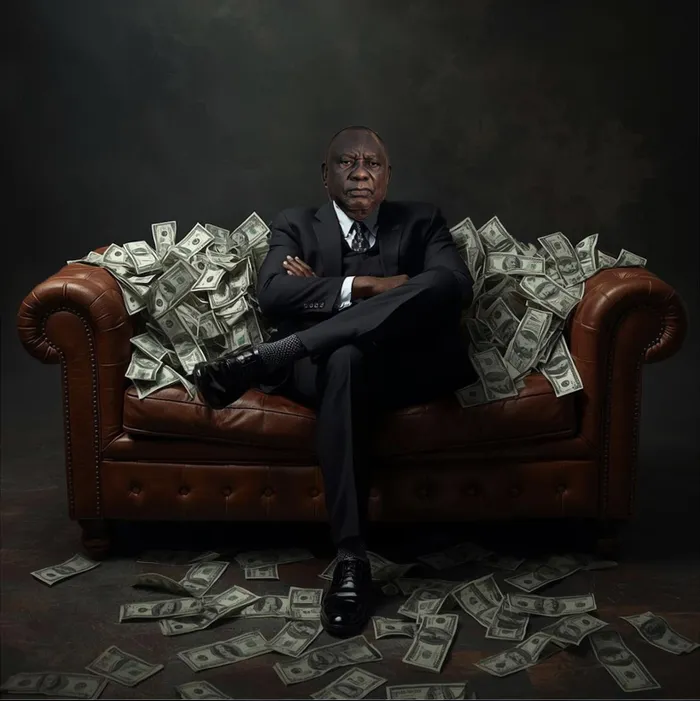
The Economic Freedom Fighters will learn on Friday whether its challenge to Parliament’s handling of the Phala Phala scandal will succeed, in a ruling that could have far-reaching implications for executive accountability.
Image: IOL Graphics / Shaakirah Lagadien
As the Constitutional Court moves closer to handing down its ruling in the Phala Phala matter, the controversy surrounding the Limpopo farm scandal has once again escalated, renewing scrutiny of South Africa’s accountability institutions and deepening public debate about transparency at the highest levels of government.
At the centre of the case is President Cyril Ramaphosa, whose handling of the 2020 theft of foreign currency from his game farm continues to divide legal analysts, political actors and members of the public. The allegations first surfaced in 2022 after former State Security Agency director-general Arthur Fraser laid criminal charges against the President.
Fraser claimed that a significant amount of undeclared foreign currency had been concealed at the farm and later stolen, further alleging that Ramaphosa did not report the matter through official policing channels, instead relying on private security operatives to investigate the incident.
These claims quickly sparked a political uproar, with questions raised about possible breaches of exchange control regulations, tax legislation, and constitutional duties expected of a sitting head of state.
In the wake of growing pressure, Parliament established an independent panel chaired by retired Chief Justice Sandile Ngcobo to assess the allegations. The panel concluded that there was prima facie evidence suggesting that Ramaphosa may have acted inconsistently with the Constitution, particularly in relation to transparency and legal compliance. This finding significantly heightened political tensions and led to renewed calls from opposition parties for impeachment proceedings.
However, the direction of the case shifted as various state institutions reached conclusions that effectively narrowed the scope for criminal prosecution. The National Prosecuting Authority declined to pursue charges, stating that the available evidence was insufficient to support a successful prosecution. The Office of the Director of Public Prosecutions echoed this position, effectively bringing an end to further criminal investigative action through prosecutorial channels.
The South African Revenue Service (SARS) also weighed in, indicating that it had found no evidence of tax evasion or unlawful financial activity connected to the foreign currency. While supporters of the President viewed this as vindication, critics argued that key financial questions remained inadequately answered.
Similarly, the Public Protector cleared Ramaphosa of misconduct, finding no violation of the Executive Ethics Code. That report, however, attracted its own controversy, with detractors arguing that it did not fully interrogate critical aspects of the allegations, while others maintained it reinforced the absence of proven wrongdoing.
The dispute ultimately progressed to the Constitutional Court after the Economic Freedom Fighters approached the apex court, challenging Parliament’s 2022 decision not to adopt the Section 89 panel’s findings. The EFF argued that Parliament had acted improperly in setting aside a report that suggested the President may have a case to answer.
The Constitutional Court is now tasked with examining both the procedural fairness of Parliament’s actions and the broader constitutional implications of how the impeachment process was handled. Its ruling is expected to clarify not only the legal standing of the parliamentary decision but also the extent to which oversight institutions must act on such investigative findings.
Adding to the complexity, the Democratic Alliance (DA) has taken a nuanced and gradually shifting position on the controversial Phala Phala scandal, reflecting both its earlier calls for accountability and its more recent strategic considerations. When the matter first came to light, the party was outspoken in its criticism, characterising the incident as a potential “cover-up” involving serious allegations of corruption and calling for thorough investigations into the conduct of Ramaphosa.
The DA openly supported Ramaphosa’s impeachment and wrote a letter to SARS and the FBI in the US relating to the undeclared dollars that were stuffed in couches on the president’s farm. However, the party's position has since evolved, particularly after entering into a coalition with the ANC. The DA made it clear that it would not back moves to remove Ramaphosa from office.
At the time, then-DA federal chairperson Helen Zille said: “We’ll deal with the issues as they come up. Our position is that we look at the evidence and we make a decision based on the evidence.
“We believe in the rule of law. It’s not the DA’s business to investigate alleged criminal cases. The police have to do that..."
This landmark case not only encapsulates a pivotal moment in Ramaphosa's presidency but also serves as a litmus test for the strength and integrity of South Africa’s democratic institutions as they navigate the interplay of power, accountability, and legal standards.
sinenhlanhla.masilela@iol.co.za
IOL News