

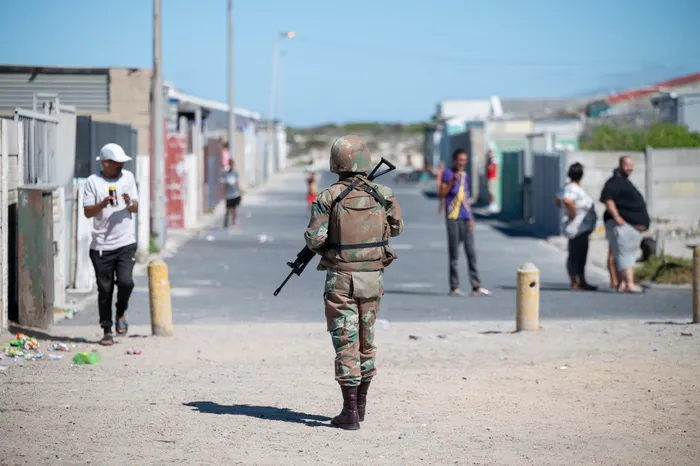
The South African National Defence Force said its deployment on the Cape Flats is having an impact with several guns confiscated and arrests made.
Image: Armand Hough / Independent Newspapers
Cape Flats communities feel that with the current Operation Prosper in place, the government grossly underestimated what is happening in the area.
Operation Prosper is a joint operation between the police and the South African National Defence Force (SANDF), launched by President Cyril Ramaphosa to clamp down on entrenched gang activity, illegal mining, extortion and violent crime.
During his State of the Nation Address on 12 February 2026, Ramaphosa outlined plans for the SANDF to be deployed across nine provinces hardest hit by serious and violent crime, with a specific focus on stabilising gang-ridden hotspot areas identified through crime intelligence.
The operation is expected to run for a full year to address the ongoing challenges of gang violence.

While hosting a media briefing to update the public on the president’s programme, Presidential spokesperson, Vincent Magwenya, shared how they are also awaiting the Phala Phala judgment.
Image: GCIS
While hosting a media briefing to update the public on the president’s programme, presidential spokesperson, Vincent Magwenya, said that a report on the operation is being compiled for the president.
“On Operation Prosper, my understanding is that a report is being prepared to give an update on progress and how that operation is unfolding. I also understand that the report, or parts of that report, will be shared with you, as the media. Let me not preempt that process at this stage.
“It's been a month or so since the deployment, and I guess, depending on how you look at it, one has to say, you're dealing with very well entrenched criminal syndicates that are at play here,” Magwenya said.
“The majority of whom are involved in some form of illicit crime, and you're not going to expect them to just disappear so quickly.
“If anything, you can expect some form of resistance, or you can expect them to try to find other creative ways to dodge law enforcement. We need to be cautious with the manner in which we judge this operation so early on, when it's an operation that has been committed for 12 months,” Magwenya said.
Public Relations Officer (PRO) for the Mitchell's Plain Residence Association, Linda Jones, said that she does not really see an improvement or a reduction in criminal activities.
“My understanding was that the joint operation would be done jointly, and sometimes you see the army van standing here or passing by. I have seen how they just drive past men standing on corners without (conducting) stop and searches, to be very brutally honest.
“I think that money could have been put to better use to fix the resources of SAPS, such as employing more intelligence services, improving the lives of those living on the streets and in doing so alleviating crime,” Jones said.
“Them driving up and down in hot spot areas has little to no impact. Gangs still do their operations even with them around. There is no fear or respect. Bodies are still found in open fields.
“We might hear here and there people are saying it is good to just see them, but we don’t need to see them. We need tangible change and reduction,” Jones said.
Fight Against Crime spokesperson Jay Jay Idel said that from their perspective, Operation Prosper has been a serious disappointment, and communities deserve to hear that said plainly.
“Between 6 April and 3 May 2026, FACSA recorded approximately 238 serious incidents across the flats through our community-based reporting platform. 67 involving fatalities or serious injuries, 48 involving critical violence, and over 131 still being classified.
“These are community-reported figures and official records may differ, but they reflect what people on the ground are actually living through while government pats itself on the back for showing up,” Idel said.
“Hanover Park, Manenberg, Heideveld, Mitchells Plain, Delft. The same areas. The same names. The same bloodshed. Gang shootings, retaliation attacks and drive-bys didn't stop because soldiers arrived. They continued, right through the deployment.
“The SANDF presence has not been anywhere near the scale needed, and the government knows it. There may have been some psychological relief seeing boots on the ground, but relief doesn't bury the dead. The sustained reduction in violence that communities were promised simply has not happened,” Idel said.
“The government grossly underestimated what is happening on the Cape Flats. Or worse, they understood it and sent an inadequate response anyway.”
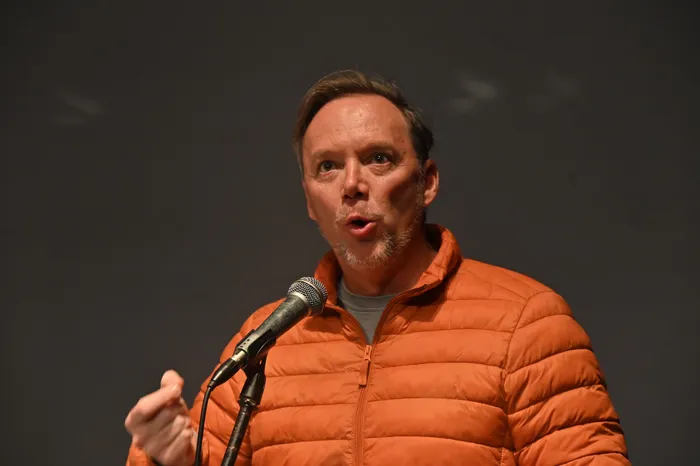
GOOD Party's Brett Herron said police alone cannot solve violent crime
Image: Ayanda Ndamane/Independent Newspapers
Good Party secretary-general, Brett Herron, said that the presence of the military in communities is having a totally predictable outcome.
“The presence of the military may give a sense of comfort, but the extra boots on the ground are not reducing violent crime or deaths. GOOD conducts a weekly monitoring of deaths reported in Cape Town.
“We are still reporting an abnormal number of violent crimes every week. The force multiplier or extra boots on the ground theory of crime reduction has a history of failure - right where we live and where it’s being experimented with again,” Herron said.
“Violent crime is the symptom. If we want safer communities, we need to deal with the disease. Broken communities, apartheid still in force even if it was legally dismantled, inequality, disparate services and chronic underinvestment in housing and infrastructure.
“We cannot police people to safety. We have to cure the disease,” Herron said.
The president is expected to appear in Parliament on Thursday, where he will answer oral questions, some of which will touch on the rollout plan of Operation Prosper, and other matters.
theolin.tembo@inl.co.za