

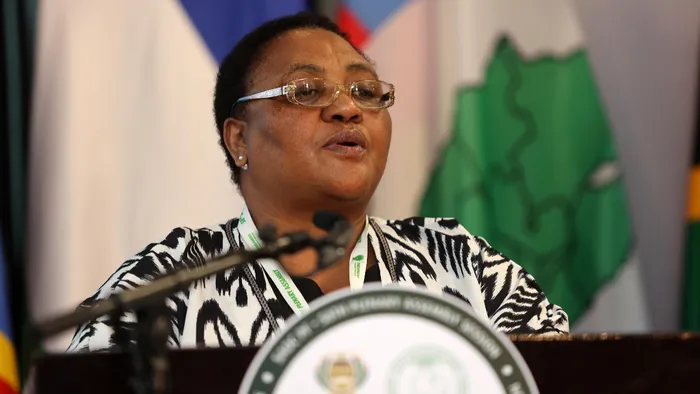
National Assembly Speaker Thoko Didiza has said that 31 MPs will make up the Impeachment Committee.
Image: Tumi Pakkies/ Independent Newspapers
Parties represented in Parliament have been given until next Friday to submit the names of MPs who will serve on the Impeachment Committee that will give effect to Section 89 of the Constitution on the removal of the President.
This comes after National Assembly Speaker Thoko Didiza determined on Wednesday the composition of the 31-member committee in line with the Constitutional Court judgment.
The committee’s composition was announced after Didiza made a presentation earlier in the day at the meeting of the Chief Whips Forum, which is made up of chief whips and representatives of political parties represented in the National Assembly.
All the parties are represented in the committee except two, the PAC and the GOOD Party.
The ANC, the DA, the MK Party and the EFF combined will get more than half of the seats in the committee.
The ANC will hold nine seats, the DA five, the MK Party three and EFF two with all the smaller parties holding one seat each.
Parliament spokesperson Moloto Mothapo said political parties have been requested to submit the names of MPs who will serve on the committee to the National Assembly Secretariat by May 22.
He said in determining the composition of the Impeachment Committee, Didiza considered not only the constitutional principle of proportional representation, but also the need for inclusivity and broad participation in this unprecedented parliamentary process.
“The determination seeks to balance traditional proportional representation with a measure of inclusivity so as to ensure that smaller political parties, which may otherwise not be accommodated through a strict mathematical application of proportional representation, are also afforded representation and participation in the committee’s work,” Mothapo said.
Asked about exclusion of their party on the committee, GOOD Party secretary-general Brett Herron said Didiza met with their leader and tourism Minister Patricia De Lille about the composition of the committee.
“Because Minister De Lille is in the President's Cabinet, she did not believe it appropriate to serve on the committee. The Speaker suggested GOOD could make written representations if we wished. And of course, GOOD will participate in the debate on the committee’s report to the National Assembly, should there be one,” Herron said.
The PAC could not be reached for comment.
Didiza’s spokesperson Reggie Ngcobo said: “The PAC and Good Party have been consulted. They said they won’t be available to serve on the committee.”
Mothapo further said Didiza has referred the Constitutional Court judgment to the National Assembly Subcommittee on the Review of Rules.
This is to ensure that the invalidated parliamentary rule is amended and submitted for consideration by the Rules Committee before it is ratified by the National Assembly.
In a majority judgment read by Chief Justice Mandisa Maya, the Constitutional Court two weeks ago upheld a court challenge by the EFF and the ATM when it set aside the vote of the National Assembly, taken in December 2022, when it declined to refer the report of the Independent Panel to an Impeachment Committee.
It declared the 129I parliamentary rule, which deals with the removal of the president, inconsistent with the Constitution and provided a read-in provision pending an amendment.
“In the event the panel concludes that sufficient evidence exists as contemplated in Rule 129G, the matter must be referred to the Impeachment Committee established by this rule for that purpose,” reads one of the read-in provisions.
The apex court also ordered that the Independent Panel report be referred to the Impeachment Committee established in terms of the National Assembly Rules.
The Independent Panel, chaired by retired Chief Justice Sandile Ngcobo, found there was prima facie evidence that President Cyril Ramaphosa violated the Constitution and other laws in the Phala Phala matter.
There have been calls for Didiza to initiate the impeachment process by establishing the committee and also to amend the parliamentary rules as directed by the Constitutional Court.
There has also been a push for the report to be referred to the Impeachment Committee to kickstart its proceedings.
However, Ramaphosa has announced that he will not resign and that he will take the report on judicial review, a move that may require him to seek a court order to interdict the proceedings of the Impeachment Committee while he seeks legal recourse.
ATM, which first moved the motion of no confidence against Ramaphosa said on Thursday, while Parliament has now moved to establish the committee, the real test lies not in its formation, but in whether the process will be conducted with integrity, impartiality and respect for the Constitution.
Spokesperson Zama Ntshona said the ATM cautions Didiza against turning the process into yet another carefully choreographed parliamentary performance where accountability mysteriously disappears the moment it approaches the doors of the Presidency.
“The Speaker now has an opportunity to demonstrate that Parliament is more than an ANC crisis-management centre disguised as a constitutional institution,” Ntshona said, before warning against attempts to frustrate the work of the committee through “delays masquerading as due process”.
mayibongwe.maqhina@inl.co.za